Bristol and Gloucestershire Archaeological Report – serie
Visar alla böcker i serien Bristol and Gloucestershire Archaeological Report. Handla med fri frakt och snabb leverans.
3 produkter
3 produkter
Del 1 - Bristol and Gloucestershire Archaeological Report
Romano-British and Medieval Settlement Site at Stoke Road, Bishop's Cleeve, Gloucestershire
Excavations in 1997
Häftad, Engelska, 2002
231 kr
Skickas
Excavations at Stoke Road, Bishop's Cleeve in 1997 revealed Romano-British agricultural enclosures, evidence of small-scale ironworking, possible structures and a small burial plQt, dating from the 3rd century AD to the last quarter of the 4th century AD. A small post-built structure, probably a temporary shelter or windbreak, was dated by a single sherd of grass-tempere~ pottery to the Saxon period between the 7th and 9th centuries AD. Medieval remains, dating ftom the 12th to 15th century, comprised a possible stock enclosure, garden plots and the rea~ of toft boundaries running perpendicular to the Stoke Road frontage. A small building, with an ~ntemal cobbled surface and an external stone-lined drain, and several waterlogged pits were r~ealed within one toft. The absence ofbiological remains from other medieval rural sites in Gloucestershire to date makes those from the waterlogged pits of particular note. Evidence of small-scale ironworking from the medieval period was also recovered.
Del 2 - Bristol and Gloucestershire Archaeological Report
Later Prehistoric and Romano-British Burial and Settlement at Hucclecote, Gloucestershire
Excavations in Advance of the Gloucester Business Park Link Road, 1998
Häftad, Engelska, 2003
231 kr
Skickas
Excavations in advance of the construction of the Gloucester Business Park Link Road, Hucclecote, in 1998 revealed alluvium deposited by the Horsbere Brook, in places up to 2m deep. Radiocarbon dating demonstrates that the alluvium had been deposited by the 12th century BC. Three or four Middle Bronze Age cremation burials were probably part of a flat cemetery, the site subsequently occupied by a Late Bronze Age or Early Iron Age settlement which contained in excess of four post-built roundhouses. In the 1st century AD a settlement that contained a number of probable mass-walled roundhouses was constructed. It was extensively reorganised in the early 2nd century when a series of ditched enclosures were linked to Ermin Street by a 320m-long trackway. A small cemetery of 12 inhumations is noteworthy as it demonstrates that the Late Iron Age tradition of burial by crouched inhumation persisted into the 2nd century AD. Several of the burials were accompanied by grave goods, and one of the males suffered from a very rare form of dwarfism to his forearms, a condition that would have been obvious to his contemporaries. The settlement continued in use until the late 3rd or early 4th century, although the trackway ditches continued to accumulate material into the later 4th century. The trackway and enclosures appear to have survived as visible earthworks into the medieval period as their orientation influenced the alignment of medieval field systems.
Del 9 - Bristol and Gloucestershire Archaeological Report
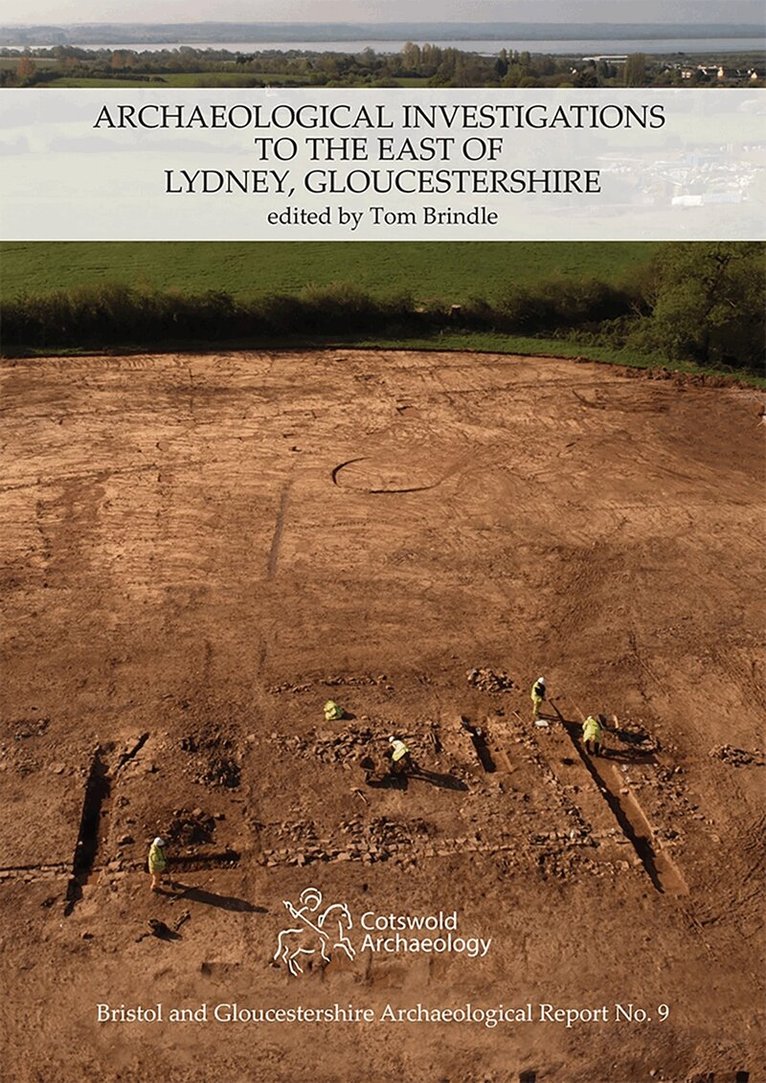
Archaeological Investigations to the East of Lydney, Gloucestershire
Häftad, Engelska, 2025
381 kr
Skickas
The series of archaeological investigations summarised in this volume took place to the east of Lydney between 2016 and 2020, in response to an extensive programme of residential development in the area. Four programmes of archaeological investigation were undertaken during this period by both Cotswold Archaeology and Headland Archaeology. The four main investigation areas were located in close proximity to one another, with in some cases coterminous boundaries, situated towards the north of a wider area of land to the east of Lydney that had been subject to preliminary archaeological investigations. The archaeological results from the investigations evidently related to a densely occupied archaeological landscape, with evidence for activity dating from the prehistoric through to the post-medieval and modern periods.Post-excavation analysis was undertaken for each of the four phases of archaeological excavation individually, and standalone archive reports are available for the individual investigations. However, given the closely interrelated archaeology identified in the individual excavation areas, the decision was made to publish summary results of the investigations collectively in a single volume, to facilitate easier access to the interconnected results.