
Center Books on Contemporary Landscape Design – serie
Visar alla böcker i serien Center Books on Contemporary Landscape Design. Handla med fri frakt och snabb leverans.
5 produkter
5 produkter
Häftad, Engelska, 2000
417 kr
Skickas inom 5-8 vardagar
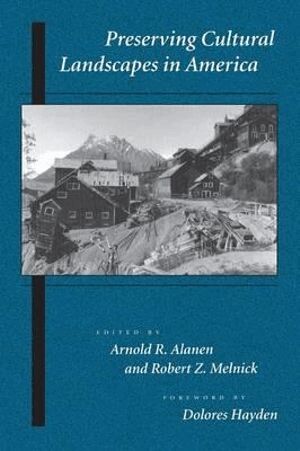
Historic preservation efforts began with an emphasis on buildings, especially those associated with significant individuals, places, or events. Subsequent efforts were expanded to include vernacular architecture, but only in recent decades have preservationists begun shifting focus to the land itself. Cultural landscapes-such as farms, gardens, and urban parks-are now seen as projects worthy of the preservationist's attention. To date, however, no book has addressed the critical issues involved in cultural landscape preservation. In Preserving Cultural Landscapes in America, Arnold R. Alanen and Robert Z. Melnick bring together a distinguished group of contributors to address the complex academic and practical questions that arise when people set out to designate and preserve a cultural landscape.Beginning with a discussion of why cultural landscape preservation is important, the authors explore such topics as the role of nature and culture, the selling of heritage landscapes, urban parks and cemeteries, Puerto Rican neighborhoods in New York City, vernacular landscapes in small towns and rural areas, ethnographic landscapes, Asian American imprints on the western landscape, and integrity as a value in cultural landscape preservation. Contributors: Arnold R. Alanen, University of Wisconsin-Madison * Luis Aponte-Peres, University of Massachusetts-Boston * Gail Lee Dubrow, University of Washington, Seattle * Richard Francaviglia, University of Texas, Arlington * Donald L. Hardesty, University of Nevada, Reno * Catherine Howett, University of Georgia, Athens * Robert Z. Melnick, University of Oregon * Patricia M. O'Donnell, Historic Preservation Consultant, Charlotte, Vermont * David Schuyler, Franklin & Marshall College

Inbunden, Engelska, 2004
715 kr
Skickas inom 5-8 vardagar
One of the physical costs of our society's breakneck consumption, sprawl, and technological innovation and production is the increasing amount of terrain relegated to accommodating the resulting waste and wasted space. These "marginal landscapes" can be divided into four distinct categories: sinks; ruins or abandoned land; toxic or damaged land; and waste landscapes. Although Professor Engler discusses all four types, she is concerned mostly with waste landscapes - "landfills, recycling and waste transfer centers, and sewage treatment plants," as she addresses two distinct aspects of waste landscapes: 1) the historic and cultural context of waste, and 2) the professional planning practices and aesthetic concerns of those who deal with waste and its landscapes. Ultimately, Professor Engler seeks to change our ideas about waste places through her discussion of how landscape design can function within the scientific and technological parameters of safety and environmental concerns to make waste places more central to our thinking and perception.In so doing, she reviews the physical evolution of waste sites, and scrutinizes perceptions and representations of these landscapes, and grounds her ideas in critiques of what environmental designers and artists have done recently with waste places to change public perceptions. Designing America's Waste Landscapes is a pioneering and original work that will appeal to professional planners and landscape designers, and students and scholars in landscape design and planning, environmental studies, urban studies, cultural geography, and even the history of technology.

Inbunden, Engelska, 2002
522 kr
Tillfälligt slut
Ecological planning is the process of understanding, evaluating, and providing options for the use of landscape to ensure a better fit with human habitation. In this ambitious analysis, Forster Ndubisi provides a succinct historical and comparative account of the various approaches to this process. He then reveals how each of these approaches offers different and uniquely useful perspectives for understanding the dialogue between human and environmental processes. Ndubisi begins by examining the philosophies behind and major contributors to ecological thinking during the past 150 years, as well as the paradigm shift in planning that occurred in recent decades as a result of a growing global ecological awareness. He then turns to landscape suitability analysis and discusses alternative approaches to ecological planning, such as applied human ecology, applied landscape ecology, and others. Finally, he offers a comparative synthesis of the approaches in order to reveal the theoretical and methodological assumptions inherent when planners choose one approach over the other.Ndubisi concludes that no one approach can by itself adequately address the whole spectrum of ecological planning issues. For this reason he offers guidance as to when it may be appropriate for landscape architects and planners to emphasize one approach rather than another.
Inbunden, Engelska, 2003
611 kr
Tillfälligt slut
Historic sites are visited by millions of people every year, but most of these places perpetuate the public notion that men have been the primary agents of historical change. This book reveals that historic sites and buildings have much to tell us about women's history. It documents women's contributions to the historic preservation movement at places such as Mount Vernon and explores women's history at several existing landmarks such as historic homes, as wells as in a wider array of cultural landscapes ranging from nurses' residences in Montreal to prostitutes' quarters in Los Angeles. The book includes essays on six exemplary projects that have advanced the integration of women's history into historic preservation and closes with three perspectives on preservation policy and practice. National in scope but applicable in any locality, Restoring Women's History through Historic Preservation combines the most important recently published information with the best new research and covers many national, state, and local initiatives of the past decade.It collects in one volume the seminal work of twenty academic historians, preservationists, and professionals at parks and monuments throughout the country who examine practical ways to represent women's history through historic preservation programs. Over the past several decades, work in the areas of women's history and historic preservation has done much to change not only how we regard history but also how we might broaden the very notion of what we consider historical. This volume reflects a growing commitment to historic preservation and shows how practitioners in both fields can benefit from an exchange of insights and create more effective public history.
Häftad, Engelska, 2003
267 kr
Tillfälligt slut
Big Plans: The Allure and Folly of Urban Design springs from the idea that human aspirations for the city tend to overstate the role of rationality in public life. Inspired by the architectural and urban criticism of such writers as Lewis Mumford, Jane Jacobs, and John Brinckerhoff Jackson, Kolson adopts a user's perspective on issues of urban design, an approach that highlights both the futility of social engineering and the resilience of the human spirit.