Centre for Research on Transportation - Böcker
Visar alla böcker i serien Centre for Research on Transportation. Handla med fri frakt och snabb leverans.
8 produkter
8 produkter
2 121 kr
Skickas inom 10-15 vardagar
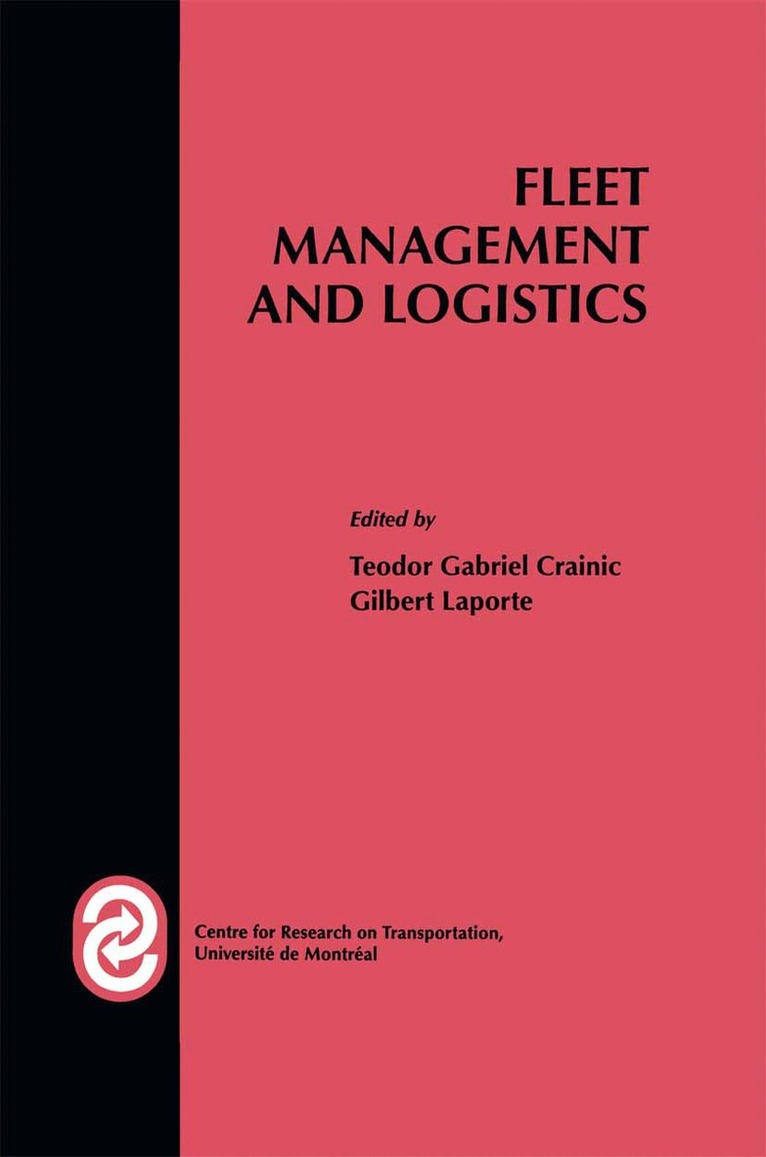
The variety and complexity of the transportation field is reflected by the richness of research areas, models, methods, and software. The ten chapters of Fleet Management and Logistics describe some of the most recent operations-research advances in the field of transportation and logistics. The first four chapters deal with various versions of the Vehicle Routing Problem (VRP), probably the most central model in distribution management. The fourth chapter discusses the Inventory Routing Problem, a variant of the VRP that combines routing and customer resupplying decisions. Growing competition in the area of logistics has forced several firms to pay closer attention to customer service and timeliness of deliveries. Dynamic real-time vehicle routing and dispatching is central to several fast-growing sectors such as emergency services, repairman dispatching, express courier delivery, and dial-a-ride transportation, as well as truckload and container operations. These fleet management issues are discussed in Chapters Five, Six and Seven.Chapters Eight and Nine address the crew scheduling problem faced by all airlines, combined locations-routing problems, and simultaneous routing decisions. In the final chapter the authors review the area of parallel metaheuristics, and provide new insight by studying commonalities among parallel implementations across several types of metaheuristics.
1 640 kr
Skickas inom 10-15 vardagar
Each chapter in this volume develops a topic from basic concepts to the state-of-the-art, and beyond. All chapters relate to aspects of network equilibrium. Chapter One advocates the use of simulation models for the representation of traffic flow movements at the microscopic level. Chapter Two presents travel demand systems for generating trip matrices from activity-based models, taking into account the entire daily schedule of network users. Chapter Three examines equilibrium strategic choices adopted by the passengers of a congested transit system, carefully addressing line selection at boarding and transfer nodes. Chapter Four provides a critical appraisal of the traditional process that consists in sequentially performing the tasks of trip generation, trip distribution, mode split and assignment, and its impact on the practice of transportation planning. Chapter Five gives an insightful overview of stochastic assignment models, both in the static and dynamic cases. Chapters Six and Seven investigate the setting of tolls to improve traffic flow conditions in a congested transportation network.
1 096 kr
Skickas inom 10-15 vardagar
Taking stock of air liberalization is about technology, economy, and policy (TEP) in the airline industry. The first part looks at the record, while the second focuses on specific impacts of policies. Policy formulation and the required tools are also discussed in this context. The book ends with perspectives in future market structure and public policy. The competition among airlines is rapidly spreading to the competition among airports, and the difficult regulation of these strategic spatial monopolies is now attracting research activity. The next discussion in the airline industry will be the role of airports.
1 064 kr
Skickas inom 10-15 vardagar
Through its fourteen chapters, this book covers some new and some still challenging older problems which arise in the planning of telecommunication networks. In such a dynamic technological and economic environment, competition is increasing among service providers and among equipment manufacturers. Consequently, optimization of the planning process is becoming essential. Telecommunications network planning will benefit both telecommunications practitioners looking for efficient methods to solve their problems and operations researchers interested in telecommunications. The book examines network design and dimensioning problems; it explores Operation Research issues related to a new standard Asynchronous Transfer Mode (ATM); it overviews problems that arise when designing survivable SDH/SONET Networks; it considers some broadband network problems; and it concludes with three chapters on wireless and mobile networks. Leading area researchers have contributed their recent research on the telecommunications and network topics treated in the volume.
1 092 kr
Skickas inom 10-15 vardagar
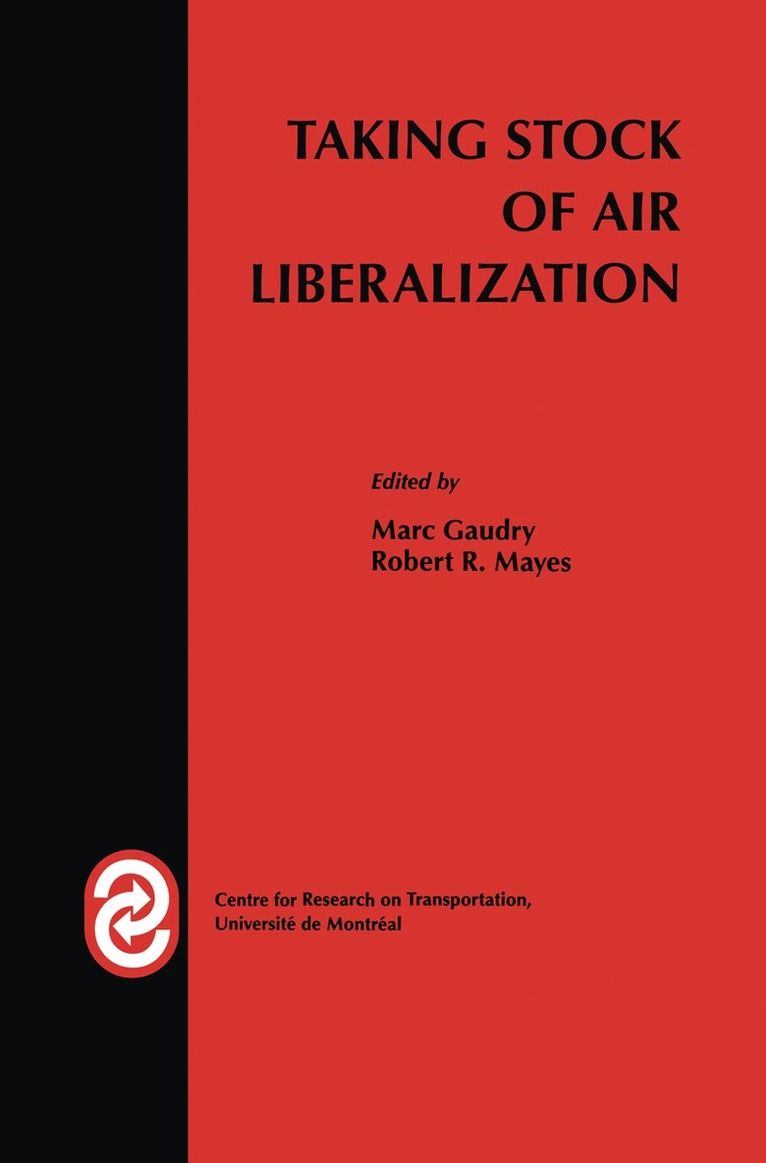
Taking Stock of Air Liberalization is about Technology, Economy, and Policy (TEP) in the airline industry. Ten years ago, the practical collaboration was begun of bringing together people who belonged to the complementary streams of economic analysis and policy analysis presented int his book. During this time, we opened discussions on the relationship between transportation technology, transportation economics and transportation policy under the general auspices of the Canadian Royal Commission on National Passenger Transportation. Working over a 40-month period (1989-1992), this Commission took stock of transportation and produced an up-to-date `État de la question' and policy framework (Hyndman, et al, 1992). Clearly, the project committee's discussions on air policy, over the period 1995-1997 (see Chapter 8), outlined the possibilities for a mechanism to understand the differences about the desirability of air liberalisation, as well as the possible TEP interactions in this area. This led to an exploratory first formulation and computer programme (HLB, 1997) incorporating the approach outlined in Chapter 15. A joint celebration of the CRT's 25th birthday and Transport Canada's 60th birthday seemed appropriate to bring together the various streams. Part I of Taking Stock of Air Liberalization looks at the record, and Part II focuses on specific impacts of policies. Policy formulation (Part III) and the required tools (Part IV - Modelling Demand) are also discussed in this context. The book ends with perspectives in Part V - The Future Market Structure and Public Policy. The competition among airlines is rapidly spreading to the competition among airports, and the difficult regulation of these strategic spatial monopolies (which is introduced in Chapter 13) is now attracting research activity. The next discussion in the airline industry will be the role of airports.
1 061 kr
Skickas inom 10-15 vardagar
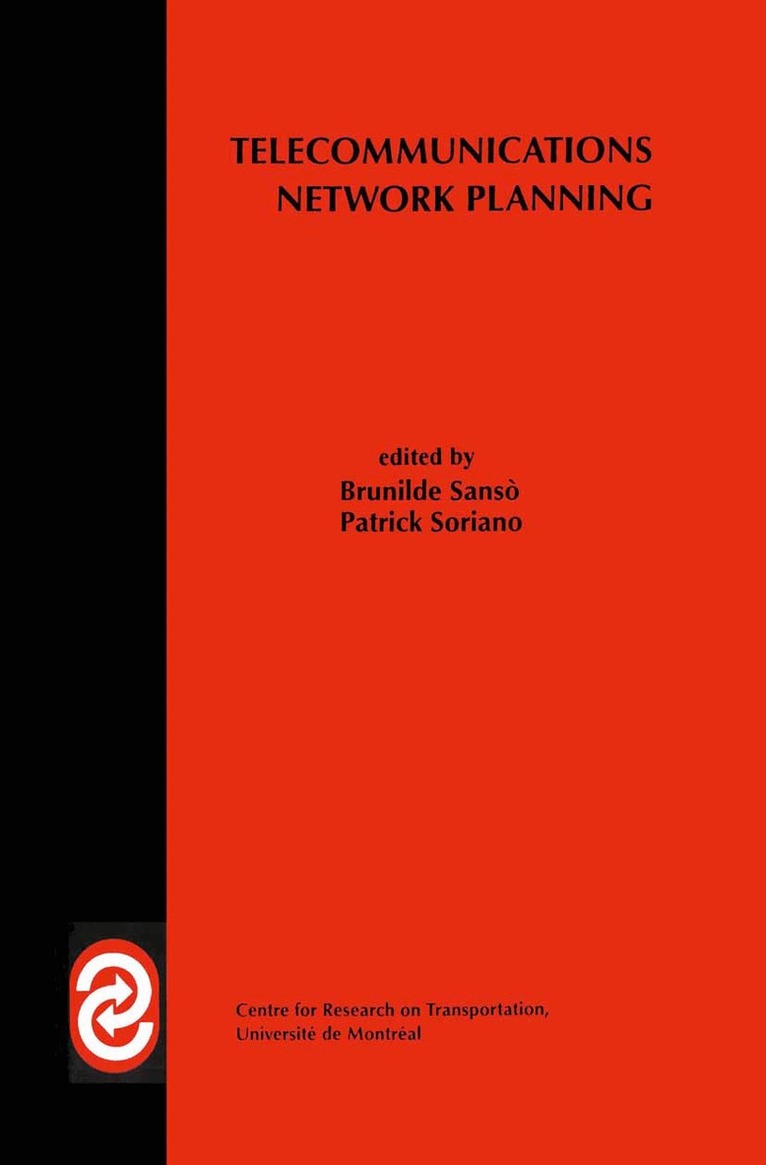
Telecommunications - central to our daily lives - continues to change dramatically. These changes are the result of technological advances, deregulation, the proliferation of broadband service offers, and the spectacular popularity of the Internet and wireless services. In such adynamic technological and economic environment, competition is increasing among service providers and among equipment manufacturers. Consequently, optimization of the planning process is becoming essential. Although telecommunications network planning has been tackled by the Operations Research community for some time, many fundamental problems remain challenging. Through its fourteen chapters, this book covers some new and some still challenging older problems which arise in the planning of telecommunication networks. Telecommunications Network Planning will benefit both telecommunications practitioners looking for efficient methods to solve their problems and operations researchers interested in telecommunications. The book examines network design and dimensioning problems; it explores Operation Research issues related to a new standard Asynchronous Transfer Mode (ATM); it overviews problems that arise when designing survivable SDH/SONET Networks; it considers some broadband network problems; and it concludes with three chapters on wireless and mobile networks. Leading area researchers have contributed their recent research on the telecommunications and network topics treated in the volume.
2 178 kr
Skickas inom 10-15 vardagar
TEODOR GABRIEL CRAINIC, DIRECTOR The Centre for Research on Transportation (C.R.T.) was founded in 1971 by the Universite de Montreal. From 1988 on, it is jointly managed by the Universite de Montreal and its affiliated schools, the Ecole des Hautes Etudes Commerciales and Ecole Poly technique. Professors, students and researchers from many institutions in the Montreal area join forces at the C.R.T. to analyze transportation, logistics and telecommunication systems from a multidisciplinary perspective. The C.R.T. pursues three major, complementary objectives: training of high-level specialists; the advancement of knowledge and technology; the transfer of technology towards industry and the public sector. Its main field of expertise is the develop ment of quantitative and computer-based models and methods for the analysis of urban, regional and intercity transportation networks, as well as telecommunication systems. This applies to the study of passenger and commodity flows, as well as to the socioeconomic aspects of transportation: policy, regulation, economics. The twenty-fifth anniversary of the C.R.T. offered the opportunity to evaluate past accomplishments and to identify future trends and challenges. Five colloquia were thus organized on major research and application themes that also reflected our main research areas. They gathered together internationally renowned researchers who linked recent scientific and technological advances to modeling and methodological challenges waiting to be tackled, particularly concerning new problems and applica tions, and the increasingly widespread use of new technologies.
1 635 kr
Skickas inom 10-15 vardagar
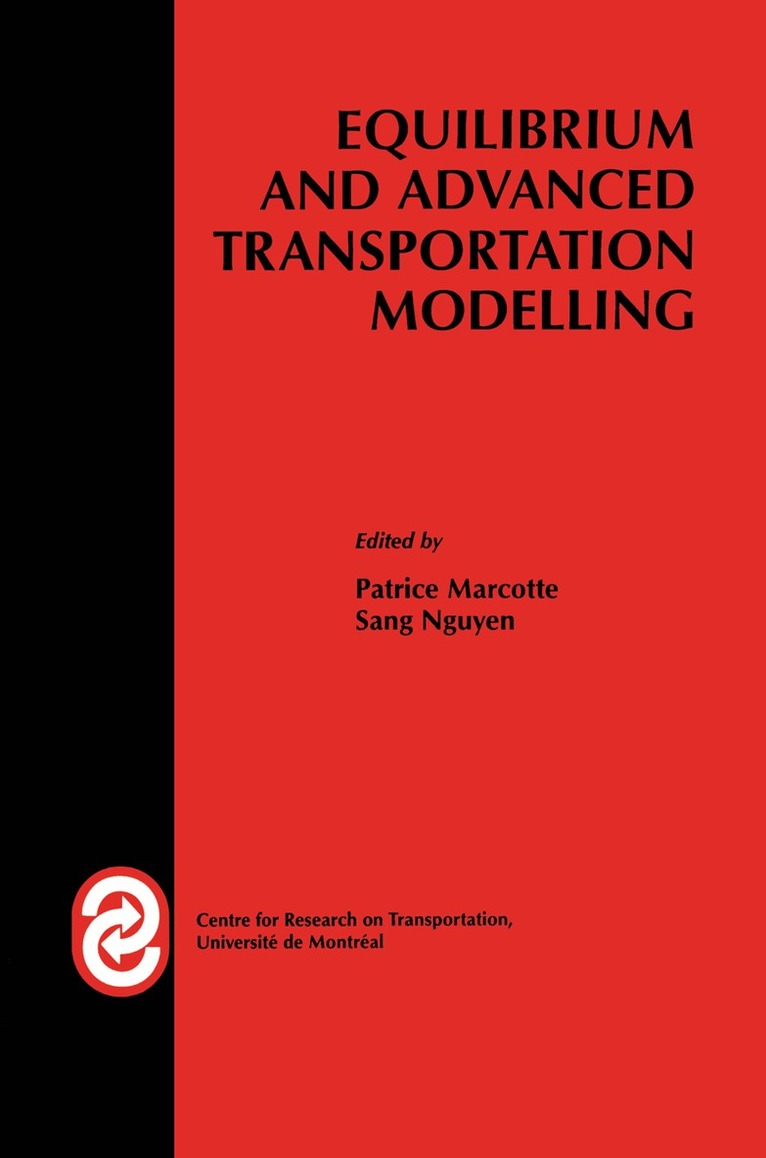
Each chapter in Equilibrium and Advanced Transportation Modelling develops a topic from basic concepts to the state-of-the-art, and beyond. All chapters relate to aspects of network equilibrium. Chapter One advocates the use of simulation models for the representation of traffic flow movements at the microscopic level. Chapter Two presents travel demand systems for generating trip matrices from activity-based models, taking into account the entire daily schedule of network users. Chapter Three examines equilibrium strategic choices adopted by the passengers of a congested transit system, carefully addressing line selection at boarding and transfer nodes. Chapter Four provides a critical appraisal of the traditional process that consists in sequentially performing the tasks of trip generation, trip distribution, mode split and assignment, and its impact on the practice of transportation planning. Chapter Five gives an insightful overview of stochastic assignment models, both in the static and dynamic cases. Chapters Six and Seven investigate the setting of tolls to improve traffic flow conditions in a congested transportation network. Chapter Eight provides a unifying framework for the analysis of multicriteria assignment models. In this chapter, available algorithms are summarized and an econometric perspective on the estimation of heterogeneous preferences is given. Chapter Nine surveys the use of hyperpaths in operations research and proposes a new paradigm of equilibrium in a capacitated network, with an application to transit assignment. Chapter Ten analyzes the transient states of a system moving towards equilibrium, using the mathematical framework of projected dynamical systems. Chapter Eleven discusses an in-depth survey of algorithms for solving shortest path problems, which are pervasive to any equilibrium algorithm. The chapter devotes special attention to the computation of dynamic shortest paths and to shortest hyperpaths. The final chapter considers operations research tools for reducing traffic congestion, in particular introducing an algorithm for solving a signal-setting problem formulated as a bilevel program.