Classical Continuum – serie
Visar alla böcker i serien Classical Continuum. Handla med fri frakt och snabb leverans.
7 produkter
7 produkter
239 kr
Skickas inom 5-8 vardagar
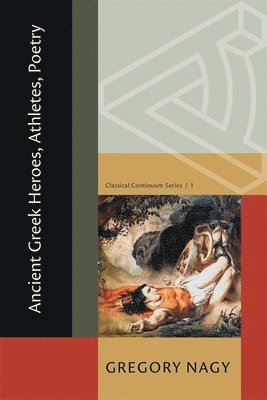
In Ancient Greek Heroes, Athletes, Poetry, Gregory Nagy continues where The Ancient Greek Hero in 24 Hours left off. This book is also centered on some of the greatest masterpieces of ancient Greek literature—including the Homeric Iliad and Odyssey and seven tragedies stemming from the grand masters of the Classical Age of Athens. It returns to the same grand era and then moves beyond, in both time and space, with a new emphasis: how did the heroes of ancient Greek poetry relate to athletes, female as well as male, who competed in the athletic festivals of ancient Greece? A primary point of interest here is the seasonally recurring festival of the ancient Olympics, notionally founded by the hero Herakles.
Del 1 - Classical Continuum
Without Within: Parenthetic Interferences in Reception History
Häftad, Engelska, 2025
193 kr
Skickas inom 5-8 vardagar
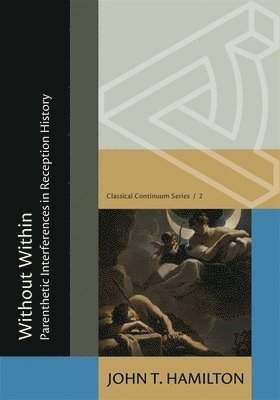
Classical reception has always implied a parenthetical relationship insofar as Antiquity appears to be inserted into (en) while remaining alongside (para) Modernity. As in any parenthetical statement, the ancient source can be said to be a part of and apart from modern revisions and reworkings, recontextualizations and reorientations, belonging to a present discourse by maintaining its status beyond it. Through this rhetorical figure, Without Within broaches fresh questions and offers new lines of inquiry in the ever-growing and disparate field of Reception Studies, a field that itself continues to occupy an intriguingly ambivalent position within Classical Studies overall: simultaneously inside and outside, profane and sacred, an included exclusion.As Quintilian defines it, a parenthesis is a figure of thought (figura sententiae) that occurs “when some thought in the middle interrupts [intervenit] the continuation of a discourse” (Inst. orat. 9, 3.23). In modern typography, this interruption or intervention is generally marked by brackets which introduce a further element of difference or heteronomy vis-à-vis the body of the text. As for specific cases of classical reception, a contrast is thereby staged between the essence of the ancient material and its modern purpose, between the what-is and the what-for. By investigating a series of exemplary instances of reception across several epochs, languages, and cultures, Hamilton aims to delineate and assess the varying contours of Antiquity’s challenge to Modernity and vice versa. What strategies of inclusion and exclusion are operative, and how might they be evaluated? What are the theoretical implications of considering the received past as both external and internal to the present day? How might we qualify the disruption and/or relevance of the past in modern contexts?
Del 6 - Classical Continuum
Beginning Again with the Classical Orders
Rhythms of Justice, Nature, and Architecture
Häftad, Engelska, 2026
412 kr
Kommande
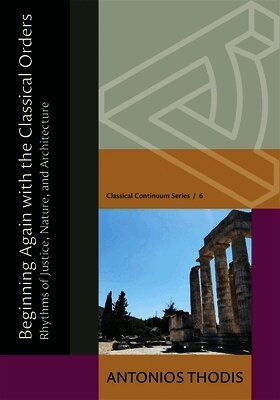
Beginning Again with the Classical Orders reconsiders well-established understandings of the Corinthian, Doric, and Ionic architectural orders that emerged during the Archaic and Classical periods in ancient Greece. The orders were significant not only in architecture, but also in myth and ritual, cosmology, and philosophical thought, informed by the ancient Greeks’ relation to nature as kosmos, “orderly, harmonious arrangement.” Antonios Thodis looks at uses of the orders in temples and material remains as well as in ancient literature, showing their relationship to practical affairs and cultural practices such as the hōrai, “hours and seasons,” dikē, “justice,” and temenos, “sacred space.” The orders were compatible and complementary, tied through the overarching theme of seasonality.
Del 3 - Classical Continuum
Time, Tripods, Textiles, and Trees
Metaphors and Metonyms that Construct the Homeric Odyssey
Häftad, Engelska, 2026
241 kr
Kommande
Time, Tripods, Textiles, and Trees focuses on metaphorical and metonymical elements in key episodes and passages of the Odyssey to better understand the architecture of the epic and its causation. Beginning with an investigation of the trees gifted by Laertes to Odysseus and moving to the reunion of father and son in Book 24, Aldo Bottino combines cognitive science and discourse studies, along with oral poetics frameworks developed by Parry-Lord, Gregory Nagy, and Douglas Frame, to offer a new interpretation of the imaginative devices at the core of crucial episodes in Homer’s poem.
Del 4 - Classical Continuum
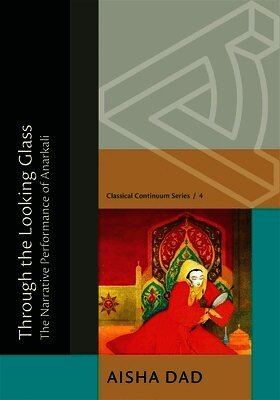
Through the Looking Glass
The Narrative Performance of Anarkali
Häftad, Engelska, 2026
204 kr
Kommande
Anarkali, an Orientalized persona assigned to the harem of the Mughal Emperor Akbar, is also the lover of Akbar’s son, Salim, the future Mughal Emperor Jahangir. Her body and narrative occupy the liminal and contentious space between Akbar and Salim especially as construed under the male gaze of seventeenth-century European travelers. But while both Akbar and Salim are historically attested personalities, Anarkali is not. And yet, her narrative is pervasive in South Asia, appearing in everything from architecture to film. Up to this point studies of the enigma of Anarkali have centered on uncovering her historicity. But in the tragic performance of the poetics of the body, Anarkali embodies the ultimate conflation of the female body with narrative construction.Informed by oral poetics, performance theory, and memory studies, Through the Looking Glass approaches Anarkali not as a historical enigma but rather as a qissa, an oral narrative. The so-called evidence of her historicity is the performance and reperformance of her qissa across different media: the Tomb of Anarkali in Lahore; early travel writings; Imtiaz Ali Taj’s seminal play Anarkali; and the Indian Cinema films Anarkali and Mughal-e-Azam. The poetics and performance of her body fundamentally signify the foreign and domestic anxieties at stake in the imperial personalities of Akbar and Salim.
365 kr
Kommande
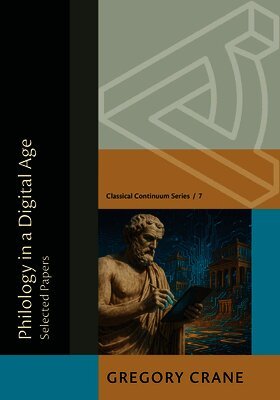
Philology in a Digital Age: Selected Papers brings together more than four decades of scholarship by Gregory Crane documenting the evolution of Classical Studies during the rise of digital technologies—including both published and previously unpublished essays ranging from early proposals in the 1980s to recent reflections on the role of AI, open data, and multilingual inclusion in the humanities. Together, these essays trace the transformation of Greco-Roman philology as it enters a new phase of engagement with digital media.Drawing on his unique perspective as a traditionally trained classicist, an early architect of the Perseus Digital Library, and a professor working across the disciplines of Classics, Digital Humanities, and Computer Science, Crane explores the profound implications of transitioning from physical to digital infrastructure, not only in terms of access and scale, but in rethinking the very practice and goals of philology. Emphasizing lived understanding over static texts or tools, he argues for a field that must continuously adapt to new technologies while remaining committed to open, inclusive scholarship. Philology in a Digital Age is both a record of a scholarly transformation and a call to envision the future of humanistic inquiry in a world of ubiquitous digitization.
364 kr
Kommande
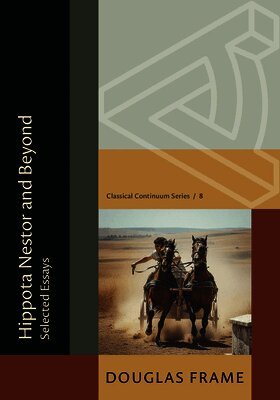
In Hippota Nestor and Beyond: Selected Essays, Douglas Frame revisits the Homeric figure of Nestor, who he argues derives from twin figures in Indo-European myth, and dates the composition and performance of the Iliad and Odyssey to the late eighth or early seventh century BCE at a festival of twelve Ionian cities in Asia Minor. Frame takes up subjects such as the evidence for Nestor’s Indo-European origins; the related origins of the Greek word noos, “mind”; the Phaeacians in the Odyssey as the key to the circumstances in which the Homeric poems were created; Nestor’s role connecting the two poems into a one whole. Other essays in the collect break new ground with respect to the circumstances of the poems’ performance; the purpose of the poems in their historical setting; the relation of the poems to other poetic monuments of the time; the reception of the poems in the Greek mainland after their origin in Ionia; and a closer tracking of the Indo-European origins of the figure hippota Nestor, “the horseman Nestor,” in light of the invention of the chariot in the Russian steppes c. 2000 BCE.