Computation in Chemistry – serie
Visar alla böcker i serien Computation in Chemistry. Handla med fri frakt och snabb leverans.
4 produkter
4 produkter
931 kr
Skickas inom 10-15 vardagar
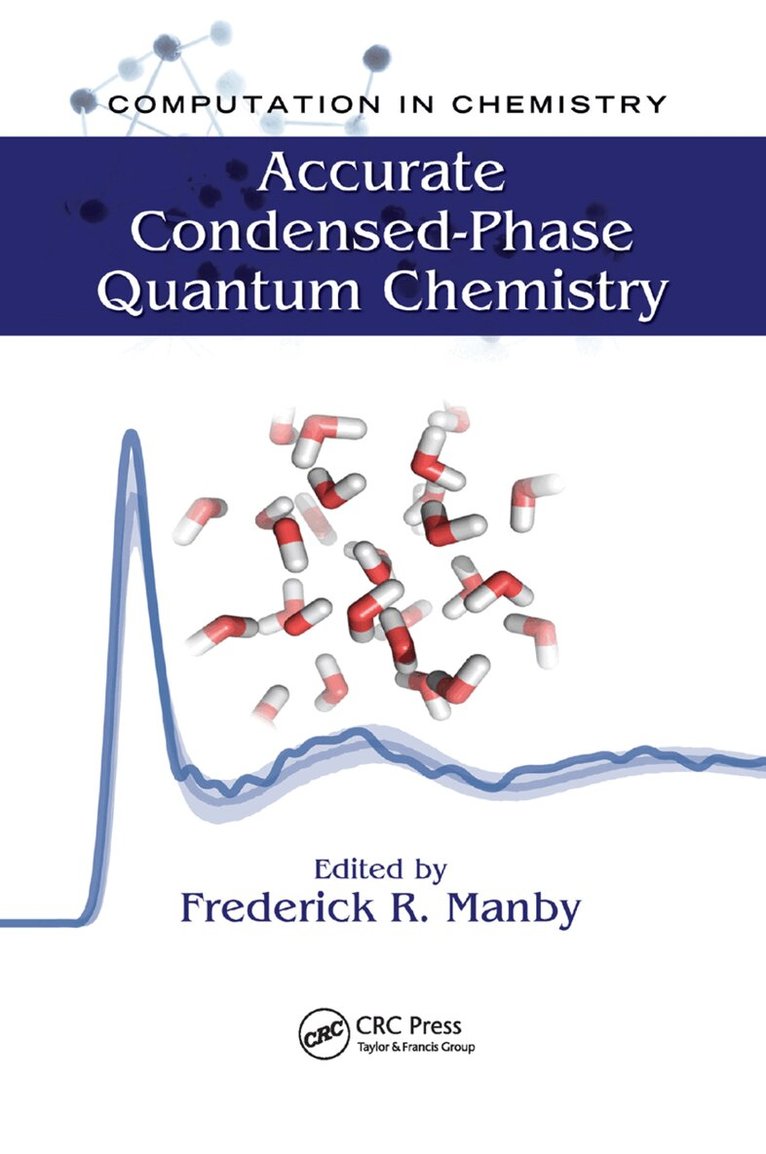
The theoretical methods of quantum chemistry have matured to the point that accurate predictions can be made and experiments can be understood for a wide range of important gas-phase phenomena. A large part of this success can be attributed to the maturation of hierarchies of approximation, which allow one to approach very high accuracy, provided that sufficient computational resources are available. Until recently, these hierarchies have not been available in condensed-phase chemistry, but recent advances in the field have now led to a group of methods that are capable of reaching this goal. Accurate Condensed-Phase Quantum Chemistry addresses these new methods and the problems to which they can be applied. The book begins with an overview of periodic treatments of electron correlation, with an emphasis on the algorithmic features responsible for their computational efficiency. The first section of the book: Describes the Laplace-transform approach to periodic second-order perturbation theory (MP2)Examines local and density fitted schemes for MP2 in crystalline systems Presents test calculations for a variety of systems with small and medium-sized unit cellsThe next section focuses on methods based on treatment of the periodic solid in terms of fragments. This part of the book: Explores the incremental many-body scheme for electron correlation in solids, and describes progress towards metals and molecules on surfacesDescribes the hierarchical method as an alternative fragment-based approach to electron correlation in crystalline solids, using conventional molecular electronic structure methodsExamines electrostatically embedded many-body expansion for large systems, with an emphasis on molecular clusters and molecular liquids Explores delocalized and localized orbital approaches to the electronic structures of periodic and non-periodic solidsLastly, the book describes a practical method by which conventional molecular electronic structure theory can be applied to molecular liquids and solids. Along with the methodology, it presents results on small to medium water clusters as well as on liquid water.
2 113 kr
Skickas inom 10-15 vardagar
The theoretical methods of quantum chemistry have matured to the point that accurate predictions can be made and experiments can be understood for a wide range of important gas-phase phenomena. A large part of this success can be attributed to the maturation of hierarchies of approximation, which allow one to approach very high accuracy, provided that sufficient computational resources are available. Until recently, these hierarchies have not been available in condensed-phase chemistry, but recent advances in the field have now led to a group of methods that are capable of reaching this goal. Accurate Condensed-Phase Quantum Chemistry addresses these new methods and the problems to which they can be applied. The book begins with an overview of periodic treatments of electron correlation, with an emphasis on the algorithmic features responsible for their computational efficiency. The first section of the book: Describes the Laplace-transform approach to periodic second-order perturbation theory (MP2)Examines local and density fitted schemes for MP2 in crystalline systems Presents test calculations for a variety of systems with small and medium-sized unit cellsThe next section focuses on methods based on treatment of the periodic solid in terms of fragments. This part of the book: Explores the incremental many-body scheme for electron correlation in solids, and describes progress towards metals and molecules on surfacesDescribes the hierarchical method as an alternative fragment-based approach to electron correlation in crystalline solids, using conventional molecular electronic structure methodsExamines electrostatically embedded many-body expansion for large systems, with an emphasis on molecular clusters and molecular liquids Explores delocalized and localized orbital approaches to the electronic structures of periodic and non-periodic solidsLastly, the book describes a practical method by which conventional molecular electronic structure theory can be applied to molecular liquids and solids. Along with the methodology, it presents results on small to medium water clusters as well as on liquid water.
2 099 kr
Skickas inom 10-15 vardagar
This volume, edited by a well-known specialist in the field of theoretical chemistry, gathers together a selection of papers on theoretical chemistry within the themes of mathematical, computational, and quantum chemistry. The authors present a rich assembly of some of the most important current research in the field of quantum chemistry in modern times. In Quantum Chemistry at the Dawn of the 21st Century, the editors aim to replicate the tradition of the fruitful Girona Workshops and Seminars, held at the University of Girona, Italy, annually for many years, which offered important scientific gatherings focusing on quantum chemistry. This volume, like the workshops, showcases a large variety of quantum chemical contributions from different points of view from some of the leading scientists in the field today. This unique volume does not pretend to provide a complete overview of quantum chemistry, but it does provide a broad set of contributions by some of the leading scientists on the field, under the expert editorship of two leaders in the field.
1 135 kr
Skickas inom 10-15 vardagar
This volume, edited by a well-known specialist in the field of theoretical chemistry, gathers together a selection of papers on theoretical chemistry within the themes of mathematical, computational, and quantum chemistry. The authors present a rich assembly of some of the most important current research in the field of quantum chemistry in modern times. In Quantum Chemistry at the Dawn of the 21st Century, the editors aim to replicate the tradition of the fruitful Girona Workshops and Seminars, held at the University of Girona, Italy, annually for many years, which offered important scientific gatherings focusing on quantum chemistry. This volume, like the workshops, showcases a large variety of quantum chemical contributions from different points of view from some of the leading scientists in the field today. This unique volume does not pretend to provide a complete overview of quantum chemistry, but it does provide a broad set of contributions by some of the leading scientists on the field, under the expert editorship of two leaders in the field.