
Discrimination Law in Theory and Practice – serie
Visar alla böcker i serien Discrimination Law in Theory and Practice. Handla med fri frakt och snabb leverans.
2 produkter
2 produkter

623 kr
Skickas inom 5-8 vardagar
'Equal is not Enough' is the title of a series of conferences that has aimed, over the years, to generate a better understanding of what shapes and reshapes inequalities by inviting and promoting multi-disciplinary insights and reflection. One of the conferences hosted at Antwerp University in February 2015 focused on discrimination law. The conveners welcomed papers on the relationship between social policy and discrimination law (or closely related human rights issues), which investigate the tensions and (in)compatibilities between the respective aims and tools of social policy and discrimination law. They were particularly interested in contributions that transcend legal technicalities and reflect on the function of discrimination law as part of a wider social policy in the European Union and its member states. Following a very strict selection procedure conducted by the editors and rigorous peer review, a collection of papers from the conference now appears in this book, Equal is not Enough, which takes its name from the title of the conference. In short, within this volume, the reader will find a selection of high-quality papers presented at this conference, organised by the Flemish Policy Research Centre on Equality Policies (a consortium of the Universities of Antwerp, Brussels, Ghent, Hasselt and Leuven). This publication is aimed at researchers, but it will also be of interest to practitioners of discrimination law who would like to enhance their scientific background.
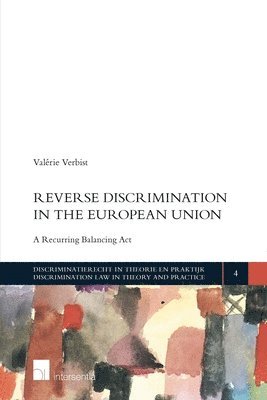
Del 4 - Discrimination Law in Theory and Practice
Reverse Discrimination in the European Union
A Recurring Balancing Act
Häftad, Engelska, 2017
793 kr
Skickas inom 5-8 vardagar
The issue of 'reverse discrimination' is a topical subject, particularly in the field of family reunification. Reverse discrimination occurs when a European Union (EU) citizen in a 'purely internal situation' is treated less favourably than an EU citizen of another nationality whose situation is largely governed by EU law. Reverse Discrimination in the European Union offers an up-to-date standard reference work on reverse discrimination. Part I of this book analyses the issue of reverse discrimination from an EU perspective. In particular, it questions whether reverse discrimination falls within the scope of application of Member State law or whether it falls within the ambit of EU law. Subsequently, it discusses the interpretation of the 'purely internal situation' doctrine on the basis of the case law of the European Court of Justice, giving special attention to recent developments since the controversial Ruiz Zambrano judgment.Although reverse discrimination is of interest from the perspective of the Member States, it is still mostly studied from the viewpoint of the EU.To address this, Part II looks at reverse discrimination in five Member States, namely Belgium, France, Italy, Germany and Austria.The focus lies on the ground(s) on which the national authorities decide whether or not to allow stricter treatment of purely internal situations. Finally, Part III analyses specific instances of reverse discrimination in federally structured Member States, from the perspective of both EU law and Belgian and German law.