Elements in the Foundations of Contemporary Physics - Böcker
Visar alla böcker i serien Elements in the Foundations of Contemporary Physics. Handla med fri frakt och snabb leverans.
6 produkter
6 produkter
234 kr
Skickas inom 7-10 vardagar
Gauge symmetries play a central role, both in the mathematical foundations as well as the conceptual construction of modern (particle) physics theories. However, it is yet unclear whether they form a necessary component of theories, or whether they can be eliminated. It is also unclear whether they are merely an auxiliary tool to simplify (and possibly localize) calculations or whether they contain independent information. Therefore their status, both in physics and philosophy of physics, remains to be fully clarified. This Element reviews the current state of affairs on both the philosophy and the physics side. In particular, it focuses on the circumstances in which the restriction of gauge theories to gauge invariant information on an observable level is warranted, using the Brout-Englert-Higgs theory as an example of particular current importance. Finally, the authors determine a set of yet to be answered questions to clarify the status of gauge symmetries.
234 kr
Kommande
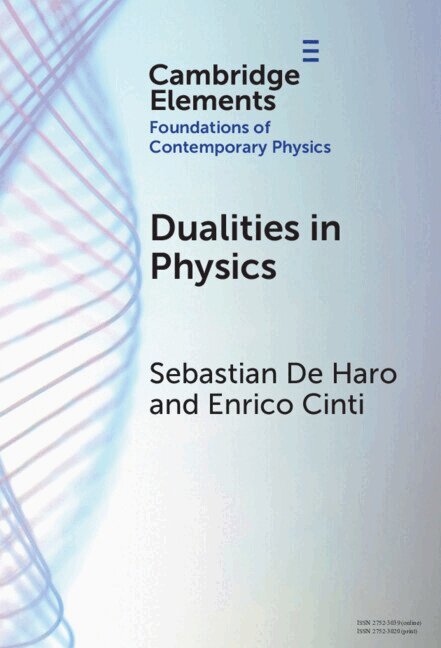
For more than half a century, dualities have been at the heart of modern physics. From quantum mechanics to statistical mechanics, condensed matter physics, quantum field theory and quantum gravity, dualities have proven useful in solving problems that are otherwise quite intractable. Being surprising and unexpected, dualities have been taken to raise philosophical questions about the nature and formulation of scientific theories, scientific realism, emergence, symmetries, explanation, understanding, and theory construction. This Element discusses what dualities are, gives a selection of examples, explores the themes and roles that make dualities interesting, and highlights their most salient types. It aims to be an entry point into discussions of dualities in both physics and philosophy. The philosophical discussion emphasises three main topics: whether duals are theoretically equivalent, the view of scientific theories that is suggested by dualities (namely, a geometric view of theories) and the compatibility between duality and emergence.
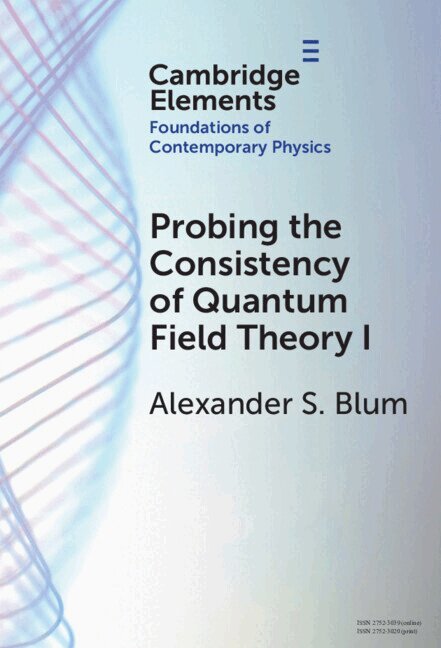
Probing the Consistency of Quantum Field Theory I
From Nonconvergence to Haag's Theorem (1949-1954)
Häftad, Engelska, 2026
234 kr
Skickas inom 7-10 vardagar
This two‐volume Element reconstructs and analyzes the historical debates on whether renormalized quantum field theory is a mathematically consistent theory. This volume covers the years the years immediately following the development of renormalized quantum electrodynamics. It begins with the realization that perturbation theory cannot serve as the foundation for a proof of consistency, due to the non-convergence of the perturbation series. Various attempts at a nonperturbative formulation of quantum field theory are discussed, including the Schwinger-Dyson equations, GunnarKällén's nonperturbative renormalization, the renormalization group of MurrayGell-Mann and Francis Low, and, in the last section, early axiomatic quantum field theory. The second volume of this Element covers the establishment of Haag's theorem, which proved that even the Hilbert space of perturbation theory is an inadequate foundation for a consistent theory. This title is also available as Open Access on Cambridge Core.
234 kr
Skickas inom 7-10 vardagar
The characteristic - Planck - energy scale of quantum gravity makes experimental access to the relevant physics apparently impossible. Nevertheless, low energy experiments linking gravity and the quantum have been undertaken: the Page and Geilker quantum Cavendish experiment, and the Colella-Overhauser-Werner neutron interferometry experiment, for instance. However, neither probes states in which gravity remains in a coherent quantum superposition, unlike - it is claimed - recent proposals. In essence, if two initially unentangled subsystems interacting solely via gravity become entangled, then theorems of quantum mechanics show that gravity cannot be a classical subsystem. There are formidable challenges to such an experiment, but remarkably, tabletop technology into the gravity of very small bodies has advanced to the point that such an experiment might be feasible in the near future. This Element explains the proposal and what it aims to show, highlighting the important ways in which its interpretation is theory-laden.
Probing the Consistency of Quantum Field Theory I
From Nonconvergence to Haag's Theorem (1949-1954)
Inbunden, Engelska, 2026
753 kr
Skickas inom 7-10 vardagar
This two‐volume Element reconstructs and analyzes the historical debates on whether renormalized quantum field theory is a mathematically consistent theory. This volume covers the years the years immediately following the development of renormalized quantum electrodynamics. It begins with the realization that perturbation theory cannot serve as the foundation for a proof of consistency, due to the non-convergence of the perturbation series. Various attempts at a nonperturbative formulation of quantum field theory are discussed, including the Schwinger-Dyson equations, GunnarKällén's nonperturbative renormalization, the renormalization group of MurrayGell-Mann and Francis Low, and, in the last section, early axiomatic quantum field theory. The second volume of this Element covers the establishment of Haag's theorem, which proved that even the Hilbert space of perturbation theory is an inadequate foundation for a consistent theory. This title is also available as Open Access on Cambridge Core.
753 kr
Kommande
For more than half a century, dualities have been at the heart of modern physics. From quantum mechanics to statistical mechanics, condensed matter physics, quantum field theory and quantum gravity, dualities have proven useful in solving problems that are otherwise quite intractable. Being surprising and unexpected, dualities have been taken to raise philosophical questions about the nature and formulation of scientific theories, scientific realism, emergence, symmetries, explanation, understanding, and theory construction. This Element discusses what dualities are, gives a selection of examples, explores the themes and roles that make dualities interesting, and highlights their most salient types. It aims to be an entry point into discussions of dualities in both physics and philosophy. The philosophical discussion emphasises three main topics: whether duals are theoretically equivalent, the view of scientific theories that is suggested by dualities (namely, a geometric view of theories) and the compatibility between duality and emergence.