Emerald Studies in Death and Culture - Böcker
Visar alla böcker i serien Emerald Studies in Death and Culture. Handla med fri frakt och snabb leverans.
6 produkter
6 produkter
653 kr
Skickas inom 7-10 vardagar
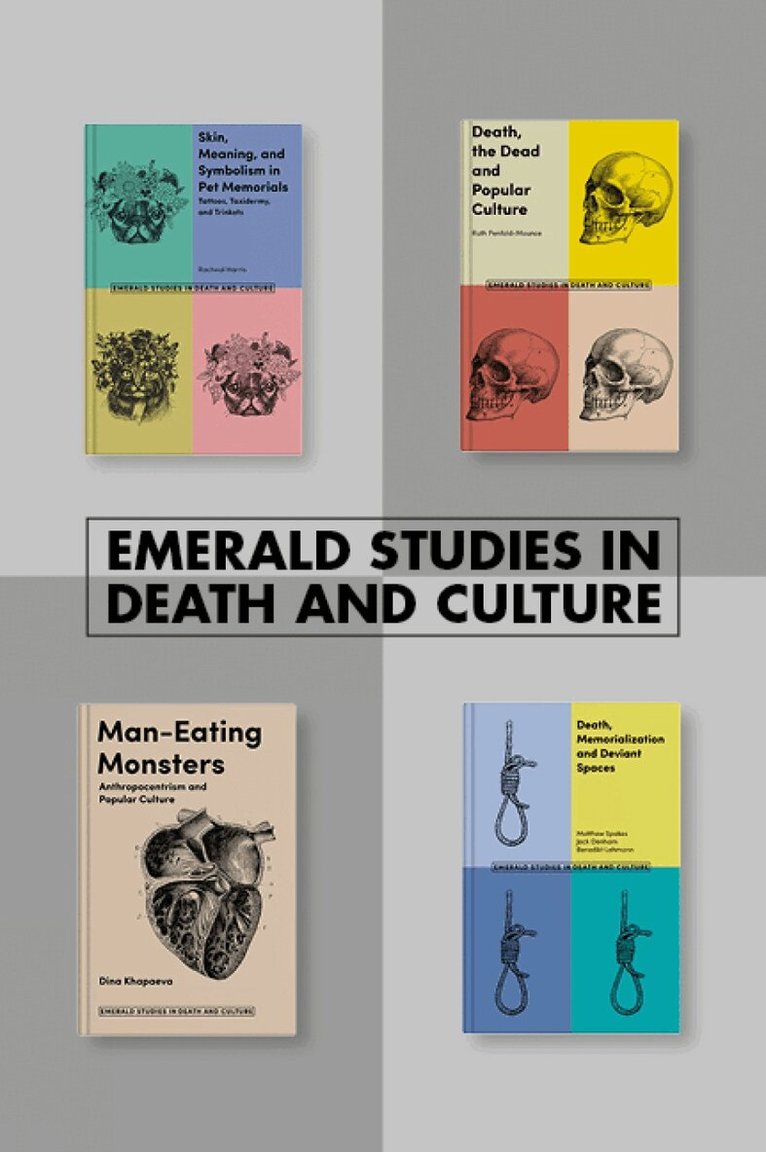
Within popular culture, death is not the end, but instead a space where the dead can exert agency whilst entertaining the consumer. Popular culture enables the dead to be consumed by the living on a mass global scale, actively engaging them with issues of mortality. This book develops the sociological intersectionality between death, the dead and popular culture by examining the agency of the dead. Drawing upon the posthumous careers of the celebrity dead and organ transplantation mythology in popular culture the dead are shown to not be hampered by death but to benefit from the symbolic and economic value they can generate. Meanwhile the fictional dead – the Undead and the dead in crime drama – are conceptualised through morbid sensibility and morbid space to mobilise consumer consideration of mortality and even challenge the public wisdom that contemporary Western society is in death denial and that death is taboo. Death and the dead, within the parameters of popular culture, form a palatable and normative bridge between viewers and mortality, iterating the innate value and hidden depths of popular culture in the study of contemporary society. This book will be of interest to anybody who researches death, popular culture and questions of mortality.
Evolution of the British Funeral Industry in the 20th Century
From Undertaker to Funeral Director
Inbunden, Engelska, 2018
956 kr
Skickas inom 7-10 vardagar
The Evolution of the British Funeral Industry in the 20th Century examines the shifts that have taken place in the funeral industry since 1900, focusing on the figure of the undertaker and exploring how organisational change and attempts to gain recognition as a professional service provider saw the role morph into that of ‘funeral director’. As the disposal of the dead increased in complexity during the twentieth century, the role of the undertaker/funeral director has mirrored this change. Whilst the undertaker of 1900 primarily encoffined and transported the body, today’s funeral director provides other services, such as taking responsibility for the body of the deceased and embalming, and has overseen changes such as the increasing preference for cremation, the impact of technology on the production of coffins and the shift to motorised transport. These factors, together with the problem of succession for some family-run funeral businesses, have led large organisations to make acquisitions and manage funerals on a centralised basis, achieving economies of scale. This book examines how the occupation has sought to reposition itself and how the ‘funeral director’ has become an essential functionary in funerary practices. However, despite striving for new-found status the role is hindered by two key issues: the stigma of handling the dead, and the perception of making a profit from loss.
653 kr
Skickas inom 7-10 vardagar
This book offers an ethnographic exploration of three sites of infamous atrocity and their differing memorialization. ‘Dark tourism’ research has studied the consumerization of spaces associated with death and barbarity, whilst ‘difficult heritage’ has looked at politicized, national debates that surround the preservation of death. This book contributes to these debates by applying spatial theory on a scalar level, particularly through the work of Henri Lefebvre. It uses escalating case studies to situate memorialization, and the multifarious demands of politics, consumption and community, within a framework that rearticulates ‘lived’, ‘perceived’ and ‘conceived’ aspects of deviant spaces ranging from the small (a bench) to the very large (a city). The first case study, the Tyburn gallows site in York, uses Lefebvre’s notion of ‘theatrical space’ to contextualize the role of performativity in memorialization. The second, Number 25 Cromwell Street in Gloucester, builds on this by exploring the absence of memorialization through Lefebvre’s concept of ‘contradictory space’ and the impact this has on consumption. The third expands to consider the city as a problematic memorial, here focusing on the political subjectivities of Dresden – rebuilt following the devastation of the Second World War – and its contemporary associations with neo-Nazi and anti-fascist protests. Ultimately, by examining the issue of scale in heritage, the book seeks to develop a new way of unpacking and understanding the heteroglossic nature of deviant space and memorialization.
903 kr
Skickas inom 7-10 vardagar
What role do man-eating monsters - vampires, zombies, werewolves and cannibals - play in contemporary culture? This book explores the question of whether recent representations of humans as food in popular culture characterizes a unique moment in Western cultural history and suggests a new set of attitudes toward people, monsters, animals, and death. This volume analyzes how previous epochs represented man-eating monsters and cannibalism. Cultural taboos across the world are explored and brought into perspective whilst we contemplate how the representations of humans as commodities can create a global atmosphere that creeps towards cannibalism as a norm. This book also explores the links between the role played by the animal rights movement in problematizing the difference between humans and nonhuman animals. Instead of looking at the relations between food, body, and culture, or the ways in which media images of food reach out to various constituencies and audiences, as some existing studies do, this collection is focused on the crucial question, of how and why popular culture representations diffuse the borders between monsters, people, and animals, and how this affects our ideas about what may and may not be eaten.
1 101 kr
Skickas inom 7-10 vardagar
Death consumes our lives. As such, it is unsurprising that our leisure time, recreational activities and playful exploits are also infatuated with dying, death and the dead. Death, Culture and Leisure offers a playful exploration of the way in which we play with both death and the dead. This inter- and multi-disciplinary work brings together a variety of scholars to consider the nexuses that exist between death, culture and leisure. Edited by Matt Coward-Gibbs, this collection provides an exploration of how our leisure time and playful exploits are interwoven with death. Embracing an array of tensions and contradictions, this book draws on a diverse trajectory of examples ranging from play in the post-Anthropocene to the articulate undead, and from the depictions of death in children's picture books to the playful activism of the death positivity movement. Bringing together debates from thanatology, game studies, sociology, music studies, theatre studies, contemporary literature, religious studies and media studies, this innovative collection offers up a rich assemblage of interdisciplinary voices. This text invites readers to not only consider the diverse ways in which we play dead but also invokes a call to explore the myriad of presentations of death, dying and disposal that exist in leisure environs.
632 kr
Skickas inom 7-10 vardagar
Photography represents a medium in which the moment of death can be captured and preserved, the image becoming a mechanism through which audiences are beguiled by the certainty of their own mortality. Examining a spectrum of post-mortem images, Photography and Death considers various ways in which the death image has been framed and what these styles communicate about changing social attitudes related to dying, mourning and the afterlife.Presenting a fresh perspective on how we might view death photography in the context of our contemporary cultural milieu, this book brings together a range of historical examples to create a richer narrative of how we see, understand and discuss death in both the private and public forum. Building upon existing publications which relate explicitly to the study of death, dying and cultures of mourning, the book discusses topics such as post-mortem portraiture, the Civil War, Spiritualism and lynching. These are positioned alongside contemporary representations of death, as seen in celebrity death images and forensic photography. Uncovering an important historical contrast, in which modern notions of death are a comment on ownership or an emotionless, clinical state, Harris highlights the various ways that the deceased body is a site of contestation and fascination. An engaging read for students and researchers with an interest in death studies, this book represents a unique account of the various ways that attitudes about death have been shaped through the photographic image.