Evolution and Cognition - Böcker
Visar alla böcker i serien Evolution and Cognition. Handla med fri frakt och snabb leverans.
3 produkter
3 produkter
615 kr
Skickas inom 5-8 vardagar
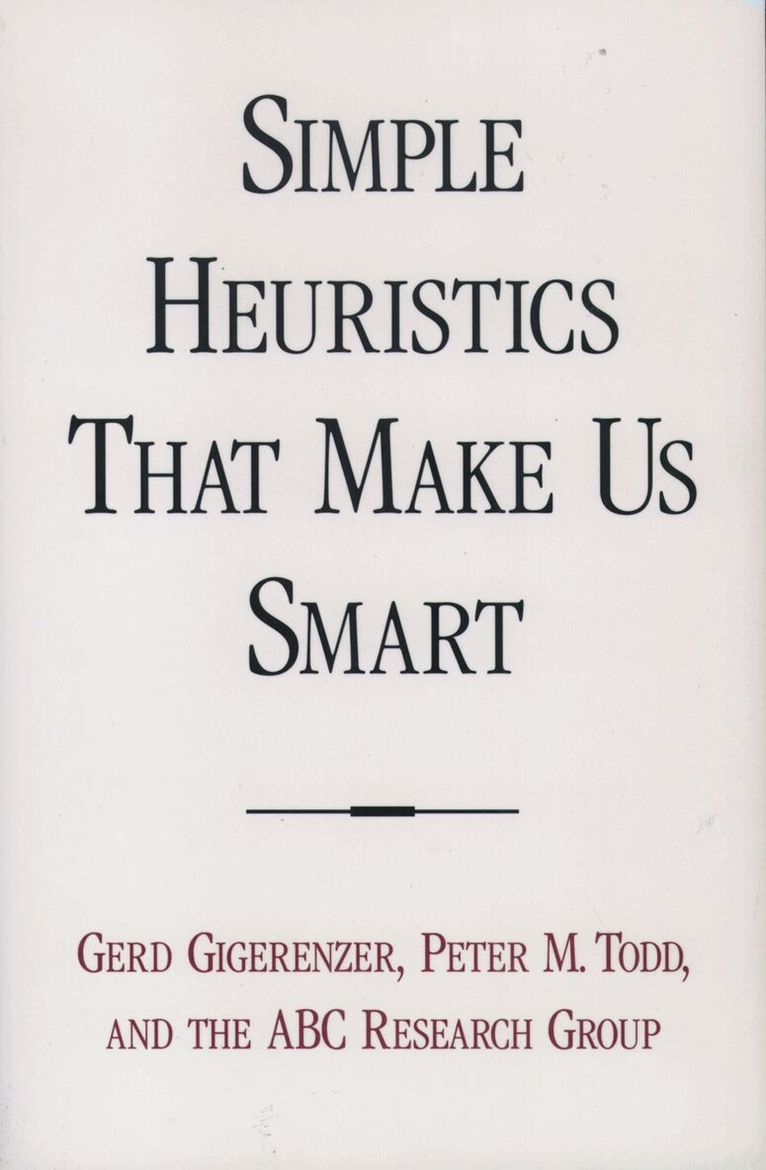
Simple Heuristics That Make Us Smart invites readers to embark on a new journey into a land of rationality that differs from the familiar territory of cognitive science and economics. Traditional views of rationality tend to see decision makers as possessing superhuman powers of reason, limitless knowledge, and all of eternity in which to ponder choices. To understand decisions in the real world, we need a different, more psychologically plausible notion of rationality, and this book provides it. It is about fast and frugal heuristics--simple rules for making decisions when time is pressing and deep thought an unaffordable luxury. These heuristics can enable both living organisms and artificial systems to make smart choices, classifications, and predictions by employing bounded rationality. But when and how can such fast and frugal heuristics work? Can judgments based simply on one good reason be as accurate as those based on many reasons? Could less knowledge even lead to systematically better predictions than more knowledge? Simple Heuristics explores these questions, developing computational models of heuristics and testing them through experiments and analyses. It shows how fast and frugal heuristics can produce adaptive decisions in situations as varied as choosing a mate, dividing resources among offspring, predicting high school drop out rates, and playing the stock market. As an interdisciplinary work that is both useful and engaging, this book will appeal to a wide audience. It is ideal for researchers in cognitive psychology, evolutionary psychology, and cognitive science, as well as in economics and artificial intelligence. It will also inspire anyone interested in simply making good decisions.
565 kr
Skickas inom 5-8 vardagar
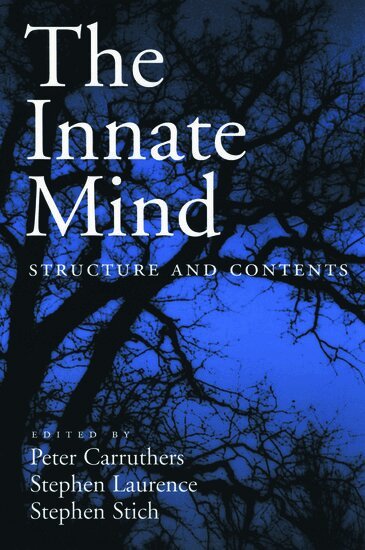
This is the first volume of a projected three-volume set on the subject of innateness. The extent to which the mind is innate is one of the central questions in the human sciences, with important implications for many surrounding debates. By bringing together the top nativist scholars in philosophy, psychology, and allied disciplines these volumes provide a comprehensive assessment of nativist thought and a definitive reference point for future nativist inquiry. The Innate Mind: Structure and Content, concerns the fundamental architecture of the mind, addressing such question as: What capacities, processes, representations, biases, and connections are innate? How do these innate elements feed into a story about the development of our mature cognitive capacities, and which of them are shared with other members of the animal kingdom? The editors have provided an introduction giving some of the background to debates about innateness and introducing each of the subsequent essays, as well as a consolidated bibliography that will be a valuable reference resource for all those interested in this area. The volume will be of great importance to all researchers and students interested in the fundamental nature and powers of the human mind. Together, the three volumes in the series will provide the most intensive and richly cross-disciplinary investigation of nativism ever undertaken. They point the way toward a synthesis of nativist work that promises to provide a new understanding of our minds and their place in the natural order.
441 kr
Skickas inom 5-8 vardagar
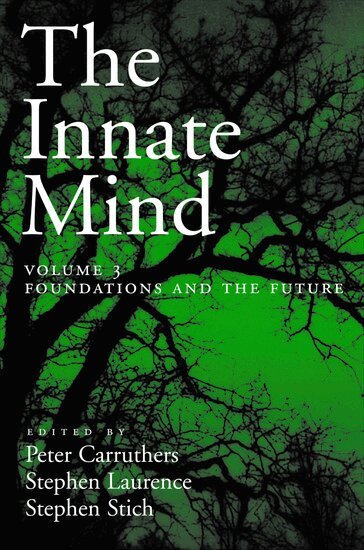
This is the third volume of a three-volume set on The Innate Mind. The extent to which cognitive structures, processes, and contents are innate is one of the central questions concerning the nature of the mind, with important implications for debates throughout the human sciences. By bringing together the top nativist scholars in philosophy, psychology, and allied disciplines these volumes provide a comprehensive assessment of nativist thought and a definitivereference point for future nativist inquiry. The Innate Mind: Volume 3: Foundations and the Future, concerns a variety of foundational issues as well as questions about the direction of future nativistresearch. It addresses such questions as: What is innateness? Is it a confused notion? What is at stake in debates between nativists and empiricists? What is the relationship between genes and innateness? How do innate structures and learned information interact to produce adult forms of cognition, e.g. about number, and how does such learning take place? What innate abilities underlie the creative aspect of language, and of creative cognition generally? What are the innate foundations of humanmotivation, and of human moral cognition? In the course of their discussions, many of the contributors pose the question (whether explicitly or implicitly): Where next for nativistresearch?Together, these three volumes provide the most intensive and richly cross-disciplinary investigation of nativism ever undertaken. They point the way toward a synthesis of nativist work that promises to provide a powerful picture of our minds and their place in the natural order.