Gothenburg Studies in Conservation - Böcker
Visar alla böcker i serien Gothenburg Studies in Conservation. Handla med fri frakt och snabb leverans.
16 produkter
16 produkter
Del 60 - Gothenburg Studies in Conservation
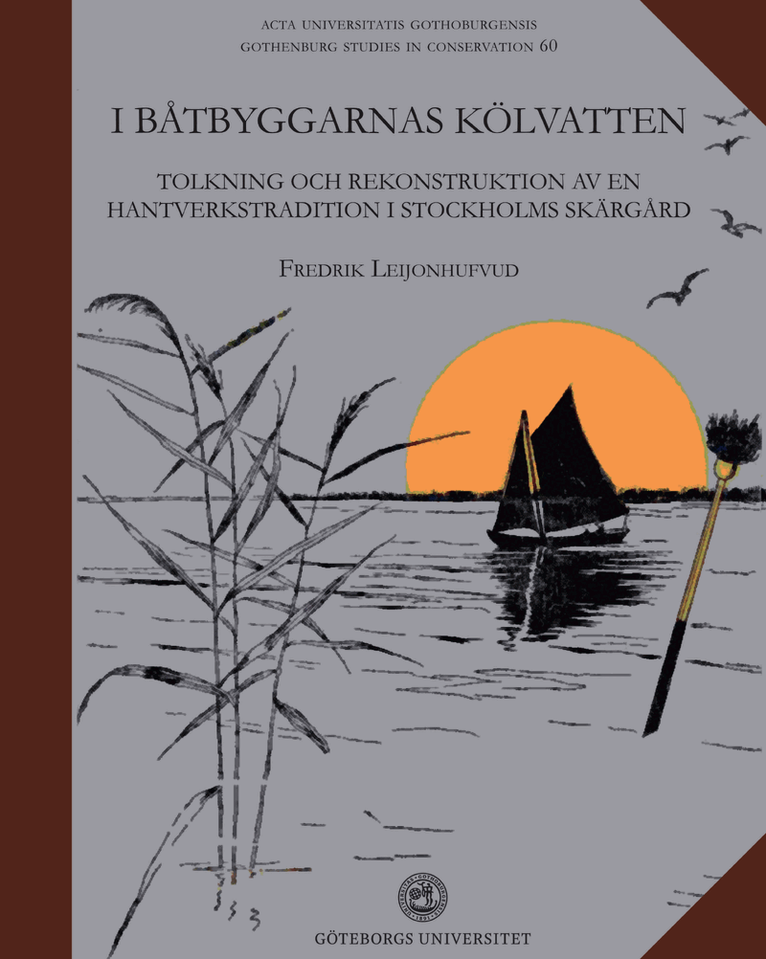
I båtbyggarnas kölvatten: Tolkning och rekonstruktion av en hantverkstradition i Stockholms Skärgård
Inbunden, Svenska, 2025
508 kr
Skickas inom 5-8 vardagar
Through an analysis of old boats and craft reconstructions, this thesis explores historical boatbuilding traditions in the Stockholm archipelago and how craftsmanship skills were shaped and transmitted in the past. The thesis investigates how these and other craft traditions can be understood and reconstructed when no living tradition remains. The focus of the thesis is on the practical reconstruction process, where the interaction between boatbuilders, materials and functions in local waters is central, and on the historical context, where archival material provides insight into the lives of 19th-century boatbuilders.
Del 44 - Gothenburg Studies in Conservation
I sökandet efter delaktighet : praktik, aktörer och kulturmiljöarbete
Häftad, Svenska, 2019
359 kr
Skickas inom 5-8 vardagar
This dissertation concerns national heritage management as it is performed as an established institutional practice and a politically defined engagement. Since the late 1990´s an overarching political objective has been to ensure “everyone’s participation in heritage and heritage management” (Gov. bill 1997/98:114, 2012/13:96). Even though participation and inclusive practices continue to be urgent issues in policymaking – both nationally and internationally – a series of unsolved questions can be identified on how a negotiation of established engagements should be implemented, carried out and handled. The aim of this research is to analyse how participation as a political objective has been governed, interpreted and put into practice by public heritage actors in Sweden during the time period between 1997 and 2017. Based in the context of critical heritage studies the research seeks to unravel a series of different aspects; such as the relations between actorhood and institutionalised practices, the interaction and positions for influence, and lastly, claims on heritage and ability to highlight an imaginary (shared) past. The theoretical approach combines the concept of ‘policy implementation process’ (Bengtsson 2012) with ‘structuration theory’ (Giddens 1993). Focus is on the circulation of ideas and on what is ‘happening on the way’ as actors interact with policy and structures of stabilized actions. The research uses a combination of three examining studies and three case studies. In these studies, heritage management and participation are explored from an intertwined perspective, travelling through the processes of regulation, policymaking, implementation and effects through a direct interaction between public and civil actors. The case studies chosen all have the character of an ‘arranged dialogue process’ that aims towards integrating public and civil actors in heritage practice. The main source material consists of policy documents, project materials and oral statements. The dissertation identifies participation as a still unfixed, uncertain and contested concept. The implementation of participation as a political objective in heritage management (public administration and authority- making), therefore collides with a set of constraints. Consequently, participation continues to be more of a normative ideal for how to act, rather than an established new practice for heritage management. The discussion of results considers, firstly, that the arrangements needed to fulfil policy are depending on special efforts made by public actors to arrange a wider space for interaction and influence. Secondly, a renegotiated interpretation of participation is transiting the ideas of how, whom and what should be taken care of: heritage is used to overcome older asymmetries on who are being recognised and represented. The conclusion drawn, is that there is a need for acknowledging the enduring heterogeneity of the contemporary, by reinterpreting and a highlighting new parts of the past.
Del 45 - Gothenburg Studies in Conservation
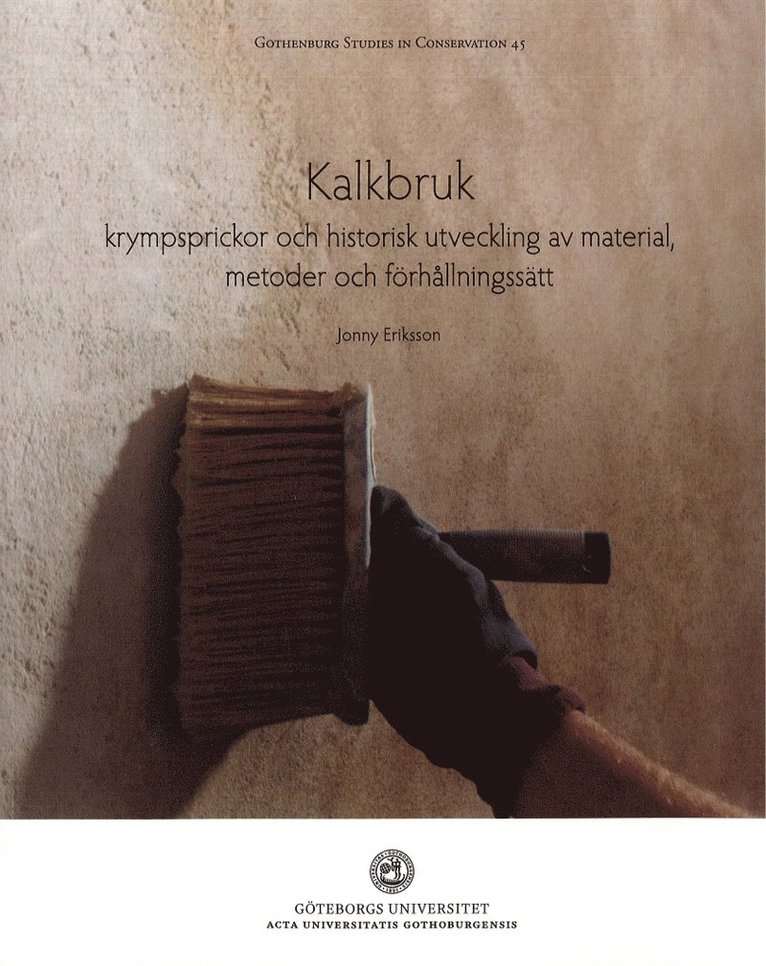
Kalkbruk : krympsprickor och historisk utveckling av material, metoder och förhållningsätt
Häftad, Svenska, 2019
365 kr
Skickas inom 5-8 vardagar
I denna avhandling undersöks uppkomst av krympsprickor i puts. I undersökningen används våtsläckt sub- hydrauliska kalk. Den aktuella kalksorten har används i Sverige under 1800- och 1900-talet men också under 2000-talet i samband med putsrestaureringar. Observationer i samband med framställning och användning av denna typ av kalk pekade på att om kalken bearbetas för att den skall vara lättare att sila och förpacka samt därefter lagras uppstod en högre frekvens krympsprickor i putsen än om kalken inte lagrades eller upparbetades. En undersökning gjordes för att undersöka det empiriskt observerade sambandet. Resultaten från undersökningen visade att upparbetning och lagring av våtsläckt sub-hydraulisk kalk bidrog till att frekvensen krympsprickor i puts ökade. Resultaten pekade på att bindemedelrika bruk kunde var möjliga att framställa och använda i praktiken. En förutsättning för framställning av bindemedelrika bruk var att bruket blandades på nysläckt kalk. Detta sätt att tillverka bruk på ökar risken för att skador av osläckt kalk uppstår. För att minska denna risk rekommenderas under 1900-talets mitt att våtsläckt kalk skall lagras från 1-4 veckor innan den används. I motsats rekommenderas under 1800-talet att bruk framställs på nysläckt kalk med motiveringen att det ger bruket bättre beständighet. För att undersöka användbarheten av nysläckt kalk i praktiken implementerades resultat i en putsrestaurering av en medeltida kyrka. Syftet med implementeringen var att undersöka om bindemedelrika bruk gick att framställa på nysläckt kalk utan att oacceptabla krympsprickor eller kalkskott uppstår. Resultat från den implementerade studien visade att bindemedelrika bruk var möjliga att framställa och använda utan att oacceptabla krympsprikor eller kalkskott uppstod. Parts of work Eriksson, J. (2015) Bruk av kalk och sand ur ett hantverkligt perspektiv. Licentiatavhandling, Acta Universitatis Gothoburgensis, Göteborgs universitet, 2015 Eriksson, J., Johansson, S. & Lindqvist J. E (2016). Development of mortars in Sweden during the period 1800-1950. 4th Historic Mortars Conference HMC- 2016, Santorini. Greece. Eriksson, J. & Lindqvist J. E. (2018). "Lime render, shrikage cracks and craftsmanship in buildingrestoration ". Journal of Cultural Heritage (2018), visa artikel Eriksson, J "Putsrestaurering av en medeltida kyrka". Manuskript.
Del 46 - Gothenburg Studies in Conservation
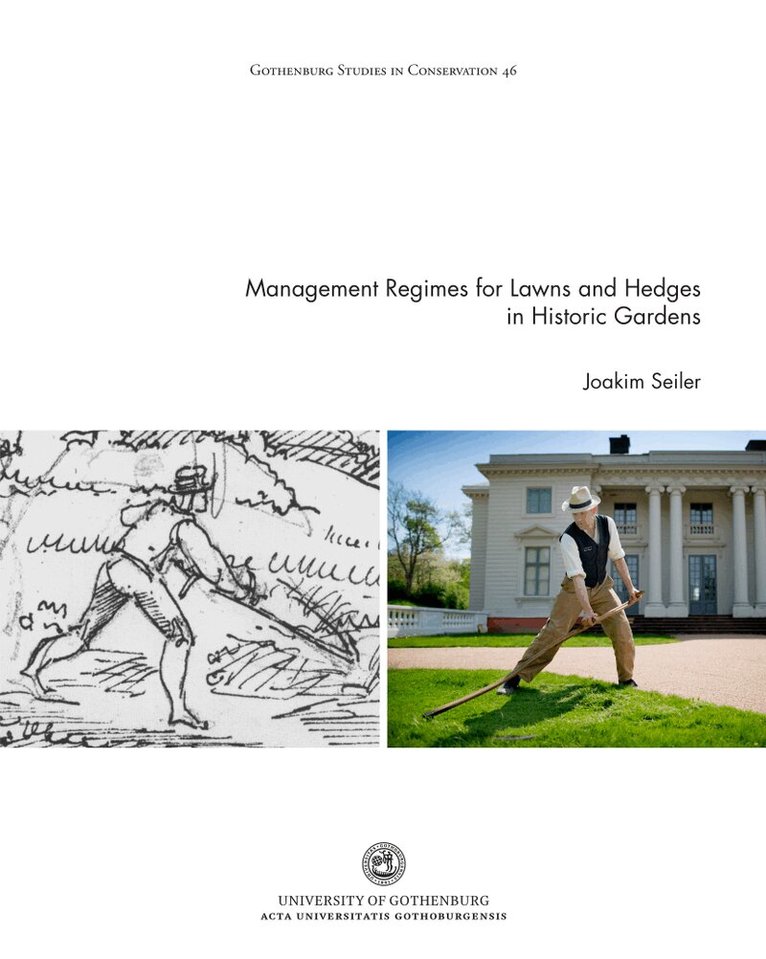
Management regimes for lawns and hedges in historic gardens
Häftad, Engelska, 2020
460 kr
Skickas inom 5-8 vardagar
This research investigates and compares eighteenth-century and contemporary garden management methods with a focus on the structural elements of lawns and hedges at Gunnebo House, which is used as a craft laboratory. The concept of management regime is utilized for a discourse analysis of the garden through the norms embedded in the management. My research asks not only how did they do it back then? but also how shall we do the work now? The research has consisted in travelling in a hermeneutical circle, from historical sources to craft experiments of historical gardening and onwards, towards an enhanced understanding of the sources through the discoveries made in the experiments. One result of this study is the development of knowledge concerning eighteenth-century management methods for lawns and hedges which has been acquired through the study of historical sources and craft experiments. The craft experiments showed that use of manual tools generally requires a higher degree of skill than is needed when using contemporary tools, which typically secure the quality of the work themselves. The tool used day after day on a particular element of the garden slowly transforms the object. Some historical gardening crafts are living traditions and other vanished methods have been reconstructed in my study. The management affects the garden as a soundscape and this investigation indicates that the contemporary power tools reduce accessibility for visitors due to the noise produced by the tools. The conclusion of the research was that there were several dominant management regimes. The first is a regime that I call the management regime of conspicuous consumption. It developed during the seventeenth century and intended to manifest the social Abstract status of a person, like John Hall at Gunnebo House, by consumption of luxury articles. The pleasure garden at Gunnebo House was an unproductive piece of land that required intense management; it was conspicuous consumption of land. Another dominant regime has been the management regime of the heritage garden at Gunnebo House since the 1990s. The aim for this regime is the revival of the eighteenth century. The conception of time, of what the eighteenth century is, is rhetorical and the regime produced a ‘heritagized’ image of a past time. In this regime, traditional crafts have been an important component and the management has developed into heritage gardening. Both the regime of conspicuous consumption and the regime of the heritage garden strive for the same esthetical ideals, the same expression and, to a large extent, the same craft practices. The major difference between these regimes is that, in the eighteenth century, the ideals, style, and craft were modern and future-oriented while today they are historical enterprises which are oriented to the past. The study has concluded in the suggestion for a new management regime, the regime of meaningful management in the age of the Anthropocene. This regime is not only focused on craft as a means to preserve historic gardens and on looking back over history and defining values based on measurements of preservation of tangible and intangible cultural historical qualities; it also highlights craft as meaningful activity in its own right for people of today. It is a regime which encourages quality and sustainability that comprises and combines good practices from different pasts with contemporary concerns for biodiversity and sustainability as well as people’s sense of heritage and interest in learning from the past. Parts of work Article I: “The Time-space of Craftsmanship” Craft Research (Journal). (2019). Volume 10:1. pp. 17-39. Reproduced with permission of publisher. Copyright © 2019 Intellect Ltd Article II: “Gardening Craft Reconstruction” Manuscript under review in the anthology Craft + Science. Article III: “Ways of Tacit Knowing” Manuscript (film) submitted to Journal of Video Ethnography.
Del 47 - Gothenburg studies in Conservation
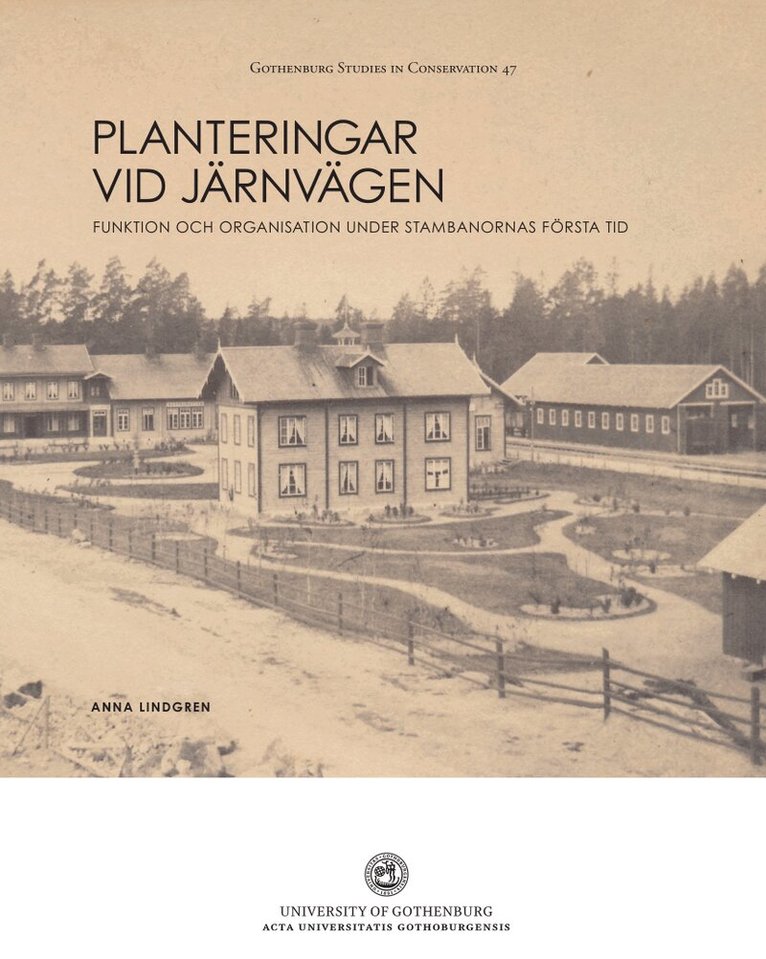
Planteringar vid järnvägen : funktion och organisation under stambanornas första tid
Häftad, Svenska, 2020
482 kr
Skickas inom 5-8 vardagar
This licentiate thesis examines gardens and plantations along the first Swedish state railways. The purpose of the investigation is to depict the planting activities during the years 1855–1875 by studying contemporary archival sources. In the field of railway history the technology in the railway system, the vehicles and the impact of the railways on society are largely investigated. However, the green areas connected to the railways are quite unknown and not acknowledged as a cultural heritage. Starting with four early stations – Alingsås, Eslöv, Stockholm and Hallsberg – several kinds of archival materials have been found in different archives. The material is analysed using the concepts role, meaning and organization. The licentiate thesis investigates when the planting activities were initiated, what kind of plantations were made along the railways, what role they played and how the organization behind the planting activities was arranged. By analysing the shifting organization of the planting activities, this study has rediscovered large quantities of archival material hitherto believed to have been discarded. This investigation intends to contribute to the understanding of how railway areas were designed and why the creation of attractive green environments was considered so important during the second half of the 19th century.
Del 48 - Gothenburg Studies in Conservation
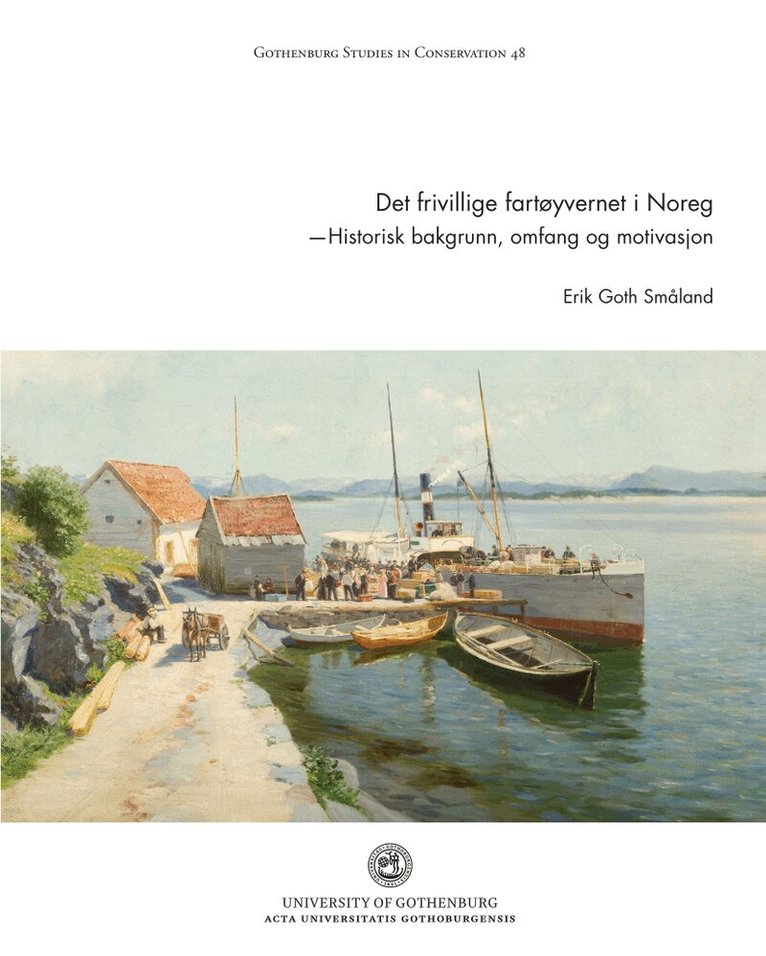
Det frivillige fartøyvernet i Norge : historisk bakgrunn, omfang og motivasjon
Häftad, Norska, 2020
460 kr
Skickas inom 5-8 vardagar
Today historic ships are recognised and publicly valued as an important part of Nor-way’s cultural heritage, with substantial annual government funding for preservation. State funds finance not only docking and repairs of listed ships at commercial shipyards, but also encourage volunteer activity with provision of parts and materials for projects that can take a decade or more to achieve the typical aim of making a historic vessel once again seaworthy. Even though this volunteer effort is crucial for restoring and maintaining the maritime heritage of Norway, little is known about its background, organization, scope and impact. This study aims to find: 1) how ship preservation in Norway has developed as a field dominated by volunteers grassroot-organizations 2) who the volunteers are, and what is the scope and impact of their ef-forts3) the volunteers’ motivations and personal experiences and the impact on their proximate social environment. Methods: The study was carried out with three sub-studies. Sub-study I is based on a literature review and discourse analysis. Sub-study II is based on a survey with data from 82 volunteer leaders and analysed quantitatively. Sub-study III is based on 14 semi-structured interviews with volunteers, using content-analysis to identify and organize different categories in the volunteers’ statements. Results: • The discourse analysis of sub-study I shows a shift in praxis, framework and argumentation for ship preservation during the period from 1964 to 1975. From ad-hoc fund-raising activities with the aim of securing ships for museums, the volunteer organisations after 1964 became permanent organisations, taking care of their own ships. In 1967 the first state funding changed the framework for ship preservation in Norway. During the 1970ies ship preservation and a new grassroot-movement promoting costal culture merged, leading to a shift in the argumentation for preserving ships: The argument changed from ships representing important maritime trades to ships representing Norwegian national culture. • The quantitative analysis in sub-study II shows that the change in praxis, framework and arguments in ship preserving in the decade from 1964 marks the beginning of a steep and continuous increase in ship preservation organizations and volunteers. Being male, elderly, and having a strong relationship with the region and/or the specific ship are the most important correlates of volunteering for this work, whose annual value is estimated to be the equivalent of 5.5 million euros in 2009. • The qualitative analysis in sub-study III shows that the ship preservation organizations are closely linked to their local communities and history, and their efforts are widely appreciated. Volunteering in a context of skilled, group-bonded, culturally prestigious activity adds considerably to social capital among this group of elderly Norwegian men. The volunteers’ experiences resemble closely the stages of the empowerment process. Conclusion: Volunteer ship preservation has played an important part in changing the way Norwegians perceive their history and national identity. Volunteers are crucial for the restoration and maintenance of Norway’s listed fleet, and those volunteering are mainly elderly males, a group generally underrepresented as volunteers in Norway.
Del 49 - Gothenburg Studies in Conservation
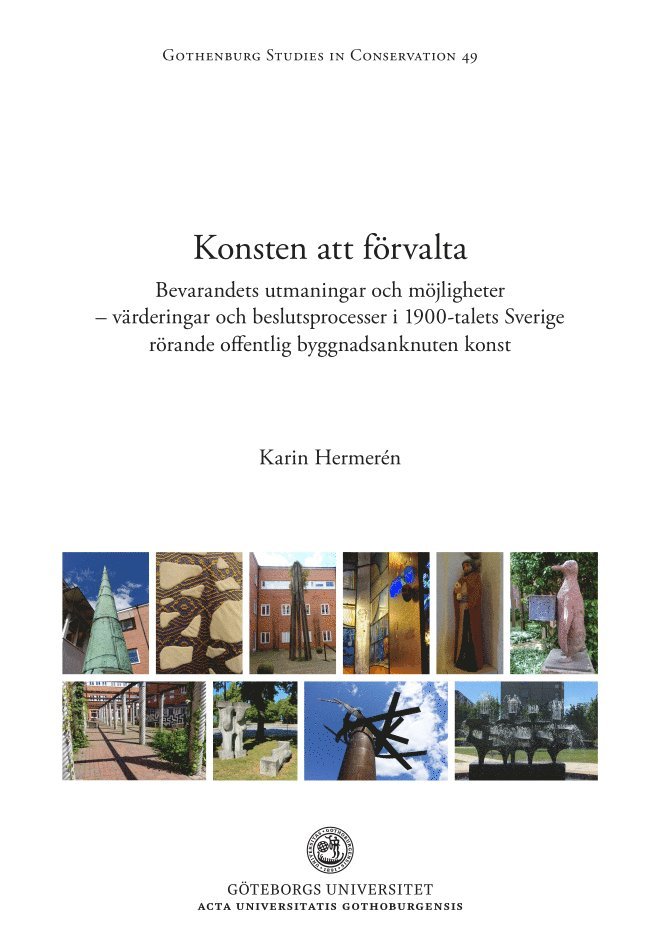
Konsten att förvalta : bevarandets utmaningar och möjligheter - värderingar och beslutsprocesser i 1900-talets Sverige rörande offentlig byggnadsanknuten konst
Häftad, Svenska, 2021
467 kr
Skickas inom 5-8 vardagar
Denna avhandling har tillkommit i syfte att förbättra förutsättningarna för bevarande av byggnadsanknuten konst i offentlig miljö. Bakgrunden är de stora utmaningar samhället står inför när det gäller att bevara det omfattande antal konstverk som har beställts sedan 1900-talets början, i synnerhet avseende kulturmiljösektorns förmåga att identifiera och prioritera vad som bör eller ska bevaras för kommande generationer. Avhandlingen analyserar val och beslutsprocesser i bevarandepraxis, samt dessas konsekvenser för långsiktig förvaltning, särskilt i relation till kulturarvsbegreppet samt förvaltning och tillsyn. Vilka och vems kunskaper, värderingar och kompetens som påverkar, styr eller avgör besluten i valsituationerna diskuteras, liksom huruvida metoder behöver utvecklas för att tydliggöra, kritiskt diskutera och analysera regelverk och underliggande etiska ställningstaganden. Avhandlingens teoretiska fundament utgörs av några begreppspar (bevarande och kulturarvsprocess, förhandling och makt, val och beslut, kulturarvifiering och kanonisering samt antikanonisering och glömska), där företeelser diskuteras huvudsakligen utifrån konserveringens och kulturvårdens teori, men även strukturerings- och värdeteori. För undersökningen har fallstudien tillämpats som metod, och tre fall har undersökts induktivt, deskriptivt och värderande genom observationer, intervjuer och dokumentstudier. Avhandlingen består av 12 kapitel, där de tre inledande presenterar bakgrund, syfte, teori och metod. Kapitel 4–5 identifierar och kontextualiserar byggnadsanknuten konst beställd av offentliga aktörer under 1900-talet ur begreppsligt, historiskt respektive juridiskt perspektiv. Kapitel 6–9 utgör avhandlingens empiriska del, där fall studeras inom kyrkligt område (Växjö domkyrka och Svenska kyrkan), bostadsområde (miljonprogramsområdet Lindängen i Malmö) och sjukvårdsområde (Vrinnevisjukhuset i Norrköping). Likheter och skillnader fallen emellan analyseras avseende beställning, reception och bevarande. Kapitel 10–12 omfattar diskussion, samlade resultat, slutsatser samt förslag på tillämpning. Fem problemområden för bevarandeverksamheten har lyfts fram, vilka rör dess mål, praxis, styrning, diskrepanser och brister. Utifrån dessa har intressenternas handlingsalternativ, resurser, kunskaper, kompetens, värderingsutgångspunkter och beslut diskuterats. Resultatet visade på en rad brister och problem inom bevarandeområdet byggnadsanknuten konst, givet de värderingar som uttryckts i politiska måldokument, professionens riktlinjer och lagstiftning på området. Dessa brister och problem är kontextberoende, men kan ändå utgöra underlag för i texten angivna rekommendationer. Avhandlingen har särskilt pekat på behovet inom kulturmiljövårdens praxis av gemensamma tydliga mål och dokumenterade bedömningar samt ett nytt konstantikvariskt kompetensområde. Beslutsprocessen bör vara tydlig och förankrad – genom använda väldefinierade begrepp, bredd i kunskapsinhämtning och kompetenssamverkan – för robusta och legitima beslut, också avseende nya konstbeställningars relation till framtida bevarande. En översyn av relevanta kriterier och lagstiftning behövs. Byggnadsanknuten konst borde omfattas av samhälleliga resurser och förståelse för förvaltning, samt tillgång till skyddsbestämmelser. Ingenting i fallstudierna har framkommit som påvisar att nya metoder för värdering behöver utarbetas. Man kan komma långt med att använda redan existerande metoder, som då bör stärkas och utvecklas samt tillämpas konsekvent och långsiktigt.
Del 50 - Gothenburg Studies in Conservation
Managing ecclesiastical heritage : transformation of discourses, roles and policy in Sweden
Häftad, Engelska, 2021
370 kr
Skickas inom 5-8 vardagar
Religious heritage is in a state of transformation. Changing religious practices and secularization affect the established Christian congregations in many countries, as membership decreases and churches close. During recent years, new approaches to use and develop churches have been explored by the heritage field and the Christian congregations. A parallel development in heritage theory and policy focuses on broad definitions of heritage and questions the position of the heritage expert. In Sweden, the ecclesiastical heritage has a prominent position through heritage legislation and the shared management model of the State and Church. Departing from two case studies of projects that explore new approaches to heritage management, the purpose of the thesis is to describe how ecclesiastical heritage is constructed and understood by public heritage institutions and the Church of Sweden. In addition, the thesis aims to describe how professional and institutional roles and responsibilities are constructed and understood within the field. The case studies cover two contemporary projects involving the built ecclesiastical heritage in Sweden: the Cathedral Hill Project in Strängnäs and the Hamra Project in the village of Hamra. The projects unite actors from the public heritage field and the Church of Sweden and aim to develop and extend the use and management of the church. Adopting a qualitative approach, the material consists of interviews with key actors, documents, and observations of the case studies. Synchronic discourse analysis is applied to identify discourses on heritage and understand the roles of the actors. The results reveal parallel discourses on heritage among the actors, which are constructed through coinciding and conflicting values on the management of the past. Conflicting values may be negotiated to reach consensus, while different interpretations of governing frameworks and objectives cause tension between actors. The institutional roles and responsibilities of the key actors provide different capacities to incorporate policy strategies in practice. Despite the difficulties of balancing the objectives of the organizational framework of public heritage management, the actors use the available resources and tools to transform the boundaries of their institutional roles from within.
Del 51 - Gothenburg studies in Conservation
Balancing building conservation with energy conservation : towards differentiated energy renovation strategies in historic buildning stocks
Häftad, Engelska, 2021
365 kr
Skickas inom 5-8 vardagar
Balancing building conservation with energy conservation is challenging. The overall aim of this thesis is to bridge the perceived conflict of reaching climate and energy goals on the one hand and the goals of a sustainable management of historic building stocks on the other hand. Historic buildings constitute an important representation of the built heritage, and make up a large part of the total building stock. Within the historic building stock, there are opportunities for energy efficiency improvements that can, and should, be undertaken in order to contribute to climate and energy goals. However, changes due to energy improvement measures need to be made without damaging or destroying the heritage values that are embodied in, and represented by, historic buildings. For this to happen, heritage values need to be identified, acknowledged and articulated in a systematic and transparent manner in order to be balanced with other interests when assessing energy saving potential in relation to building conservation requirements. Three areas are of importance to move the issue of balancing building conservation with energy conservation from building level to building stock level. These are 1) adapted decision support processes for historic building stocks, 2) methods to integrate aspects of heritage values for decision support processes, and 3) building stock analysis aiming at developing differentiated energy renovation strategies for historic building stocks. Decision-support processes have been developed and tested for buildings and building stocks. On building level, the proposed process allows for interaction between a quantitative assessment of the techno-economic optimisation and a qualitative assessment of vulnerability and risks. On building stock level, categorisation to produce archetype buildings, restrictions with regard to heritage values and extrapolation of results from the optimisation are added to the process. The building stock analysis visualises the relationship between different segments of a selected historic building stock and thereby shows the need for differentiated energy renovation goals and strategies that reflect the diversity of the building stocks. The results provide not only a method to develop differentiated energy renovation strategies, but also argue for the need for coherent and coordinated information about the historic building stock. As a conclusion, my thesis has shown how to support informed decisions that balance energy conservation with building conservation for both individual buildings and building stocks. Further development is needed towards standardised decision support processes for historic building stocks that include the trade-off between preservation of heritage values and energy efficiency. Parts of work Paper I, Eriksson, Petra, Anna Donarelli, Endrik Arumägi, Fredrik Ståhl and Tor Broström (2013) ‘Energy efficient historic stone houses – a case study highlighting possibilities and risks’, proceeding in: Sustainable BuildingConference Munich (sb13 munich), Implementing Sustainability – Barriers and chances. Munich, April 24-26, 2013. Paper II, Eriksson, Petra, Carsten Hermann, Sára Hrabovszky-Horváth and Dennis Rodwell (2014) ’EFFESUS methodology for assessing the impacts of energyrelated retrofit measures on heritage significance’, The Historic Environment 5(2), pp. 132 – 149. visa artikel Paper III, Broström, Tor, Petra Eriksson, Linn Liu, Patrik Rohdin, Fredrik Ståhl and Bahram Moshfegh (2014) ’A method to assess the potential for and consequences of energy retrofits in Swedish historic buildings’, The Historic Environment 5(2), pp. 150 – 166. visa artikel Paper IV, Eriksson, Petra, Vlatko Milić and Tor Broström (2020) ’Balancing preservation and energy efficiency in building stocks’, International Journal of Building Pathology and Adaptation 38(2), pp. 356 – 373. visa artikel Paper V, Eriksson, Petra and Tim Johansson, ‘Towards differentiated energy renovation strategies for heritage classified multifamily building stocks’, Manuscript 2021.
Del 52 - Gothenburg Studies in Conservation
Painting treatments of weather-exposed ferrous heritage : exploration of oil varnish paints and painting skills
Häftad, Engelska, 2021
607 kr
Skickas inom 5-8 vardagar
This thesis is about industrial heritage—the protection of ferrous heritage by using anticorrosive oil varnish paints. The purpose of this thesis in Kulturvård and craft research is to provide guidelines, tools, concepts, and models that may be used in anticorrosive oil varnish painting maintenance of ferrous heritage. This is needed in in order to improve maintenance interventions and working descriptions. The methodology is a holistic, multiple methods approach; involving methods that collect quantitative and qualitative data to enlighten the phenomena from different views and exemplify different types of quality assessments of substrates, paints, craft skills, and final results. The research is characterised by an insider perspective of the craft and paint materials. The maintenance could be improved by systematic anamnesis, diagnosis, therapy, control, and monitoring. Tools for assessing the status of existing paint layers, a matrix for the specification of working procedures, and critical quality control of checkpoints and tools are provided. The paint types in focus are fat oil varnish paints, especially the so-called armour paint, used from the 1920s until the 1960s. The armour paints have long durability, and the concept of the paint system is explained in the research in terms of origin, formulation, use, and characteristics. Armour paints produced with the guidance of historical recipes are aged naturally in Southern Sweden and in accelerated, standardised laboratory tests compared to historical paint samples. Moreover, sensory profiling of drying oils and varnishes has been conducted by the using of methods common in sensory studies in the field of food and beverage and a vocabulary for sensory quality assessments and communication is initiated. Improved communication methods could be used in practice and education, and to highlight the importance of craft skills and evidence-based experiences for the final results. Parts of work Paper I: Källbom, A., and Almevik, G. (2020). Maintenance of Painted Steel Sheet Roofs on Historic Buildings in Sweden. International Journal of Architectural Heritage, 14(9). pp. 1-16. visa artikel Paper II: Källbom, A (2021): The Concept of Anticorrosive Aluminium-Pigmented Armour Paint, for Sustainable Maintenance of Ferrous Heritage. International Journal of Architectural Heritage, 14(10). pp. 1–19. visa artikel Paper III: Källbom, A., Izzo, F., & Nevin, A. (2021). Multi-analytical Assessment of Armour Paints: The Ageing Characteristics of Historic Drying Oil Varnish Paints for Protection of Steel and Iron Surfaces in Sweden. Heritage, 4(3). pp. 1141–1164. visa artikel Paper IV: Izzo, F. C., Källbom, A., & Nevin, A. (2021). Multi-analytical Assessment of Bodied Drying Oil Varnishes and their use as binders in Armour Paints. Heritage, 4 (4). Pp. 3402-3420; visa artikel Paper V: Källbom, A. (2020). Using profiling methods to develop the sensory vocabulary of architectural painters who use linseed oils. Book chapter in Anthology Craft + Science. Gothenburg: Kriterium, Acta Univeristatis Gothoburgensis. In press. Paper VI: Källbom, A, Nilsen, A., & Örstrom, Å. (2018). Olfactory description for refined linseed oils for paints: Characterization for reconstructing material and craft skills in paintmaking. Journal of Sensory Studies, 34(2), pp.1–10. visa artikel
499 kr
Skickas inom 5-8 vardagar
The field of ‘Craft Sciences’ refers to research conducted across and within different craft subjects and academic contexts. This anthology aims to expose the breadth of topics, source material, methods, perspectives, and results that reside in this field, and to explore what unites the research in such diverse contexts as, for example, the arts, conserva-tion, or vocational craft education. The common thread between each of the chapters in the present book is the augmented attention given to methods—the craft research methods—and to the relationship between the field of inquiry and the field of practice. A common feature is that practice plays an instrumental role in the research found within the chapters, and that the researchers in this publication are also practitioners. The aut-hors are researchers but they are also potters, waiters, carpenters, gardeners, textile artists, boat builders, smiths, building conservators, painting restorers, furniture designers, il-lustrators, and media designers. The researchers contribute from different research fields, like craft education, meal sciences, and conservation crafts, and from particular craft subjects, like boat-building and weaving. The main contribution of this book is that it collects together a number of related case studies and presents a reflection on concepts, perspectives, and methods in the general fields of craft research from the point of view of craft practitioners. It adds to the existing academic discussion of crafts through its wider acknowledgement of craftsmanship and extends its borders and its discourse outside the arts and crafts context. This book provides a platform from which to develop context-appropriate research strategies and to associate with the Craft Sciences beyond the bor-ders of faculties and disciplines.
Del 55 - Gothenburg Studies in Conservation
Hidden carpentry. Investigations of Medieval Church Roofs in Västergötland and Northern Småland
Häftad, Svenska, 2023
375 kr
Skickas inom 5-8 vardagar
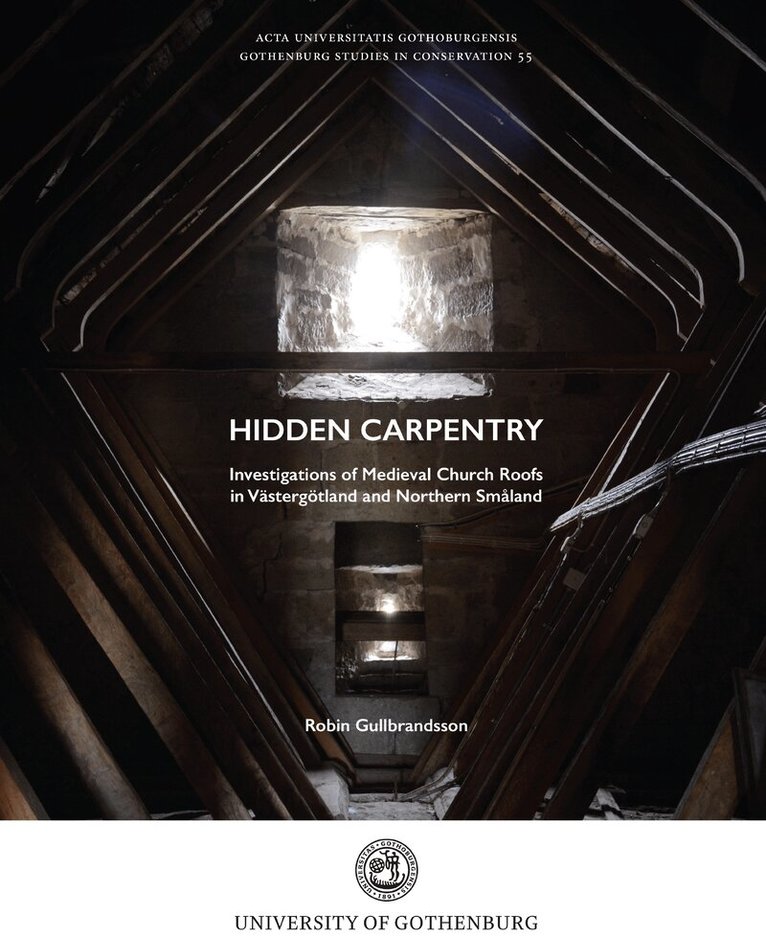
This licentiate thesis examines through three articles the corpus of preserved medieval timber roofs in churches of Västergötland and Northern Småland, based on surveys in the dioceses of Linköping, Skara and Gothenburg 2010–2021. These were the first systematic surveys of medieval roof structures in the regions. The primary aim of this thesis is a typology and chronology concerning the medieval church roofs of the two regions. Focus is put on the High Medieval material of Västergötland, where cross-disciplinary case studies have been made. Systems and techniques applied by the medieval carpenters could be identified, interpreted and structured. These in-depth field studies have together with studies of reference roofs from other regions and countries given a deeper insight into the roof structure and its part in medieval church building. Motives behind technical choices are discussed as well as the extent of possible domestic features. A narrative for Västergötland is sketched, from a pluralistic carpentry in the first half of the 12th century – although part of a European tradition of trussed tiebeam roofs – towards a more normative one. The latter just slowly opened up for new impulses from the continent, due to a decline in church building commissions in Västergötland after the mid-13th century. The uniform character that developed in Västergötland is not at hand in the material of Northern Småland. This thesis also points at the values that can be identified in historic roof structures through cross-disci- plinary fieldwork and how such investigations are necessary in order to maintain and restore an important European heritage in timber.
Del 56 - Gothenburg Studies in Conservation
Leaving dry land : water, heritage and imaginary agency
Häftad, Engelska, 2023
365 kr
Skickas inom 5-8 vardagar
This doctoral dissertation explores the interplay between water, heritage and the agency of the imagination. Instead of seeking how to map subjects or heritage, the research focuses on the ways in which mapping and the cartographic gaze have produced subjects in specific categories. It seeks to create moments of orientation and reorientation to experience the effects, affects and possibilities to imagine ways beyond these fixed geocodes and the taken for granted. As such, this dissertation contributes to broader discussions regarding critical design practices alongside critical heritage studies, while channelling design’s ability to shape the world and to explore potential approaches that foster collective imagination and planetary care. Two iterations of a fluid methodology were conducted in Mexico City and Gothenburg, foregrounding precarious issues in heritagisation processes and exploring aquatic agency. The methodology provides a tool for bridging different epistemologies, disciplines and perspectives, fostering transdisciplinary collaboration and knowledge permeation. By engaging with water as a subject and employing imaginative techniques, the research aims to actively (re)imagine the past, present and future of urban environments, enabling diverse infrastructures, ecologies and cosmologies to emerge. Heritage is reconceptualised as a navigational system that traces diverse relations in the world. In this sense, the research challenges modern heritage paradigms by acknowledging the ephemerality of water.
Del 57 - Gothenburg Studies in Conservation
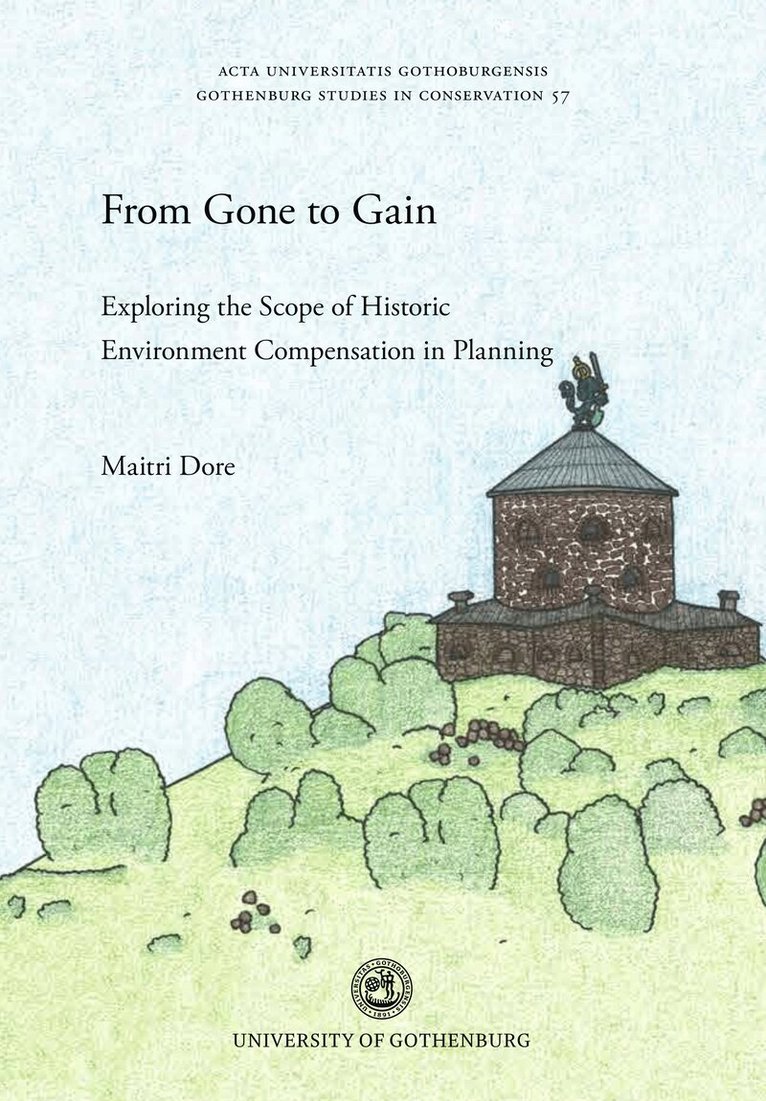
From gone to gain : exploring the scope of historic environment compensation in planning
Häftad, Engelska, 2023
359 kr
Skickas inom 5-8 vardagar
Large planning projects inserted in old cities often cause physical loss of the historic environments they encounter. Public actors face the challenge of conserving these environments, while simultaneously considering planning needs for the future. Departing from an understanding of conservation as the dynamic management of change, the thesis explores “compensation” for historic environment loss in response to urban planning projects. To do so, it delves into law and policy, theory, and practice. The thesis finds that in law and policy, the provision for compensation is severely inadequate, with environments largely being understood from the natural sciences perspective. This often connotes re-creation and/or relocation of the affected environments. In theory, historic environment compensation is inadequately researched, misunderstood, and often contested. And in practice, there are hardly any precedents for it. Given this background, the thesis fleshes out an understanding of compensation using two cases of large infrastructure projects that affect officially designated historic environments. The primary case is the West Link train tunnel in Gothenburg, Sweden, and the secondary one, the Mumbai Metro, in Mumbai, India. Findings show the presence of compensation in the West Link and preservation in the Mumbai Metro. Compensation is an additive and change-oriented response. It can take the form of conveying stories through signage, design elements, displaying excavated remains, as well as by creating entirely new public spaces and programmes at the urban scale. This is in contrast to preservation in the Mumbai Metro, which focuses on preserving the physical and visual integrity of the affected historic environment. The responses in the cases also reveal authorised views to varying extents, in the selection of certain historic environment values by experts. Further, compensation and preservation are heavily mediated by their planning contexts. They emerge through negotiations, are dependent on various institutional and policy frameworks, regulations, multiple actors and their approaches and mandates, and several constraints associated with these. In this context, it is often a challenge to implement more change-oriented approaches to conservation. Nevertheless, compensation offers a dynamic alternative to managing change to historic environments in moments of major urban transformation.
Del 59 - Gothenburg Studies in Conservation
Antikvariska planeringsunderlag : den byggda miljöns form och uttryck
Häftad, Svenska, 2025
359 kr
Skickas inom 5-8 vardagar
Utgångspunkten för avhandlingen är behovet av antikvariska planeringsunderlag med operativ relevans inom fysisk planering och byggnadsvård med avseende på deras analytiska ändamålsenlighet vid såväl utvärderingen som modelleringen av förslag till ingrepp i den byggda miljön. I avhandlingen presenteras en uppsättning analytiska kategorier och undersökningsinstrument, vilka använts för kvalitativa och kvantitativa analyser av diskursutvecklingen inom svensk kulturminnes(miljö)vård från 1970-talet till senare hälften av 2010-talet. Härigenom har avhandlingen också tillfört en begreppsapparat med vilken man kan tala om och reflektera över den byggda miljön som ett rumsligt teckensystem, dels vid analysen och bestämningen av det antikvariska planeringsunderlagets begreppsverkan i ett fortsatt uttolkningsförfarande, dels vid modelleringen av såväl generella som riktade planeringsunderlag med god operativ potential. Avhandlingens övergripande syfte är att lämna ett underbyggt bidrag till utvidgningen av antikvariens tolkningsrepertoar och beskrivningskapacitet vid framtagningen av planeringsunderlag med operativ ändamålsenlighet som bevarande- och påverkansinstrument. Denna underbyggnad har omfattat följande forskningsuppgifter: - Begreppsläggning av den operativa (analytiska) potentialens grundkategorier, inskrivna i en planeringskontext som det integrerade tolknings- och beskrivningsproblemet. - Empirisk granskning av antikvariska planeringsunderlag och officiella metodanvisningar för klarläggandet av kulturminnes(miljö)vårdens beskrivningsdiskurser över tid, syftande till att ge ett begreppshistoriskt bakgrundsperspektiv i arbetet med att utveckla de antikvariska planeringsunderlagens ändamålsenlighet. Det granskade materialet omfattar drygt tusen generella planeringsunderlag, tjugofem metodanvisningar och nästan etthundrafemtio artiklar och rapporter. I detta inbegrips också fördjupade textgranskningar med illustrativa exemplifieringar av underlag med god analytisk potential. - Begreppslig prövning i vad mån värde- och upplevelsebegreppens karaktäristika och tillämpningar inom kulturmiljövårdsfältet kan stå hindrande i vägen för utvidgningen av antikvariens tolknings- och beskrivningsrepertoar. - Vidare redogörs för tidigare forskning och teoribildning som på olika sätt angör miljö- och byggnadstolkningens problem, syftande till att bidra med olika infallsvinklar som kan underbygga ett bredare uppmärksamhetsfokus och en fördjupad tolkningshorisont. I detta inbegrips också fenomenologiskt orienterade teoribildningar, i syfte att visa på möjligheten att använda upplevelsen som ett kreativt verktyg i tolkningen och beskrivningen av den byggda miljön.
Del 61 - Gothenburg Studies in Conservation
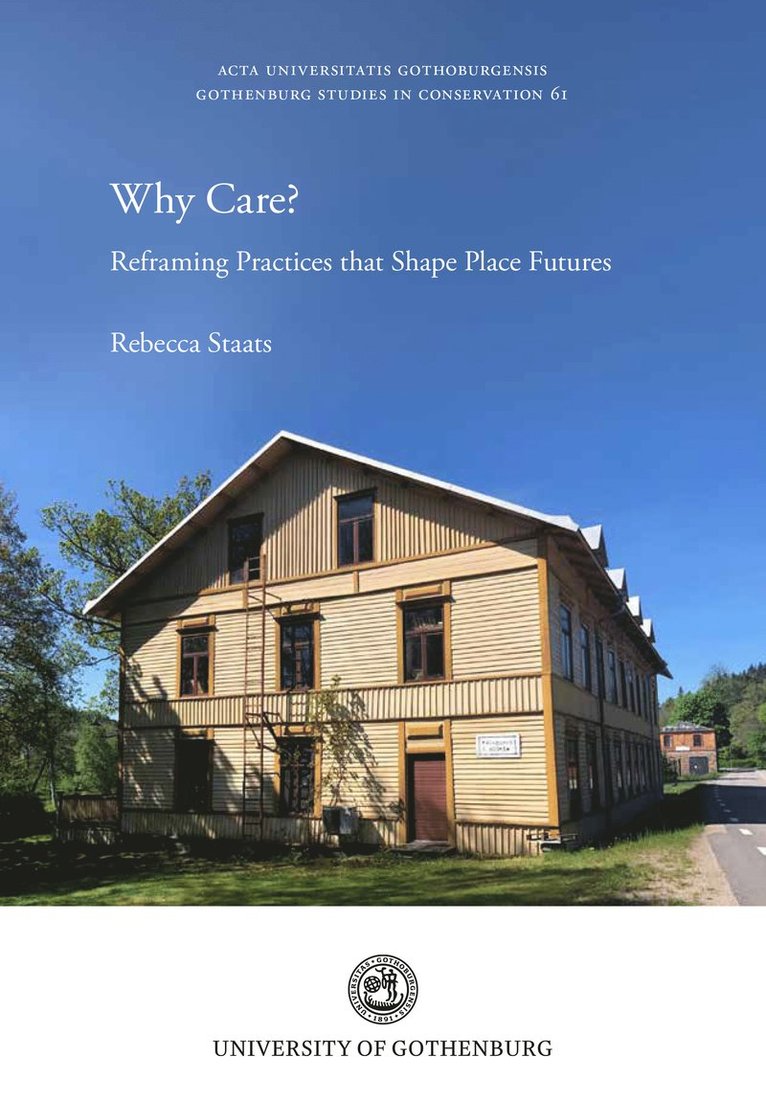
Why care? : reframing practices that shape place futures
Häftad, Engelska, 2025
329 kr
Skickas inom 5-8 vardagar
This dissertation explores the people and practices that shape place futures. Many professional fields go into shaping places such as placemaking, place branding, and heritage practices. Each of these spheres brings different knowledges, norms of practice and goals. Civil society actors also shape the future of places through participation in place planning and everyday activities. However, differences in language, priorities and professional expertise create challenges for connected and holistic approaches. A lack of clarity about what place planning activities are and what they should achieve is compounded by the fact that actors may care for a different idea of what their place is or should become. To bridge these differences and pay attention to competing ideas of the place in question, a conceptual reframing is required. To address this, the thesis employs the concept of care as an analytical framework to study the actors and practices, their motivations and relations, that shape place futures. This framework is applied to two empirical case studies in Sweden and the UK. The different scales of the case studies demonstrate the importance of situating actors within their temporal, spatial and institutional contexts. Through the application of the analytical framework the study demonstrates that the care concept provides two benefits: firstly, it directs our analytical attention in new ways to examine the values and relationships underpinning place planning practices that might otherwise remain implicit. Secondly, the care framework provides an integrative frame to both bridge differences between place planning paradigms and recognise the role of everyday practices in shaping the place. Through an iterative dialogue between theory and practice this research demonstrates that the care concept is a way forward in rethinking approaches to place futures.