Heterodox Studies in the Critique of Political Economy – serie
Visar alla böcker i serien Heterodox Studies in the Critique of Political Economy. Handla med fri frakt och snabb leverans.
5 produkter
5 produkter
Dissolution of the Financial State
A Marxian Examination of the Political Economy of Money Since the 1930s
Inbunden, Engelska, 2015
1 343 kr
Skickas inom 10-15 vardagar
This book argues that post-Keynesian theories of endogenous money can be combined with Marxian analysis in order to give insight into the changing power relations between the state, finance sector and real economy since WW2. A key theme is that financial power, derived from the control of money-issue and its purchasing power, is determined by the state and market in varying proportions (depending on context) but that state sovereignty has been lost in recent decades. In addition, the growth of financial markets in recent decades, so-called financialization, has led many to assume that private finance is an important proximate driver of economic affairs in general. In contrast, the book argues that this provides insufficient explanation of events. To discuss financial factors as causes of financial crisis risks describing the phenomena without illustrating the root causes. Instead, the book argues that systemic drivers of capitalism (rooted in production), probably best understood by Marx, actually do provide a more plausible explanation of the causes of the financialization and erosion of state sovereignty. In addition, the Post-Keynesian descriptions of monetary processes are considered to best reflect the actual reality of the monetary system. This represents an interesting synthesis of the classical Marx with modern money theory. The interpretation of Marx used to explain this financial transformation has been named the Temporal Single System Interpretation, which illustrates Marx’s value theory across periods and identifies a tendency towards falling profit rates. It is claimed that falling profits, in turn, are an underlying driver of the systemic propensity towards financialisation, crisis and stagnation. The empirical findings presented, taken from case studies of the UK and Germany, appear to support this view. The central argument is that the response of agents (including the state) to the profit tendency has been a significant driver of the observed financial transformation. The book then concludes that this synthesis provides a more appropriate explanation of the historical transformation of the financial system since the Great Depression, than much of the financialization literature, and illustrates the source (and operation) of financial power in the modern capitalist state and market.
501 kr
Skickas inom 10-15 vardagar
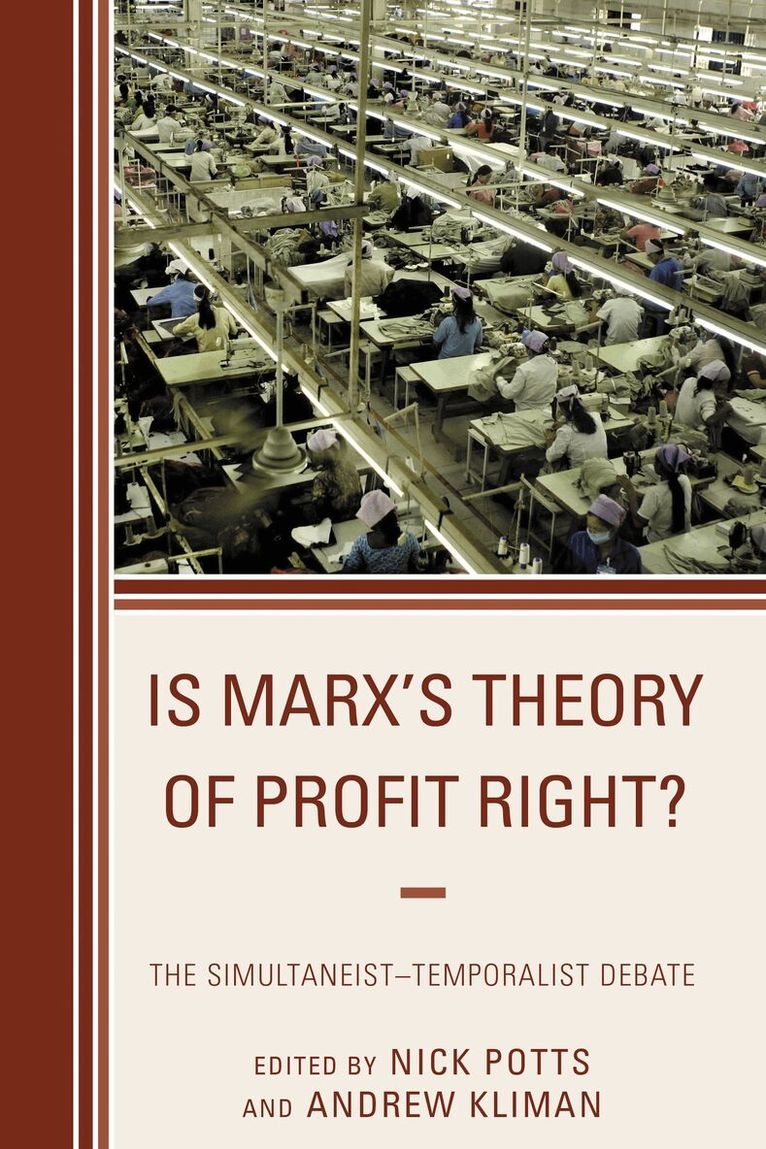
This collection focuses on a long-running debate over the logical validity of Karl Marx’s theory that exploitation is the exclusive source of capitalists’ profits. The “Fundamental Marxian Theorem” was long thought to have shown that orthodox Marxian economics succeeds in replicating Marx’s conclusion. The debate begins with Andrew Kliman’s disproof of that claim. On one side of the debate, representing orthodox Marxian economics, are contributions by Simon Mohun and Roberto Veneziani. Although they concede that their simultaneist models cannot replicate Marx’s theory of profit in all cases, they insist that this is as good as it gets. On the other side, representing the temporal single-system interpretation of Marx’s theory (TSSI), are contributions by Kliman and Alan Freeman. They argue that his theory is logically valid, since it can indeed be replicated when it is understood in accordance with the TSSI. While the debate initially focused on logical concerns, issues of pluralism, truth, and scientificity increasingly assumed center stage. In his introduction to the volume, Nick Potts situates the debate in its historical context and argues forcefully that the arguments of the orthodox Marxist economists, and the manner in which those arguments were couched, were “suppressive and contrary to scientific norms.”The volume concludes with a 2014 debate, in which many of the same issues re-surfaced, between the philosopher Robert Paul Wolff and proponents of the TSSI.
1 619 kr
Skickas inom 10-15 vardagar
Many scholars discuss Marx’s Capital from many perspectives, but Accounting for Value uniquely advances and defends an ‘accounting interpretation’ of his theory of value, that he used it to explain capitalists’ accounts. It confirms and builds on the Temporal Single-System Interpretation’s refutation of the charge that Marx’s illustration of the ‘transformation from values to prices’ is inconsistent, and its defense of his ‘Law of the Tendential Fall in the Rate of Profit’. It rejects other interpretations by showing that only a ‘temporal’, ‘single-system’ interpretation is consistent with Marx’s accounting. The book shows that Marx became seriously interested in accounts from the late 1850s during an important period in the development of his critique of political economy, asking Engels for information and explanations. Examining their letters in the context of Marx’s evolving work, it argues, supports the hypothesis that discovering he could explain them with his theory of value gave him the breakthrough he needed to decide how to present his work and explains why, in 1862, he decided to change its title to Capital. Marx’s explanations of capitalist accounting, it concludes, amount to an ‘accounting theory’ that explains how individual capitalists and the capital market use what is, for many, the ‘invisible hand’ of accounting to control the production and distribution of surplus value.Marx claimed his theory of value was a work of ‘science’, a critique of political economy that would deliver a ‘theoretical blow’ from which the bourgeoisie would ‘never recover’. He failed, critics argue, because his critique depends on hypothetical entities, which we cannot directly observe, such as ‘value’ and ‘abstract labour’, ‘surplus value’, which means his theory is not open to empirical refutation. The book, however, argues that he used his theory of value to explain the ‘phenomenal forms’ of ‘profit’, ‘rate of profit’, etc., by explaining the observable accounting principles and practices capitalists use to calculate and control them, in which, as he said, we can ‘glimpse’ the determination of value by socially necessary labor time, which experience could have refuted.
585 kr
Skickas inom 10-15 vardagar
Many scholars discuss Marx’s Capital from many perspectives, but Accounting for Value uniquely advances and defends an ‘accounting interpretation’ of his theory of value, that he used it to explain capitalists’ accounts. It confirms and builds on the Temporal Single-System Interpretation’s refutation of the charge that Marx’s illustration of the ‘transformation from values to prices’ is inconsistent, and its defense of his ‘Law of the Tendential Fall in the Rate of Profit’. It rejects other interpretations by showing that only a ‘temporal’, ‘single-system’ interpretation is consistent with Marx’s accounting. The book shows that Marx became seriously interested in accounts from the late 1850s during an important period in the development of his critique of political economy, asking Engels for information and explanations. Examining their letters in the context of Marx’s evolving work, it argues, supports the hypothesis that discovering he could explain them with his theory of value gave him the breakthrough he needed to decide how to present his work and explains why, in 1862, he decided to change its title to Capital. Marx’s explanations of capitalist accounting, it concludes, amount to an ‘accounting theory’ that explains how individual capitalists and the capital market use what is, for many, the ‘invisible hand’ of accounting to control the production and distribution of surplus value.Marx claimed his theory of value was a work of ‘science’, a critique of political economy that would deliver a ‘theoretical blow’ from which the bourgeoisie would ‘never recover’. He failed, critics argue, because his critique depends on hypothetical entities, which we cannot directly observe, such as ‘value’ and ‘abstract labour’, ‘surplus value’, which means his theory is not open to empirical refutation. The book, however, argues that he used his theory of value to explain the ‘phenomenal forms’ of ‘profit’, ‘rate of profit’, etc., by explaining the observable accounting principles and practices capitalists use to calculate and control them, in which, as he said, we can ‘glimpse’ the determination of value by socially necessary labor time, which experience could have refuted.
1 754 kr
Skickas inom 10-15 vardagar
Accounting for History uses the accounting interpretation of Marx’s theories of history and value to explain and defend his prediction of the inevitability of socialism as the end of history. In addition to the technological and institutional development of advanced capitalism, Bryer argues that the key necessary conditions, are that workers see through capitalist ideology, understanding that Marx’s theory of value explains why the phenomenal forms appearing in capitalist accounts are distortions of the underlying social reality, and that demystified accounting is integral to his concept of socialism on Day One. To get to Day One, the book concludes, Marx left Marxists the tasks of critical accounting.