History of Violence – Serie
Visar alla böcker i serien History of Violence. Handla med fri frakt och snabb leverans.
2 produkter
2 produkter
382 kr
Skickas inom 7-10 vardagar
In the decades following the 9/11 attacks, complex webs of anti-terrorism laws have come into play across the world, promising to protect ordinary citizens from bombings, hijackings and other forms of mass violence. But are we really any safer? Has freedom been secured by active deployment of state power, or fatally undermined?In this groundbreaking new book, Conor Gearty unpacks the history of global anti-terrorism law, explaining not only how these regulations came about, but also the untold damage they have wrought upon freedom and human rights. Ranging from the age of colonialism to the Cold War, through the perennial crises in the Middle East to the exponential growth of terrorism discourse compressed into the first two decades of the 21st century, the coercion these laws embody is here to stay. The ‘War on Terror’ was something that colonial and neo-colonial liberal democracies had always been doing—and something that is not going away. Anti-terrorism law no longer requires terrorism to survive.Wide-ranging, elegant and with a perceptive analytical sting, this book is essential reading for anyone seeking to understand the deep origins of terrorism and counter-terrorism, and how these concepts fundamentally shape the world we live in.
289 kr
Skickas inom 5-8 vardagar
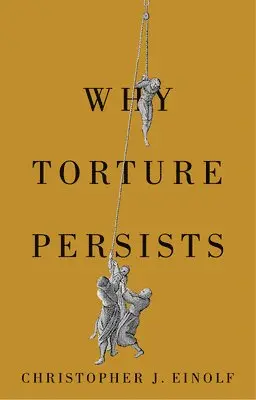
Since antiquity, governments have used torture to gather information and determine guilt. But its track record is shaky, to say the least: thinkers from Aristotle to the present have observed that torture does not work, and thinkers from Foucault to Orwell have doubted that this is torture's true purpose. Guilty people can resist torture and remain silent, while innocent people can give in and tell their torturers what they want to hear. Why, then, do governments keep using it?In this timely and compelling book, Chistopher J. Einolf recounts the history of torture from public trials in ancient Athens to the international scandal of Abu Ghraib. He details its brutal use in the persecution of the Templars, the Spanish Inquisition, and early modern witch hunts; describes its abolition in the 18th century; and tracks its alarming resurgence across the 20th and 21st centuries. In exposing torture's sordid past, Einolf also explores the social science of torture, supplementing a broad historical account with relevant insights from sociology, political science, and psychology. The distressing reality is that governments use torture as a tool of oppression: convinced that they are beset by traitors and enemies, those with power torture victims until they confirm their worst fears.Chilling yet vital, Why Torture Persists is a call to face humanity's troubling weapons of political coercion and control head-on. Despite recounting a disturbing history, Why Torture Persists ultimately concludes with hope. It is only by understanding torture that we can learn how to prevent it.