IBM Research Symposia Series - Böcker
Visar alla böcker i serien IBM Research Symposia Series. Handla med fri frakt och snabb leverans.
13 produkter
13 produkter
1 059 kr
Skickas inom 10-15 vardagar
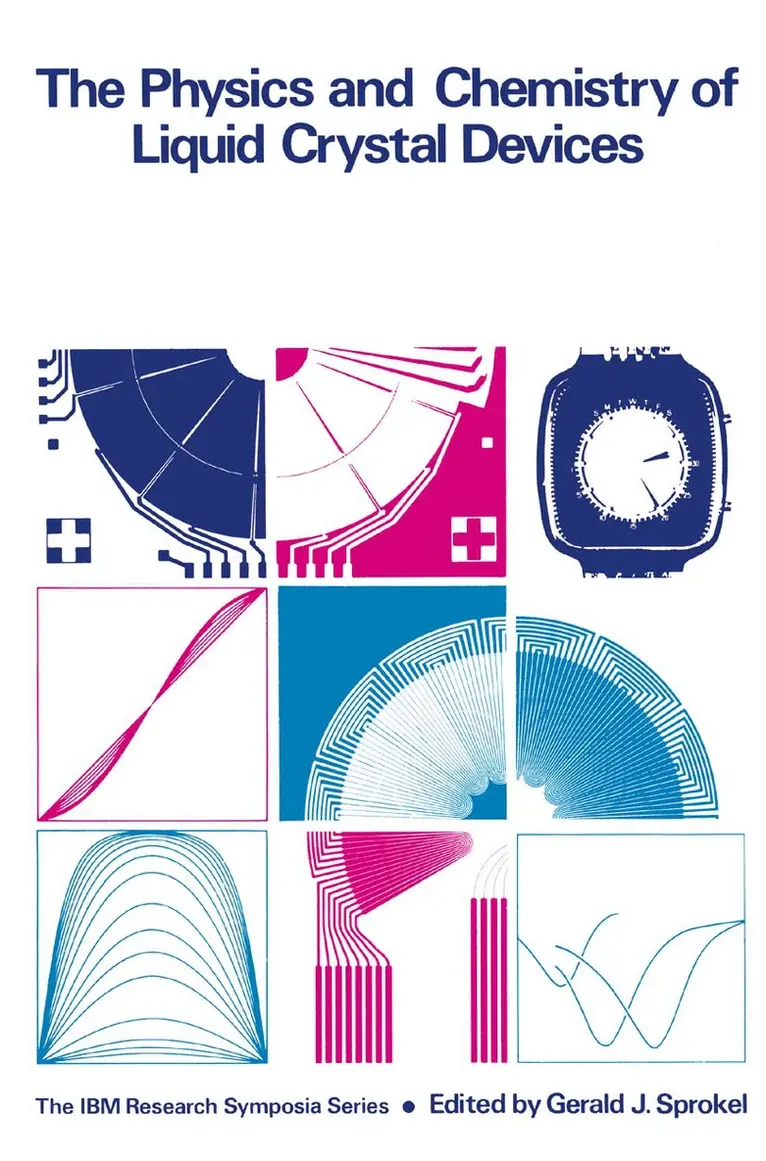
Over 100 scientists met at the IBM Research Laboratory in San Jose. California for a symposium on the Physics and Chemistry of Liquid Crystal Devices. The two-day meeting was intellectually stimulating with excellent oral presentations and with person-to-person discussions. The applications of liquid crystals have developed dramatically in the past ten years. In these few years, they have moved from being a laboratory curiosity to products in the market place. The first commercial application (1940's) of liquid crystals was the preparation of a light polarizer. The second commercial application was their use as temperature sensors. The third major application of liquid crystals dealt with commercial displays. Other current applications include polymeric and graphitic fibers and light attenuators. The future of liquid crystals looks very promising indeed. One can expect to see new fibers of qualities which will be superior to those presently known. Graphitic fibers or other physical forms of graphitic materials will be used as catalytic surfaces for chemical synthesis. In the display area. one can expect to see television screens using liquid crystals. Larger displays than are now used in wrist watches and pocket calculators will become available. Liquid crystals using color displays will become commercially practical. Watches. calculators and television screens will have color.
533 kr
Skickas inom 10-15 vardagar
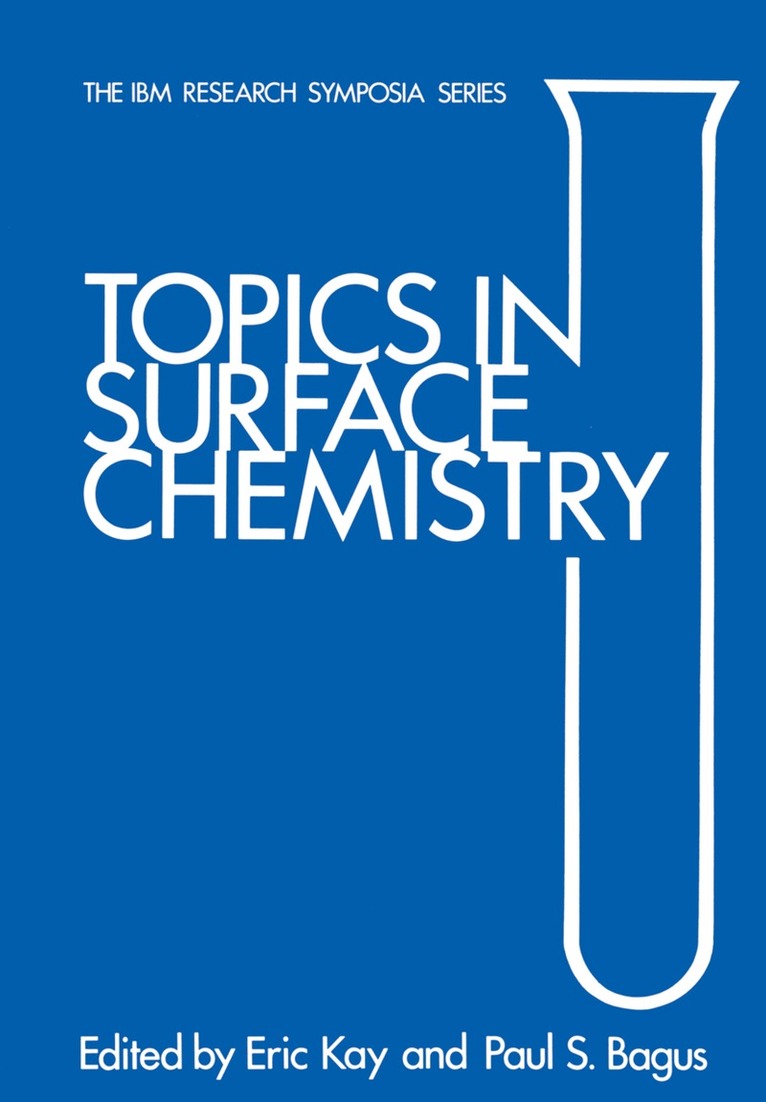
The papers in this volume were presented at an international symposium on Topics in Surface Chemistry which was held in Bad Neuenahr, West Germany., September 7-9, 1977. The symposium was sponsored by IBM Germany. It has been recognized for many years that our understanding of bulk phenomena and their subsequent exploitation depends largely on our ability to define correlations between microscopic structure and the physical and chemical phenomena of interest. The role played by surface phenomena in the overall behavior of a material has been a subject for speculation for a long time, but only during the last decade or so have experimental and theor etical tools been developed which make it possible to investigate surface structure and related surface phenomena uniquely. Numerous surface spectroscopies have been developed in recent years intended to describe the geometric, vibrational and electronic structure of a surface. Our present understanding of surface, thin film and interfacial phenomena in solid state physics owes much to these developments. In chemistry much of the interest in surface science has come from the obvious implications to such important and diverse fields as catalysis and corrosion. It takes little imagination to recognize that there are many other areas where advances in surface science can be brought to bear.
525 kr
Skickas inom 10-15 vardagar
This book contains papers on sparse matrices and their appli cations which were presented at a Symposium held at the IBM Thomas J. Watson Research Center, Yorktown Heights, New York on September 9-10, 1971. This is a very active field of research since efficient techniques for handling sparse matrix calculations are an important aspect of problem solving. In large scale problems, the feasibility of the calculation depends critically on the efficiency of the underlying sparse matrix algorithms. An important feature of the conference and its proceedings is the cross-fertilization achieved among a broad spectrum of application areas, and among combinatorialists, numerical analysts, and computer scientists. The mathematical, programming, and data management features of these techniques provide a unifying theme which can benefit readers in many fields. The introduction summarizes the major ideas in each paper. These ideas are interspersed with a brief survey of sparse matrix technology. An extensive unified bibliography is provided for the reader interested in more systematic information. The editors wish to thank Robert K. Brayton for his many helpful suggestions as chairman of the organizing committee and Redmond O'Brien for his editorial and audio-visual assistance. We would also like to thank Mrs. Tiyo Asai and Mrs. Joyce Otis for their help during the conference and on the numerous typing jobs for the manuscript. A special thanks goes to William J. Turner for establishing the IBM Research Symposia Series with Plenum Press.
525 kr
Skickas inom 10-15 vardagar
This volume contains the papers presented at the Conference on Computational Methods in Band Theory sponsored jointly by IBM and the American Physical Society and held at the IBM Thomas J. Watson Research Center, Yorktown Heights, New York, on May 14-15, 1970. The purpose of the conference was a sharing of information on the computational problems involved in relating models for the electron-electron and electron-ion interactions to experimentally measurable quantities. The papers comprising this volume therefore present up-to-date methodology for the calculation of single-particle energies and wave functions for periodic and near-periodic systems, the integration over these states required to describe experiment, and computationally practicable procedures for the introduction of exchange and correlation and the achievement of self-consistency. The proceedings is actually an expansion of the conference in that, unlike the oral presentations, the papers were not limited as to length. Furthermore, time was allowed after the conference to permit the papers to be written with the conference in retrospect, and five "prepared discussion" papers written by attendees of the conference but not on the original program are included. The latter are indicated in the table of contents by asterisks. The explicit emphasis of the conference on comparison of technique generated much lively argument, which is surely an indi cation of the current interest in the subject and the vigor of those working in it. It is our hope that the proceedings will make these comparisons available to the widest possible audience.
Computational Solid State Physics
Proceedings of an International Symposium Held October 6–8, 1971, in Wildbad, Germany
Häftad, Engelska, 2012
533 kr
Skickas inom 10-15 vardagar
During the past 20 years, solid state physics has become one of the major branches of physics. 1-2 Today over one-third of all scientific articles published in physics deal with solid state 3 topics. During the last two decades, there has also been ra~id growth of scientific computation in a wide variety of fields. -5 The combination of solid state physics and comp~tation may be termed computational solid state physics. This emerging field is distin guished from theoretical solid state physics only to the extent that electronic computers rather than slide rules or backs of envelopes are used to solve numerical or logical problems, test scientific hypotheses, and discover the essential physical content of formal mathematical theories. Papers in computational solid state physics are widely scatter ed in the literature. They can be found in the traditional physics journals and review series, such as The Physical Review and Solid State Physics; in more specialized publications, such as Journal of Computational Physics, Computer Physics Communications, and Methods in Computational Physics; and in the proceedings of a number of re 6 9 cent conferences and seminar courses. - Plans for holding an International Symposium on Computational Solid State Physics in early October 1971 were formulated by Dr.
525 kr
Skickas inom 10-15 vardagar
The Symposium on the Complexity of Computer Compu tations was held at the IBM Thomas J. Watson Research Center in Yorktown Heights, New York, March 20-22, 1972. These Proceedings contain all papers presented at the Symposium together with a transcript of the concluding panel discussion and a comprehensive bibliography of the field. The Symposium dealt with complexity studies closely re lated to how computations are actually performed on computers. Although this area of study has not yet found an appropriate or generally accepted name, the area is recognizable by the signif icant commonality in problems, approaches, and motivations. The area can be described and delineated by examples such as the following. (1) Determining lower bounds on the number of operations or steps required for computational solutions of specific problems such as matrix and polynomial calculations, sorting and other combinatorial problems, iterative com putations, solving equations, and computer resource allocation. (2) Developing improved algorithms for the solution of such problems which provide good upper bounds on the number of required operations, along with experimental and v vi PREFACE theoretical evidence concerning the efficiency and numer ical accuracy of those algorithms. (3) Studying the effects on the efficiency of computation brought about by variations in sequencing and the intro duction of parallelism.
Computational Methods for Large Molecules and Localized States in Solids
Proceedings of a Symposium, Held May 15–17, 1972, at the IBM Research Laboratory, San Jose, California
Häftad, Engelska, 2012
1 059 kr
Skickas inom 10-15 vardagar
During the past few years, there has been dramatic progress in theoretical and computational studies of large molecules and local ized states in solids. Various semi-empirical and first-principles methods well known in quantum chemistry have been applied with considerable success to ever larger and more complex molecules, including some of biological importance, as well as to selected solid state problems involving localized electronic states. In creasingly, solid state physicists are adopting a molecular point of view in attempting to understand the nature of electronic states associated with (a) isolated structural and chemical defects in solids; (b) surfaces and interfaces; and (c) bulk disordered solids, most notably amorphous semiconductors. Moreover, many concepts and methods already widely used in solid state physics are being adapted to molecular problems. These adaptations include pseudopotentials, statistical exchange approxi mations, muffin-tin model potentials, and multiple scattering and cellular methods. In addition, many new approaches are being de vised to deal with progressively more complex molecular and local ized electronic state problems.
1 059 kr
Skickas inom 10-15 vardagar
During the years since the first conference in this series was held at Thousand Oaks, California, in 1970, ion implantation has been an expanding and exciting research area. The advances in this field were so rapid that a second conference convened at Garmisch Partenkirchen, Germany, in 1971. At the present time, our under standing of the ion implantation process in semiconductors such as Si and Ge has reached a stage of maturity and ion implantation techniques are firmly established in semiconductor device technology. The advances in compound semiconductors have not been as rapid. There has also been a shift in emphasis in ion implanta tion research from semiconductors to other materials such as metals and insulators. It was appropriate to increase the scope of the conference and the IIIrd International Conference on Ion Implanta tion in Semiconductors and Other Materials was held at Yorktown Heights, New York, December 11 to 14, 1972. A significant number of the papers presented at this conference dealt with ion implanta tion in metals, insulators, and compound semiconductors. The International Committee responsible for organizing this conference consisted of B. L. Crowder, J. A. Davies, F. H. Eisen, Ph. Glotin, T. Itoh, A. U. MacRae, J. W. Mayer, G. Dearnaley, and I. Ruge. The Conference attracted 180 participants from twelve countries. The success of the Conference was due in large measure to the financial support of our sponsors, Air Force Cambridge Research Laboratories and the Office of Naval Research.
525 kr
Skickas inom 10-15 vardagar
The papers in these proceedings were presented at an Inter national Symposium on Stiff Differential Systems, which was held at the Hotel Quellenhof, Wildbad, Federal Republic of Germany, October 4-6, 1973. The sumposium was organized by IBM Germany and sponsored by the IBM World Trade Corporation. On behalf of all the participants we wish to express our appreciation to the sponsors and organizers for their generous support,particularly to Dr. G. HUbner, representing Scientific Relations, IBM Germany, and Dr. G. Kozak, representing IBM World Trade Headquarters, New York. The purpose of the conference was to provide an intensive treatment of all apsects of a difficult problem class, stiff differential systems. Some major fields of interest of attendees and contributors are: 1) Modeling and problem solving in scien tific and technological applications, 2) Qualitative theory of stiff systems, 3) Numerical Analysis, including design, valida tion, and comparison of algorithms, as well as error and stability analysis, and 4) Computer Science, in particular problem-oriented programming languages, program packages, and applications-oriented computer architecture.
533 kr
Skickas inom 10-15 vardagar
The papers in this volume were presented at an International Symposium on Optimal Estimation in Approximation Theory which was held in Freudenstadt, Federal Republic of Germany, September 27-29, 1976. The symposium was sponsored by the IBM World Trade Europe/Middle East/Africa Corporation, Paris, and IBM Germany. On behalf of all the participants we wish to express our appreciation to the spon sors for their generous support. In the past few years the quantification of the notion of com plexity for various important computational procedures (e. g. multi plication of numbers or matrices) has been widely studied. Some such concepts are necessary ingredients in the quest for optimal, or nearly optimal, algorithms. The purpose of this symposium was to present recent results of similar character in the field or ap proximation theory, as well as to describe the algorithms currently being used in important areas of application of approximation theory such as: crystallography, data transmission systems, cartography, reconstruction from x-rays, planning of radiation treatment, optical perception, analysis of decay processes and inertial navigation system control. It was the hope of the organizers that this con frontation of theory and practice would be of benefit to both groups. Whatever success th•~ symposium had is due, in no small part, to the generous and wise scientific counsel of Professor Helmut Werner, to whom the organizers are most grateful. Dr. T. J. Rivlin Dr. P. Schweitzer IBM T. J. Watson Research Center IBM Germany Scientific and Education Programs Yorktown Heights, N. Y.
533 kr
Skickas inom 10-15 vardagar
The papers collected in this volume were presented at an international symposium on Computational Methods in Chemistry. This symposium was sponsored by IBM Germany and was held September 17-19, 1979, in Bad Neuenahr, West Germany. According to Graham Richards [Nature 278, 507 (1979)] the "Third Age of Quantum Chemistry" has started-;-where the results of quantum chemical calculations have become so accurate and reliable that they can guide the experimentalists in their search for the unknown. The particular example highlighted by Richards was the suc cessful prediction and subsequent identification of the relative energies, transition probabilities and geometries of the lowest triplet states of acetylene. The theoretical predictions were based chiefly upon the work of three groups: Kammer [Chern. Phys. Lett. ~, 529 (1970)] had made qualitatively correct predictions; Demoulin [Chern. Phys. 11, 329 (1975)] had calculated the potential energy curves for the two lowest triplet states (3 and 3 ) of B A acetylene; and Wetmore and Schaefer III [J. Chern. Phys. ~~ 1648 (1978)] had determined the geometries of the cis (3B and ~A ) and the trans (3B and 3A ) isomers of these two sta~es. Inua 2 2 guided search, Wendt, Hunziker and Hippler [J. Chern. PHys. 70, 4044 (1979)] succeeded in finding the predicted near infrared absorption of the cis triplet acetylene (no corresponding absorp tion for the trans form was found, which is in agreement with theory), and the resolved structure of the spectrum confirmed the predicted geometries conclusively.
1 059 kr
Skickas inom 10-15 vardagar
The papers collected in this volume were presented at the International Symposium on Methods and Materials in Microelectronic Technology. This symposium was sponsored by IBM Germany, and it was held September 29 - October 1, 1982, in Bad Neuenahr, West Germany. The progress of semiconductor and microelectronic technology has become so rapid and the field so sophisticated that it is imperative to exchange the latest insight gained as frequently as it can be accomplished. In addition, it is peculiar for this field that the bulk of the investigations are carried out at industrial research and development laboratories, which makes some of the results less readily accessible. Because of these circumstances, the academic community, which among other things, is supposed to communicate the prog ress in this field to students of different disciplines, finds it rather difficult to stay properly informed. It was the intent of this IBM sponsored symposium to bring together key scientists from academic institutions, primarily from Europe, with principal investigators of the industrial scene. Accordingly, this symposium exposed technologists to scientists and vice versa. Scientific advances often lead directly to technological innovations. In turn, new technologies are often arrived at empirically and, because of that, are initially poorly understood. Scientific inquiry then attempts to probe these processes and phenomena in order to achieve a better understanding. Thus science and technology are intricately interconnected, and it is important that technical exchange between technolo gists and scientists is facilitated, since the problems are typically interdiscipli nary in nature.
1 059 kr
Skickas inom 10-15 vardagar
Over 100 scientists met at the IBM Research Laboratory in San Jose. California for a symposium on the Physics and Chemistry of Liquid Crystal Devices. The two-day meeting was intellectually stimulating with excellent oral presentations and with person-to-person discussions. The applications of liquid crystals have developed dramatically in the past ten years. In these few years, they have moved from being a laboratory curiosity to products in the market place. The first commercial application (1940's) of liquid crystals was the preparation of a light polarizer. The second commercial application was their use as temperature sensors. The third major application of liquid crystals dealt with commercial displays. Other current applications include polymeric and graphitic fibers and light attenuators. The future of liquid crystals looks very promising indeed. One can expect to see new fibers of qualities which will be superior to those presently known. Graphitic fibers or other physical forms of graphitic materials will be used as catalytic surfaces for chemical synthesis. In the display area. one can expect to see television screens using liquid crystals. Larger displays than are now used in wrist watches and pocket calculators will become available. Liquid crystals using color displays will become commercially practical. Watches. calculators and television screens will have color.