Mathematical and Computational Chemistry - Böcker
Visar alla böcker i serien Mathematical and Computational Chemistry. Handla med fri frakt och snabb leverans.
10 produkter
10 produkter
1 064 kr
Skickas inom 10-15 vardagar
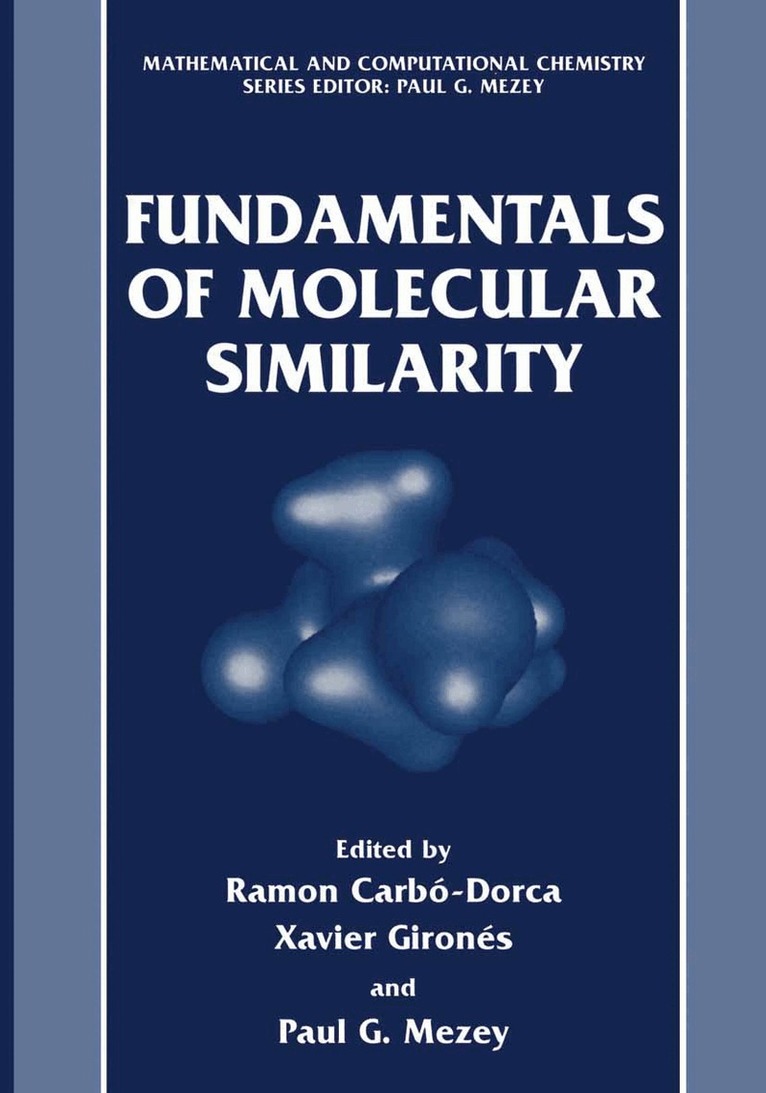
Motivated by the increased degree of understanding of elementary molecular properties on the levels ranging from fundamental quantum chemistry to the complex interactions of biomolecules, and aided by the progress in computer technology and access to computer power, the field of molecular similarity analysis has opened up to many new ideas and approaches. This book covers topics in quantum similarity approaches, electron density shape analysis methods, and it provides better theoretical understanding of molecular similarity. Additionally, quantitative shape analysis, especially activity relations (QShAR) and the prediction of the pharmacological or toxicological effects of molecules in the related context of quantum QSAR (QQSAR).
1 064 kr
Skickas inom 10-15 vardagar
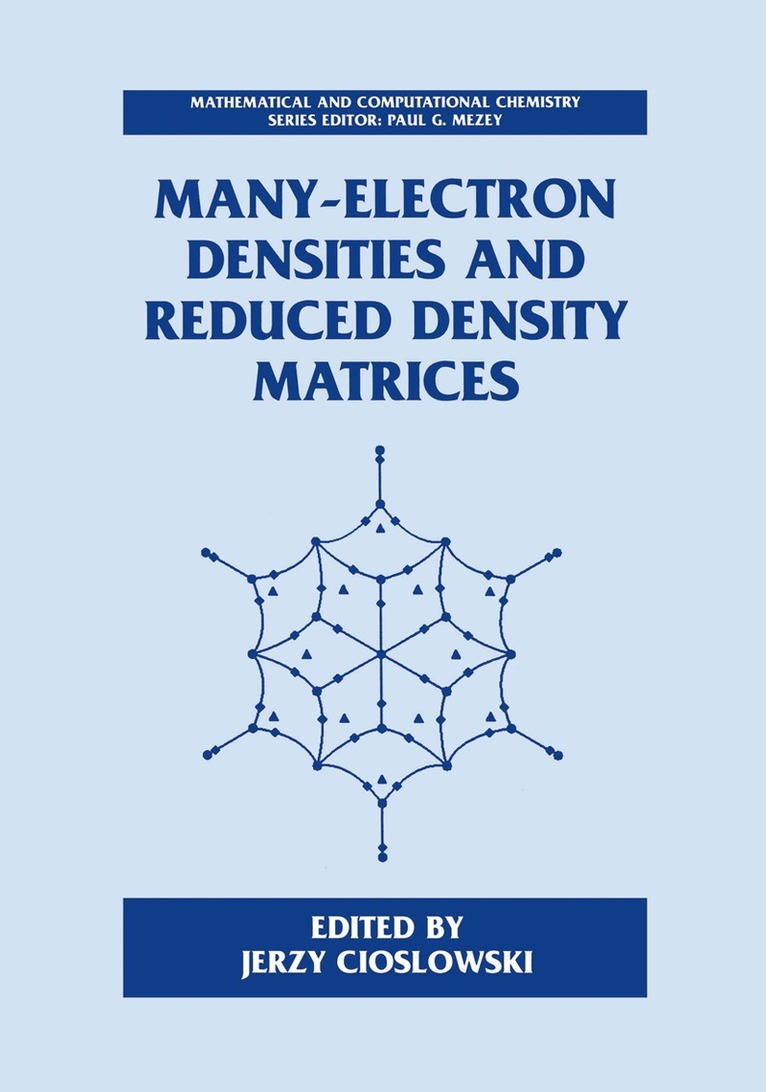
Reduced density matrices, upon their initial introduction, promised great simplifications of quantum-chemical approaches. Although they did not immediately meet the high expectations held of them, recent work has placed them at the center of new electron correlation functions. This text presents the developments that are giving new importance to reduced density matrices. The volume stresses not only their applications, but also the relevance of many-electron densities. Leading experts in the field have put together a book which covers topics ranging from fundamental theorems describing mathematical structures of many-electron densities and reduced density matrices, to new electronic structure methods that open an avenue to highly accurate atomic and molecular simulations. The book should be of interest to quantum and theoretical chemists, solid state theorists, chemical physicists and physical chemists, and finally mathematical, statistical, and computational chemists. In addition to being a valuable resource for researchers, the book should be suitable as a textbook in special topic courses at the advanced graduate level.
2 333 kr
Skickas inom 10-15 vardagar
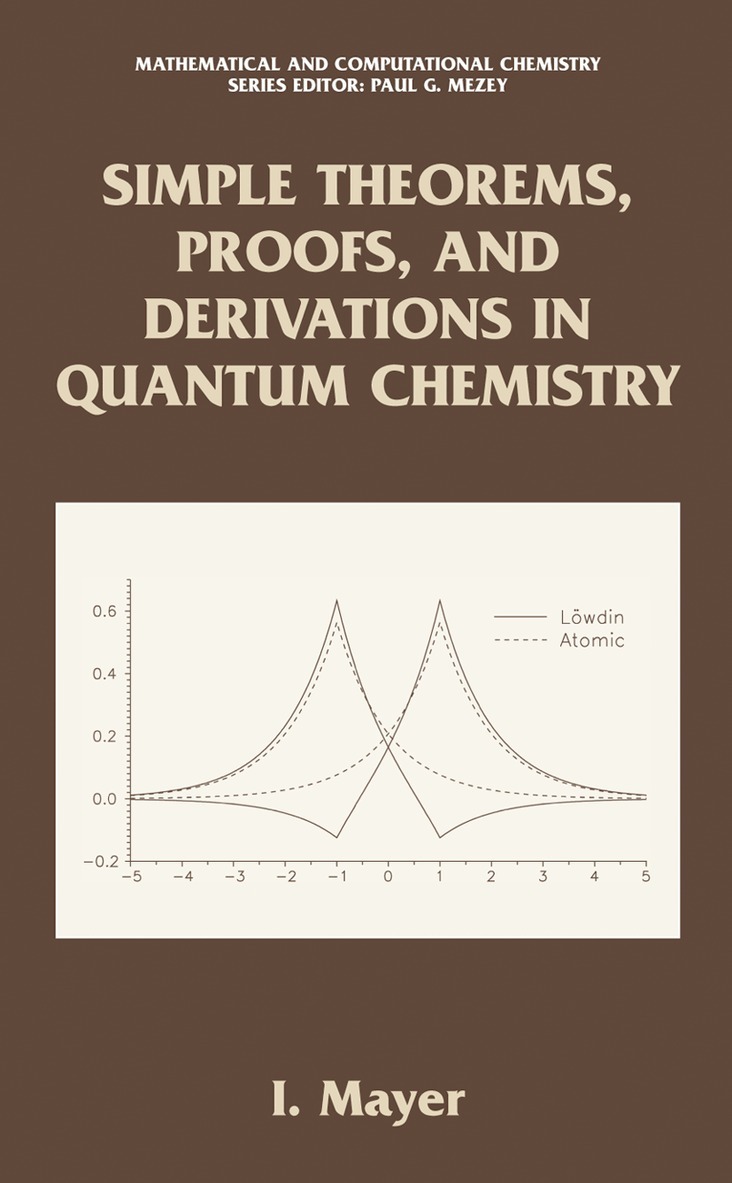
This is an advanced volume on quantum chemistry that will be useful for graduate students and as a reference for people in or moving into the field. It will be multi-disciplinary in nature, attracting a market in physical chemistry, spectroscopy, physics, and material science.
2 121 kr
Skickas inom 10-15 vardagar
Dr. Gànti has introduced Chemoton Theory to explain the origin of life. Theoretical Foundations of Fluid Machineries is a discussion of the theoretical foundations of fluid automata. It introduces quantitative methods - cycle stoichiometry and stoichiokinetics - in order to describe fluid automata with the methods of algebra, as well as their construction, starting from elementary chemical reactions up to the complex, program-directed, proliferating fluid automata, the chemotons.Chemoton Theory outlines the development of a theoretical biology, based on exact quantitative considerations and the consequences of its application on biotechnology and on the artificial synthesis of living systems.
1 064 kr
Skickas inom 10-15 vardagar
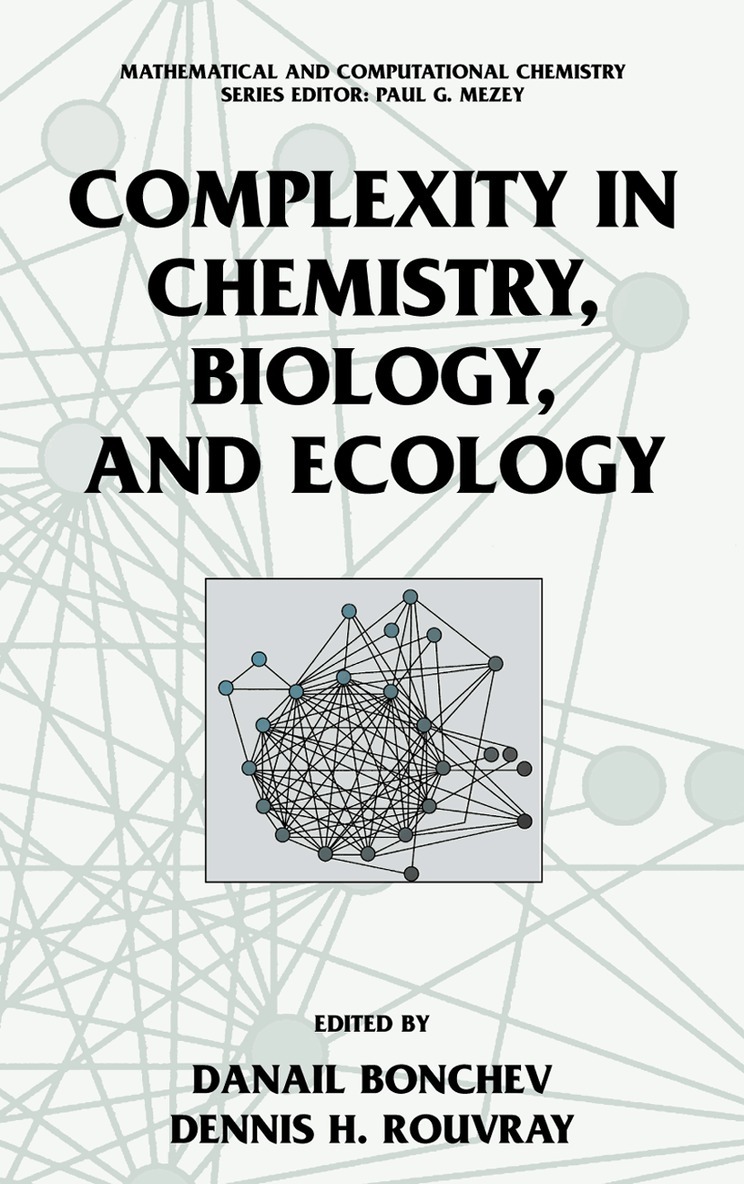
As we were at pains to point out in the companion volume to this mo- graph, entitled Complexity in Chemistry: Introduction and Fundamentals, complexity is to be encountered just about everywhere. All that is needed forustoseeitisasuitablytrainedeyeanditthenappearsalmostmagically in all manner of guises. Because of its ubiquity, complexity has been and currentlystillisbeingde?nedinanumberofdifferentways. Someofthese de?nitions have led us to major and powerful new insights. Thus, even in the present monograph, the important distinction is drawn between the - terpretations of the concepts of complexity and complication and this is shown to have a signi?cant bearing on how systems are modeled. Having said this, however, we should not fail to mention that the broad consensus that now gained acceptance is that all of the de?nitions of complexity are in the last analysis to be understood in essentially intuitive terms. Such de?nitions will therefore always have a certain degree of fuzziness as- ciated with them. But this latter desideratum should in no way be viewed as diminishing the great usefulness of the concept in any of the many scienti?c disciplines to which it can be applied. In the chapters that are included in this monograph the fact that differing concepts of complexity can be utilized in a variety of disciplines is made explicit. The speci?c d- ciplines that we embrace herein are chemistry, biochemistry, biology, and ecology. Chapter 1, “On the Complexity of Fullerenes and Nanotubes,” is wr- ten by an international team of scientists led by Milan Randic.
1 061 kr
Skickas inom 10-15 vardagar
In recent years the fundamental concepts and applied methodologies of molecular similarity analysis have experienced a revolutionary development. Motivated by the increased degree of understanding of elementary molecular properties on the levels ranging from fundamental quantum chemistry to the complex interactions of biomolecules, and aided by the spectacular progress in computer technology and access to computer power, the area has opened up to many new ideas and new approaches. This book covers topics in quantum similarity approaches, electron density shape analysis methods, and it provides better theoretical understanding of molecular similarity. Additionally, quantitative shape analysis, especially activity relations (QShAR) and the prediction of the pharmacological or toxicological effects of molecules in the related context of quantum QSAR (QQSAR). This volume written by the experts in the various subfields of molecular similarity, provides a collection of the most recent ideas, advances, and methodologies.It is the hope of the Editors that by representing these topics within a single volume, the readers will find a balanced overview of the status of the field. We also hope that the book will serve as a tool for selecting and assessing the best approach for various new types of problems of molecular similarity that may arise and it will provide a set of easy references for further studies and applications.
2 115 kr
Skickas inom 10-15 vardagar
This is an advanced volume on quantum chemistry that will be useful for graduate students and as a reference for people in or moving into the field. It will be multi-disciplinary in nature, attracting a market in physical chemistry, spectroscopy, physics, and materials science.
1 588 kr
Skickas inom 10-15 vardagar
As we were at pains to point out in the companion volume to this mo- graph, entitled Complexity in Chemistry: Introduction and Fundamentals, complexity is to be encountered just about everywhere. All that is needed forustoseeitisasuitablytrainedeyeanditthenappearsalmostmagically in all manner of guises. Because of its ubiquity, complexity has been and currentlystillisbeingde?nedinanumberofdifferentways. Someofthese de?nitions have led us to major and powerful new insights. Thus, even in the present monograph, the important distinction is drawn between the - terpretations of the concepts of complexity and complication and this is shown to have a signi?cant bearing on how systems are modeled. Having said this, however, we should not fail to mention that the broad consensus that now gained acceptance is that all of the de?nitions of complexity are in the last analysis to be understood in essentially intuitive terms. Such de?nitions will therefore always have a certain degree of fuzziness as- ciated with them. But this latter desideratum should in no way be viewed as diminishing the great usefulness of the concept in any of the many scienti?c disciplines to which it can be applied. In the chapters that are included in this monograph the fact that differing concepts of complexity can be utilized in a variety of disciplines is made explicit. The speci?c d- ciplines that we embrace herein are chemistry, biochemistry, biology, and ecology. Chapter 1, “On the Complexity of Fullerenes and Nanotubes,” is wr- ten by an international team of scientists led by Milan Randic.
1 588 kr
Skickas inom 10-15 vardagar
Dr. Gànti has introduced Chemoton Theory to explain the origin of life. Theoretical Foundations of Fluid Machineries is a discussion of the theoretical foundations of fluid automata. It introduces quantitative methods - cycle stoichiometry and stoichiokinetics - in order to describe fluid automata with the methods of algebra, as well as their construction, starting from elementary chemical reactions up to the complex, program-directed, proliferating fluid automata, the chemotons.Chemoton Theory outlines the development of a theoretical biology, based on exact quantitative considerations and the consequences of its application on biotechnology and on the artificial synthesis of living systems.
1 061 kr
Skickas inom 10-15 vardagar
Science advances by leaps and bounds rather than linearly in time. I t is not uncommon for a new concept or approach to generate a lot of initial interest, only to enter a quiet period of years or decades and then suddenly reemerge as the focus of new exciting investigations. This is certainly the case of the reduced density matrices (a k a N-matrices or RDMs), whose promise of a great simplification of quantum-chemical approaches faded away when the prospects of formulating the auxil iary yet essential N-representability conditions turned quite bleak. How ever, even during the period that followed this initial disappointment, the 2-matrices and their one-particle counterparts have been ubiquitous in the formalisms of modern electronic structure theory, entering the correlated-level expressions for the first-order response properties, giv ing rise to natural spinorbitals employed in the configuration interaction method and in rigorous analysis of electronic wavefunctions, and al lowing direct calculations of ionization potentials through the extended Koopmans'theorem. The recent research of Nakatsuji, Valdemoro, and Mazziotti her alds a renaissance of the concept of RDlvls that promotes them from the role of interpretive tools and auxiliary quantities to that of central variables of new electron correlation formalisms. Thanks to the economy of information offered by RDMs, these formalisms surpass the conven tional approaches in conciseness and elegance of formulation. As such, they hold the promise of opening an entirely new chapter of quantum chemistry.