Ramon Carbo – författare
Visar alla böcker från författaren Ramon Carbo. Handla med fri frakt och snabb leverans.
2 produkter
2 produkter
Inbunden, Engelska, 2001
1 073 kr
Skickas inom 10-15 vardagar
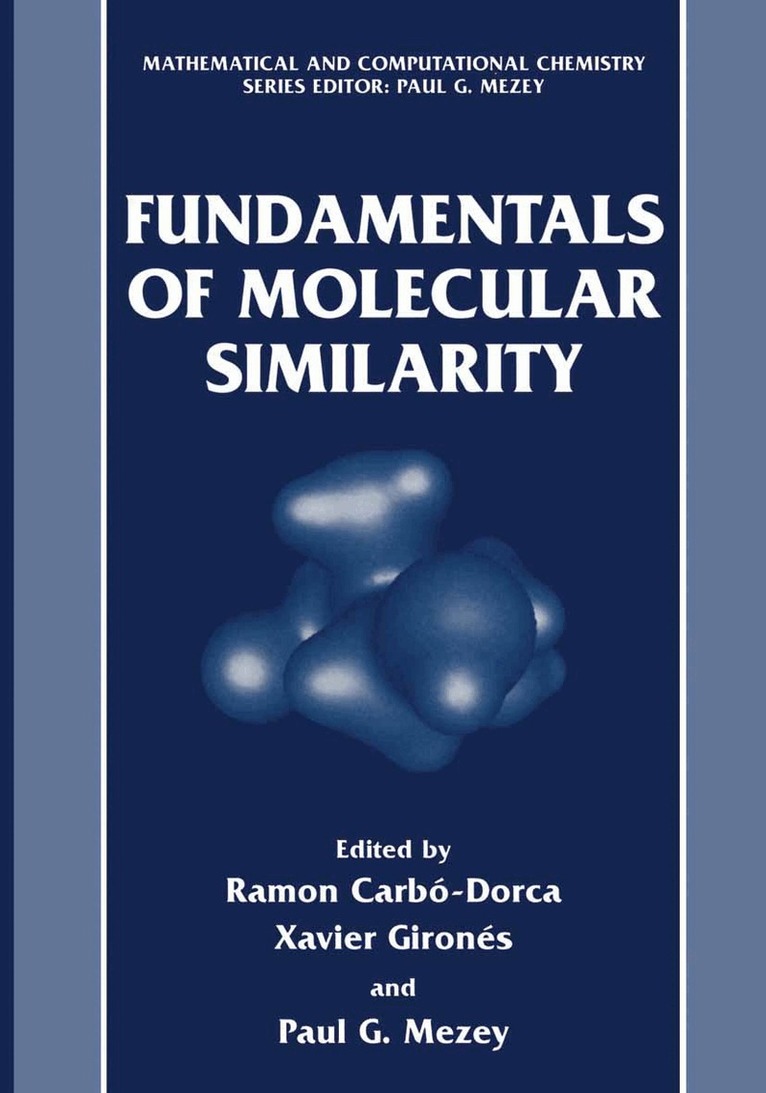
In recent years the fundamental concepts and applied methodologies of molecular similarity analysis have experienced a revolutionary development.Motivated by the increased degree of understanding of elementary molecular properties on the levels ranging from fundamental quantum chemistry to the complex interactions of biomolecules, and aided by the spectacular progress in computer technology and access to computer power, the area has opened up to many new ideas and new approaches.This book covers topics in quantum similarity approaches, electron density shape analysis methods, and it provides better theoretical understanding of molecular similarity. Additionally, quantitative shape analysis, especially activity relations (QShAR) and the prediction of the pharmacological or toxicological effects of molecules in the related context of quantum QSAR (QQSAR). This volume written by the experts in the various subfields of molecular similarity, provides a collection of the most recent ideas, advances, and methodologies. It is the hope of the Editors that by representing these topics within a single volume, the readers will find a balanced overview of the status of the field. We also hope that the book will serve as a tool for selecting and assessing the best approach for various new types of problems of molecular similarity that may arise and it will provide a set of easy references for further studies and applications.
Del 5 - Lecture Notes in Chemistry
General SCF Theory
Häftad, Engelska, 1978
544 kr
Skickas inom 10-15 vardagar
We live in a molecular world, almost closed shell in nature, and for this reason Chemistry has been a science dealing with closed shell mol ecules. However, the high degree of experimental sophistication reached in the past decade has made more apparent the role of open shell structures in chemical research. A parallel phenomenon can be observed in the development of SCF theory, where closed shell molecular calculations at any level of complexity compose the main body of references which can be obtained in Quantum Chemistry today. Besides the linkage between experimental and theoretical behaviour, there are, obviously, other reasons which can be attached to a lack of molecular open shell calculations. Among others, there was no connec tionbetween closed or open shell theoretical treatments. In this manner, many computational features used by closed shell connoisseurs have not been extended to other computational areas. Since the work of Roothaan in 1960, the open shell molecular landscape has been, the oretically, a very closed one. Further development of SCF theory, which has led to an outburst of multiconfigurational procedures, has paid no, or very faint, attention to the interconnection between these SCF theory advanced features, the open shell framework and closed shell common practice. A good theoretical goal, generally speaking, and in particular inside SCF theory, may consist of a procedure which can be used to solve a given chemical problem, within the physical and approx imate limits of the theory.