• Fri frakt över 249 kr
  • •
  • Snabba leveranser
  • •
  • Billiga böcker
Kundservice

Du är på sajten för privatpersoner.

Företag, bibliotek eller offentlig verksamhet?

Du handlar på classic.bokus.com, där alla dina funktioner finns intakta.
Till classic.bokus.com
Bokus logotyp. Gå till startsidan.
  • Erbjudanden
  • Nyheter
  • Student
  • Topplistor
  • Barn & ungdom
  • Bokus Play
  • E-böcker
  • Pocketböcker
  • Spel & pussel

10% rabatt på allt med kod NYSTART10 →

Sidfot

Mina sidor

    Hjälp

    • Kundservice
    • Vanliga frågor och svar
    • Frakt och leverans
    • Retur vid ångerrätt
    • Reklamera vara
    • Betalning
    • Köpvillkor
    • Allmänna villkor
    • Information om webbplatsens tillgänglighet

    Om Bokus

    • Om oss
    • Pressrum
    • För studenter
    • För företag
    • För bibliotek och offentlig verksamhet
    • För leverantörer
    • Hållbarhet

    Populärt

    • Aktuella erbjudanden
    • Presentkort
    • Studentlitteratur
    • Nya böcker
    • Topplistor
    • Signerade böcker
    • Engelska böcker

    Inspiration

    • Boktips
    • BookTok
    • Populära bokserier
    • Barnbokskaraktärer
    • Populära författare
    Logotyp för Bokus
    Följ oss på Facebook (extern länk)Följ oss på Instagram (extern länk)Följ oss på YouTube (extern länk)Följ oss på TikTok (extern länk)
    bokus @ CookiesAnpassa cookiesIntegritetspolicyKöpvillkor
    Till Citymail hemsida (extern länk)Till Budbee hemsida (extern länk)Till Postnord hemsida (extern länk)Till Schenker hemsida (extern länk)Till Early Bird hemsida (extern länk)Till Walleys hemsida (extern länk)
    1. Naturvetenskap och teknik
    2. Matematik och naturvetenskap
    3. Kemi
    4. Fysikalisk kemi

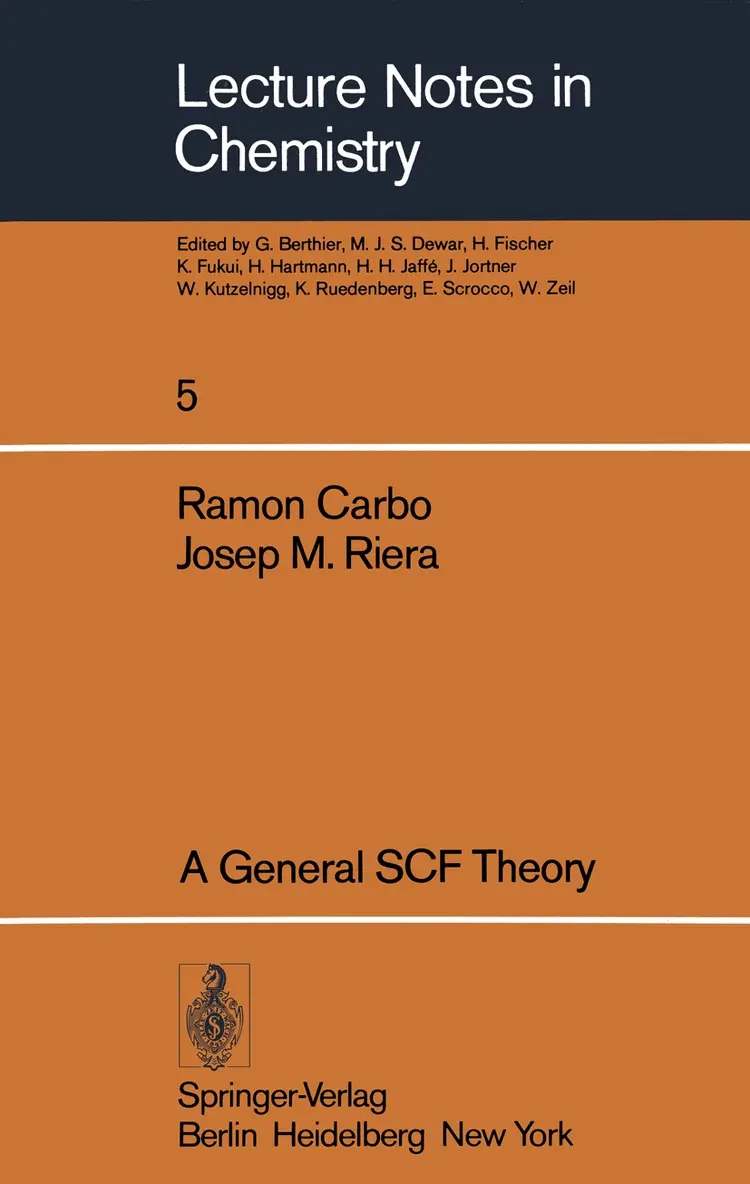
    General SCF Theory

    AvRamon Carbo,Joseph M. Riera

    Häftad, Engelska, 1978

    Del 5 i serien Lecture Notes in Chemistry

    546 kr

    Beställningsvara. Skickas inom 10-15 vardagar. Fri frakt över 249 kr.

    Beskrivning

    We live in a molecular world, almost closed shell in nature, and for this reason Chemistry has been a science dealing with closed shell mol­ ecules. However, the high degree of experimental sophistication reached in the past decade has made more apparent the role of open shell structures in chemical research. A parallel phenomenon can be observed in the development of SCF theory, where closed shell molecular calculations at any level of complexity compose the main body of references which can be obtained in Quantum Chemistry today. Besides the linkage between experimental and theoretical behaviour, there are, obviously, other reasons which can be attached to a lack of molecular open shell calculations. Among others, there was no connec­ tionbetween closed or open shell theoretical treatments. In this manner, many computational features used by closed shell connoisseurs have not been extended to other computational areas. Since the work of Roothaan in 1960, the open shell molecular landscape has been, the­ oretically, a very closed one. Further development of SCF theory, which has led to an outburst of multiconfigurational procedures, has paid no, or very faint, attention to the interconnection between these SCF theory advanced features, the open shell framework and closed shell common practice. A good theoretical goal, generally speaking, and in particular inside SCF theory, may consist of a procedure which can be used to solve a given chemical problem, within the physical and approx­ imate limits of the theory.

    Produktinformation

    • Utgivningsdatum:1978-01-01
    • Mått:155 x 235 x 13 mm
    • Vikt:347 g
    • Format:Häftad
    • Språk:Engelska
    • Serie:Lecture Notes in Chemistry
    • Antal sidor:210
    • Förlag:Springer-Verlag Berlin and Heidelberg GmbH & Co. KG
    • ISBN:9783540085355

    Utforska kategorier

    • Fysikalisk kemi inom Naturvetenskap och teknik

    Innehållsförteckning

    • I. Historical Review.- 1. The Open Shell Development.- 2. The Multiconfigurational Scheme.- II. Electronic Energy, Fock Operators and Coupling Operators.- 1. Introduction.- 2. General Energy Expression.- 3. General Coulomb and Exchange Operators.- 4. Energy and Lagrangian Variation: Fock Operators and Euler Equations.- 5. Coupling Operator.- 6. Null Gradient Coupling Operator Part.- 7. Lagrange multipliers Hermitean Condition Coupling Operator Part.- 8. LCAO Form of Coupling Operator.- 9. Simplified Energy Forms. Monoconfigurational Open Shell.- 10. Closed Shell.- 11. Corollary.- III. Eigenspace Manipulations.- 1. Introduction.- 2. General Formalism.- 3. Unconditional Convergence in SCF Procedures: Level Shift Techniques.- IV. Multiconfigurational Structure of Monoconfigurational SCF Procedures.- 1. Monoconfigurational Energy and Euler Equations.- 2. Results.- 3. Final Remarks.- V. Paired Excitation Multiconfigurational SCF.- 1. Closed Shell MCPESCF Theory.- 2. Complete MCPE Energy Expression.- 3. Two Electron Systems.- 4. MCPESCF Theory with an Invariant Closed Shell.- 5. Open Shell PEMCSCF.- 6. Special Cases.- VI. SCF Perturbation Theory.- 1. Perturbation Theory.- 2. Open Shell SCF Theory.- 3. Interaction of Two Molecules as an Application Example.- VII. General Theory for Two and Three Electron Systems.- 1. Two Electron Systems.- 2. Three Electron Systems.- VIII. Approximate SCF Theories.- 1. Atomic Orbital Representation.- 2. Decomposition of the Electronic Repulsion Matrix.- 3. Empirical Approximate Methods.- 4. Model Potentials: Huzinaga’s Approach.- IX. Miscellaneous Remarks.- 1. A Synthetic Approach.- 2. The Concept of Shell.- 3. Symmetry.- 4. Optimization of Non-Linear Parameters.- 5. Generalized Brillouin’s Theorem and Off-Diagonal Hermitean Conditions onLagrange Multipliers.- 6. Error Analysis.- 7. Mathematical Structure of SCF.- X. The Problem of the Helium Atom First Excited Singlet State.- 1. A Possible Solution.- 2. The “Triplet Catastrophe”.- 3. Further Analysis of the “The Triplet Catastrophe”.- 4. Some Results on Monoconfigurational He SCF.- XI. Applications.- 1. Introduction.- 2. SCF Study of Water: Ground and Excited States.- 3. Paired Excitation Calculation on Water.- 4. Formaldehyde.- 5. Magnesium Oxyde.- 6. Nitrogen Dioxyde.- 7. Methanol.- 8. Diimine.- 9. Methylenimine.- 10. Glycine.- 11. Excited States of Some Molecules with C=O and C=N Bonds: INDO Procedure.- Appendix A: Monoconfigurational State Parameters.- Appendix B: Slater Rules.- Appendix C: Multiconfigurational Fock Operators.- Suggested Reading.- Bibliographical Survey.- A. Open Shell SCF Theory.- B. Multiconfigurational SCF Theory.