• Fri frakt över 249 kr
  • •
  • Snabba leveranser
  • •
  • Billiga böcker
Kundservice

Du är på sajten för privatpersoner.

Företag, bibliotek eller offentlig verksamhet?

Du handlar på classic.bokus.com, där alla dina funktioner finns intakta.
Till classic.bokus.com
Bokus logotyp. Gå till startsidan.
  • Erbjudanden
  • Nyheter
  • Student
  • Topplistor
  • Barn & ungdom
  • Bokus Play
  • E-böcker
  • Pocketböcker
  • Spel & pussel

10% rabatt på allt med kod NYSTART10 →

Sidfot

Mina sidor

    Hjälp

    • Kundservice
    • Vanliga frågor och svar
    • Frakt och leverans
    • Retur vid ångerrätt
    • Reklamera vara
    • Betalning
    • Köpvillkor
    • Allmänna villkor
    • Information om webbplatsens tillgänglighet

    Om Bokus

    • Om oss
    • Pressrum
    • För studenter
    • För företag
    • För bibliotek och offentlig verksamhet
    • För leverantörer
    • Hållbarhet

    Populärt

    • Aktuella erbjudanden
    • Presentkort
    • Studentlitteratur
    • Nya böcker
    • Topplistor
    • Signerade böcker
    • Engelska böcker

    Inspiration

    • Boktips
    • BookTok
    • Populära bokserier
    • Barnbokskaraktärer
    • Populära författare
    Logotyp för Bokus
    Följ oss på Facebook (extern länk)Följ oss på Instagram (extern länk)Följ oss på YouTube (extern länk)Följ oss på TikTok (extern länk)
    bokus @ CookiesAnpassa cookiesIntegritetspolicyKöpvillkor
    Till Citymail hemsida (extern länk)Till Budbee hemsida (extern länk)Till Postnord hemsida (extern länk)Till Schenker hemsida (extern länk)Till Early Bird hemsida (extern länk)Till Walleys hemsida (extern länk)
    1. Naturvetenskap och teknik
    2. Matematik och naturvetenskap
    3. Kemi
    4. Fysikalisk kemi

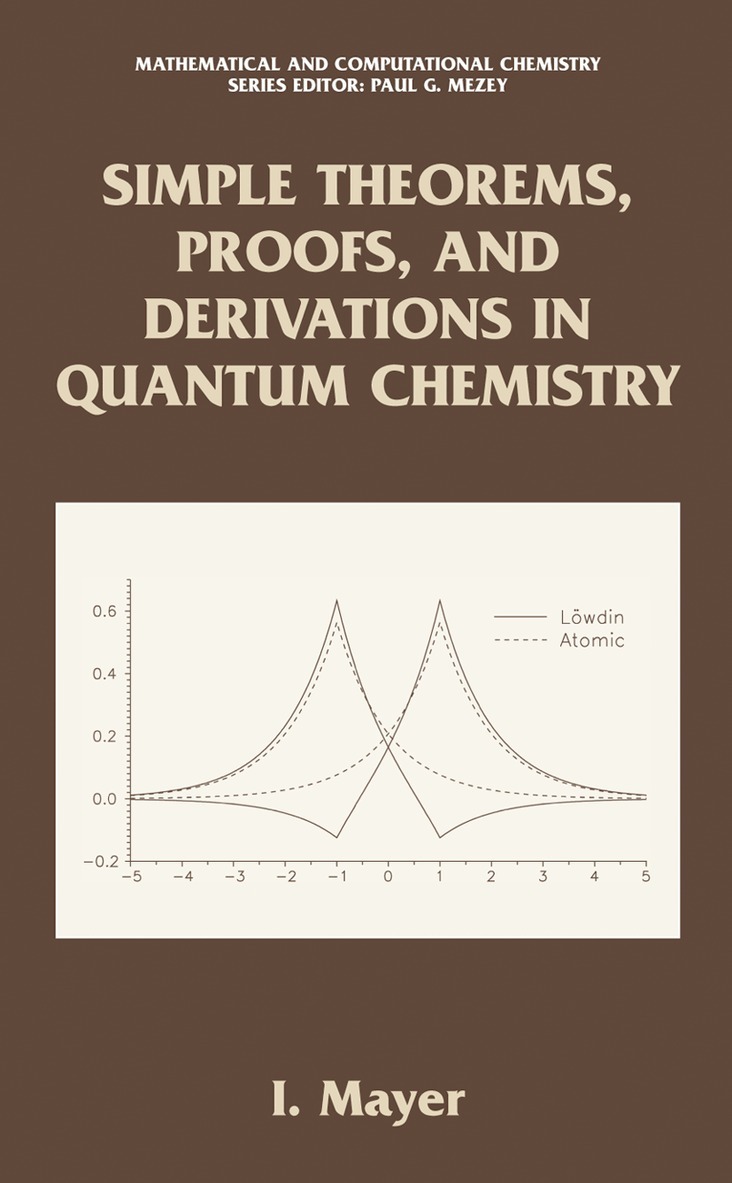
    Simple Theorems, Proofs, and Derivations in Quantum Chemistry

    AvIstvan Mayer

    Häftad, Engelska, 2010

    Del i serien Mathematical and Computational Chemistry

    2 164 kr

    Beställningsvara. Skickas inom 10-15 vardagar. Fri frakt över 249 kr.

    Fler format och utgåvor

    Inbunden

    2 380 kr

    E-bok

    3 045 kr

    Beskrivning

    Since 1983 I have been delivering lectures at Budapest University that are mainly attended by chemistry students who have already studied quantum chem­ istry in the amount required by the (undergraduate) chemistry curriculum of the University, and wish to acquire deeper insight in the field, possibly in prepara­ tion of a master's or Ph.D. thesis in theoretical chemistry. In such a situation, I have the freedom to discuss, in detail, a limited number of topics which I feel are important for one reason or another. The exact coverage may vary from year to year, but I usually concentrate on the general principles and theorems and other basic theoretical results which I foresee will retain their importance despite the rapid development of quantum chemistry. I commonly organize my lectures by treating the subject from the begin­ ning, without referring explicitly to any actual previous knowledge in quantum chemistry-only some familiarity with its goals, approaches and, to a lesser ex­ tent, techniques is supposed. I concentrate on the formulae and their derivation, assuming the audience essentially understands the reasons for deriving these results. This book is basically derived from the material of my lectures. The spe­ cial feature, distinguishing it from most other textbooks, is that all results are explicitly proved or derived, and the derivations are presented completely, step by step. True understanding of a theoretical result can be achieved only if one has gone through its derivation.

    Produktinformation

    • Utgivningsdatum:2010-12-06
    • Mått:178 x 254 x 20 mm
    • Vikt:663 g
    • Format:Häftad
    • Språk:Engelska
    • Serie:Mathematical and Computational Chemistry
    • Antal sidor:337
    • Förlag:Springer-Verlag New York Inc.
    • ISBN:9781441933898

    Utforska kategorier

    • Fysikalisk kemi inom Naturvetenskap och teknik
    • Fysik inom Naturvetenskap och teknik
    • Kvantfysik inom Naturvetenskap och teknik

    Innehållsförteckning

    • 1. The Born-Oppenheimer Hamiltonian.- 2. General Theorems and Principles.- 3. The Linear Variational Method and Löwdin’s Orthogonalization Schemes.- 4. Perturbational Methods.- 5. Determinant Wave Functions.- 6. The Hartree-Fock Method.- 7. Population Analysis, Bond Orders, and Valences.- 8. The Electron Correlation.- 9. Miscellaneous.- Appendices.- I. Separating the motion of the center of mass in classical mechanics.- II. Reducing the two-body problem to two one-body ones in classical mechanics.- III. Analogy between differentials and variations.- IV. Euler’s theorem for homogenous functions.- V. The virial theorem in classical mechanics.- VI. The electronic Schrödinger equation in atomic units.- VII. The “bra-ket” formalism.- 1. Dirac’s “bra” and “ket” vectors.- 2. Analogy with the matrix formalism.- 3. The use of an overlapping basis.- 4. Example of using the bra-ket formalism: The hypervirial theorem.- 5. Projection operators.- 6. Resolution of identity.- 7. Spectral resolution of Hermitian operators.- 8. The case of non-Hermitian operators—biorthogonal sets of functions.- 9. The trace of the projector.- VIII. Collection of formulas for Rayleigh-Schrödinger perturbation theory (nondegenerate case).- IX. Direct products of matrices.- X. Permutations.- XI. An orthogonalization algorithm.