Rice University Campbell Lectures - Böcker
Visar alla böcker i serien Rice University Campbell Lectures. Handla med fri frakt och snabb leverans.
7 produkter
7 produkter
284 kr
Skickas inom 11-20 vardagar
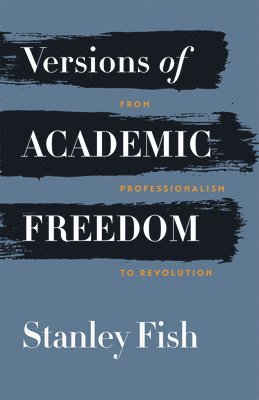
Through his columns in the New York Times and his numerous best-selling books, Stanley Fish has established himself as our foremost public analyst of the fraught intersection of academia and politics. Here Fish for the first time turns his full attention to one of the core concepts of the contemporary academy: academic freedom. Depending on who's talking, academic freedom is an essential bulwark of democracy, an absurd fig leaf disguising liberal agendas, or, most often, some in-between muddle that both exaggerates its own importance and misunderstands its actual value to scholarship. Fish enters the fray with his typical clear-eyed, no-nonsense analysis. The crucial question, he says, is located in the phrase "academic freedom" itself: Do you emphasize "academic" or "freedom"? The former, he shows, suggests a limited, professional freedom, while the conception of freedom implied by the latter could expand almost infinitely. Guided by that distinction, Fish analyzes various arguments for the value of academic freedom: Is academic freedom a contribution to society's common good? Does it authorize professors to critique the status quo, both inside and outside the university?Does it license and even require the overturning of all received ideas and policies? Is it an engine of revolution? Are academics inherently different from other professionals? Or is academia just a job, and academic freedom merely a tool for doing that job? No reader of Fish will be surprised by the deftness with which he dismantles weak arguments, corrects misconceptions, and clarifies muddy arguments. And while his conclusion - that academic freedom is simply a tool, an essential one, for doing a job - may surprise, it is unquestionably bracing. Stripping away the mystifications that obscure academic freedom allows its beneficiaries to concentrate on what they should be doing: following their intellectual interests and furthering scholarship.
241 kr
Skickas inom 7-10 vardagar
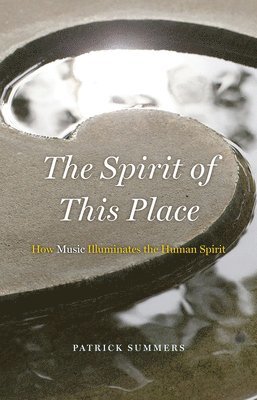
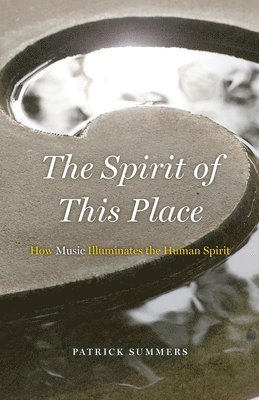
Artists today are at a crossroads. With funding for the arts and humanities endowments perpetually under attack, and school districts all over the United States scrapping their art curricula altogether, the place of the arts in our civic future is uncertain to say the least. At the same time, faced with the problems of the modern world—from water shortages and grave health concerns to global climate change and the now constant threat of terrorism—one might question the urgency of this waning support for the arts. In the politically fraught world we live in, is the “felt” experience even something worth fighting for?In this soul-searching collection of vignettes, Patrick Summers gives us an adamant, impassioned affirmative. Art, he argues, nurtures freedom of thought, and is more necessary now than ever before.As artistic director of the Houston Grand Opera, Summers is well positioned to take stock of the limitations of the professional arts world—a world where the conversation revolves almost entirely around financial questions and whose reputation tends toward elitism—and to remind us of art’s fundamental relationship to joy and meaning. Offering a vehement defense of long-form arts in a world with a short attention span, Summers argues that art is spiritual, and that music in particular has the ability to ask spiritual questions, to inspire cathartic pathos, and to express spiritual truths. Summers guides us through his personal encounters with art and music in disparate places, from Houston’s Rothko Chapel to a music classroom in rural China, and reflects on musical works he has conducted all over the world. Assessing the growing canon of new operas performed in American opera houses today, he calls for musical artists to be innovative and brave as opera continues to reinvent itself.This book is a moving credo elucidating Summers’s belief that the arts, especially music, help us to understand our own humanity as intellectual, aesthetic, and ultimately spiritual.
146 kr
Skickas inom 7-10 vardagar
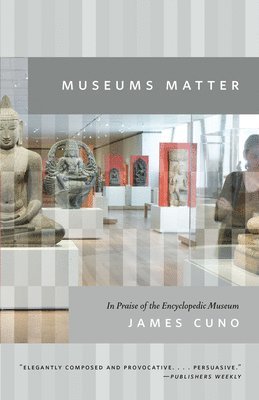
The concept of an encyclopedic museum was born of the enlightenment, a manifestation of European society's growing belief that the spread of knowledge, promotion of intellectual inquiry, and trust in individual agency were crucial to human development and the future of a rational society. But in recent years, encyclopedic museums have been under attack as little more than relics and promoters of imperialism. Could it be that the encyclopedic museum has outlived its usefulness? With Museums Matter, James Cuno, president and CEO of the J. Paul Getty Trust and former president and director of the Art Institute of Chicago, replies with a resounding "No!" He takes us on a brief tour of the modern museum, from the creation of the British Museum - the archetypal encyclopedic collection - to the present, when major museums host millions of visitors annually and play a significant role in the cultural lives of their cities.Along the way, Cuno acknowledges the legitimate questions about the role of museums in nation building and imperialism, but he argues strenuously that even a truly national museum like the Louvre can't help but open visitors' eyes and minds to the wide diversity of world cultures and the stunning art that is our common heritage. Ultimately Cuno makes a powerful case for the encyclopedic museum as a truly cosmopolitan institution, promoting tolerance, understanding, and a shared sense of history-values that are essential in our ever more globalized age.
161 kr
Skickas inom 7-10 vardagar
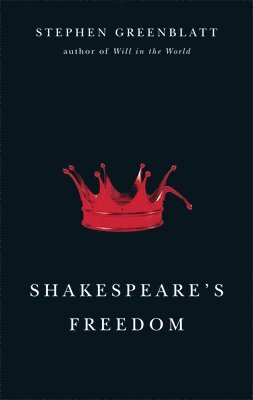
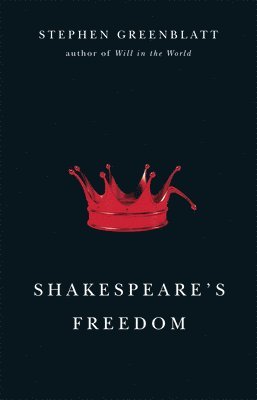
Shakespeare lived in a world of absolutes - the absolute authority claimed for God over the world, for the holy scriptures over the faithful, monarchs over subjects, fathers over wives and children, men over women, the old over the young, and the gentle over the baseborn. With the elegance and verve for which he is well known, Stephen Greenblatt, author of the best-selling "Will in the World", shows that Shakespeare was strikingly averse to such absolute claims and constantly probed the possibility of freedom from them. Greenblatt explores this rich theme by addressing four of Shakespeare's preoccupations across all the genres in which he worked: beauty, hatred, authority, and autonomy. He considers Shakespeare's challenge to the cult of featureless perfection, his sense of the inherent limits of murderous hatred, his awareness of the ethical ambiguity of power, and his doubt that artists, guided by distinctive forms of perception, were at liberty to create without constraints of any kind.A book that could only have been written by Stephen Greenblatt, "Shakespeare's Freedom" is a wholly original and eloquent meditation by the most acclaimed and influential Shakespearean of our time.
143 kr
Skickas inom 7-10 vardagar
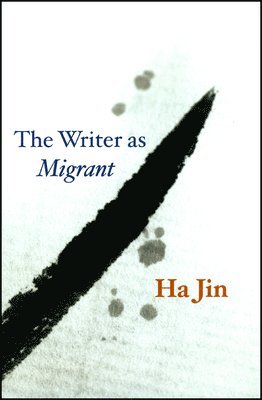
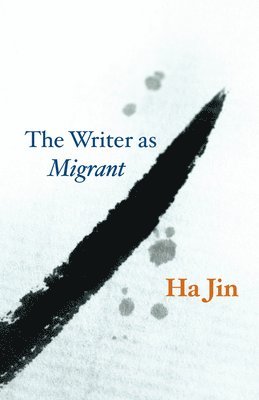
As a teenager during China's Cultural Revolution, Ha Jin served as an uneducated soldier in the People's Liberation Army. Thirty years later, a resident of the United States, he won the National Book Award for his novel "Waiting", completing a trajectory that has established him as one of the most admired exemplars of world literature.Ha Jin's journey raises rich and fascinating questions about language, migration, and the place of literature in a rapidly globalizing world - questions that take center stage in "The Writer as Migrant", his first work of nonfiction. Consisting of three interconnected essays, this book sets Ha Jin's own work and life alongside those of other literary exiles, creating a conversation across cultures and between eras. He employs the cases of Aleksandr Solzhenitsyn and Chinese novelist Lin Yutang to illustrate the obligation a writer feels to the land of his birth, while Joseph Conrad and Vladimir Nabokov - who, like Ha Jin, adopted English for their writing - are enlisted to explore a migrant author's conscious choice of a literary language.A final essay draws on V. S.Naipaul and Milan Kundera to consider the ways in which our era of perpetual change forces a migrant writer to reconceptualize the very idea of home. Throughout, Jin brings other celebrated writers into the conversation as well, including W. G. Sebald, C. P. Cavafy, and Salman Rushdie - refracting and refining the very idea of a literature of migration.Simultaneously a reflection on a crucial theme and a fascinating glimpse at the writers who compose Ha Jin's mental library, "The Writer as Migrant" is a work of passionately engaged criticism, one rooted in departures but feeling like a new arrival.
179 kr
Skickas inom 7-10 vardagar
Artists today are at a crossroads. With funding for the arts and humanities endowments perpetually under attack, and school districts all over the United States scrapping their art curricula altogether, the place of the arts in our civic future is uncertain to say the least. At the same time, faced with the problems of the modern world—from water shortages and grave health concerns to global climate change and the now constant threat of terrorism—one might question the urgency of this waning support for the arts. In the politically fraught world we live in, is the “felt” experience even something worth fighting for?In this soul-searching collection of vignettes, Patrick Summers gives us an adamant, impassioned affirmative. Art, he argues, nurtures freedom of thought, and is more necessary now than ever before.As artistic director of the Houston Grand Opera, Summers is well positioned to take stock of the limitations of the professional arts world—a world where the conversation revolves almost entirely around financial questions and whose reputation tends toward elitism—and to remind us of art’s fundamental relationship to joy and meaning. Offering a vehement defense of long-form arts in a world with a short attention span, Summers argues that art is spiritual, and that music in particular has the ability to ask spiritual questions, to inspire cathartic pathos, and to express spiritual truths. Summers guides us through his personal encounters with art and music in disparate places, from Houston’s Rothko Chapel to a music classroom in rural China, and reflects on musical works he has conducted all over the world. Assessing the growing canon of new operas performed in American opera houses today, he calls for musical artists to be innovative and brave as opera continues to reinvent itself.This book is a moving credo elucidating Summers’s belief that the arts, especially music, help us to understand our own humanity as intellectual, aesthetic, and ultimately spiritual.
116 kr
Skickas inom 7-10 vardagar
National Book Award winner Ha Jin raises questions about language, migration, and the place of literature in a rapidly globalizing world.Consisting of three interconnected essays, The Writer as Migrant sets Ha Jin’s own work and life alongside those of other literary exiles, creating a conversation across cultures and between eras. He employs the cases of Alexander Solzhenitsyn and Chinese novelist Lin Yutang to illustrate the obligation a writer feels to the land of their birth, while Joseph Conrad and Vladimir Nabokov—who, like Ha Jin, adopted English for their writing—are enlisted to explore a migrant author’s conscious choice of a literary language. A final essay draws on V. S. Naipaul and Milan Kundera to consider the ways in which our era of perpetual change forces a migrant writer to reconceptualize the very idea of home. Throughout, Jin brings other celebrated writers into the conversation as well, including W. G. Sebald, C. P. Cavafy, and Salman Rushdie—refracting and refining the very idea of a literature of migration.Simultaneously a reflection on a crucial theme and a fascinating glimpse at the writers who compose Ha Jin’s mental library, The Writer as Migrant is a work of passionately engaged criticism, one rooted in departures but feeling like a new arrival.