Roman Studies: Interdisciplinary Approaches - Böcker
Visar alla böcker i serien Roman Studies: Interdisciplinary Approaches. Handla med fri frakt och snabb leverans.
6 produkter
6 produkter
1 442 kr
Skickas inom 5-8 vardagar
Reading Rivers is the first book in a new series: Roman Studies: Interdisciplinary Approaches. Author Prudence Jones examines rivers as a literary phenomenon, particularly in the poetry of Vergil. The point of such an investigation is twofold: an examination of Vergil’s poetry elucidates particularly clearly a point about rivers: that their inclusion functions almost as a literary device, and an examination of rivers makes a point about Vergil: that rivers are essential to understanding the trajectory of his works, in particular the structure of the Aeneid. This study depends primarily on the close analysis of the poetry of Vergil and of other relevant authors. In Part I Jones examines the Greco-Roman understanding of the river in its primary symbolic roles: cosmological, ritual and ethnographical. Part II analyzes the river as a literary device, with particular attention to the works of Vergil, and argues that descriptions of rivers in Roman poetry are, in many cases, a form of authorial comment on the progress or structure of a narrative. Jones gives scholars in the classics, and literary critics who focus specifically on Roman antiquity a special prism through which to view the works of Vergil as well as other significant authors. This book is also for those working in the fields of cultural studies, cultural geography, and ancient philosophy.
712 kr
Skickas inom 5-8 vardagar
Reading Rivers is the first book in a new series: Roman Studies: Interdisciplinary Approaches. Author Prudence Jones examines rivers as a literary phenomenon, particularly in the poetry of Vergil. The point of such an investigation is twofold: an examination of Vergil’s poetry elucidates particularly clearly a point about rivers: that their inclusion functions almost as a literary device, and an examination of rivers makes a point about Vergil: that rivers are essential to understanding the trajectory of his works, in particular the structure of the Aeneid. This study depends primarily on the close analysis of the poetry of Vergil and of other relevant authors. In Part I Jones examines the Greco-Roman understanding of the river in its primary symbolic roles: cosmological, ritual and ethnographical. Part II analyzes the river as a literary device, with particular attention to the works of Vergil, and argues that descriptions of rivers in Roman poetry are, in many cases, a form of authorial comment on the progress or structure of a narrative. Jones gives scholars in the classics, and literary critics who focus specifically on Roman antiquity a special prism through which to view the works of Vergil as well as other significant authors. This book is also for those working in the fields of cultural studies, cultural geography, and ancient philosophy.
1 531 kr
Skickas inom 5-8 vardagar
Intercepted Letters examines the phenomenon of epistolarity within a range of classical Greek and Roman texts, with a focus on letters as symbols for larger, culturally constructed processes of reading, writing, and interpretation. In addition, it analyzes how the epistolary form occasionally problematizes—for lack of a better word—the introduction of the technology of writing into cultures already heavily implicated in the authority of the spoken, or sung, word. The methods of intertextuality and reader-response theory that have so revolutionized other aspects of classical scholarship have not, in the main, been applied to epistolarity studies; studies of epistolarity have instead tended to focus on individual collections: Cicero's letters, Pliny's letters, Plato's letters. Epistolarity that occurs in larger narrative contexts (such as tragedy, oratory, and historiography) remains woefully under-theorized; moreover, a consistent thread in the introduction of epistolarity into non-epistolary contexts is that of a destabilizing or dislocating narrative device. Intercepted Letters argues that epistolarity has certain formal features that can be found evenoutside of epistolary collections, including the problematics of communication, an emphasis on authorial absence, a hypersensitivity to interpretation, and an implicit focus on power (who controls the voice?). These aspects are as integral to studies of epistolary episodes as sheep, flutes, shepherds, and amoebic poetry are to pastoral ones, and yet seem to be comparatively neglected, or else formulated as individual observances rather than a pattern. Intercepted Letters thus examines a number of epistolary tropes—in authors as wide-ranging as Euripides, Ovid, and the authors of the Historia Augusta—as it argues for the importance of epistolarity in analyzing the poetics of reading in the ancient world.
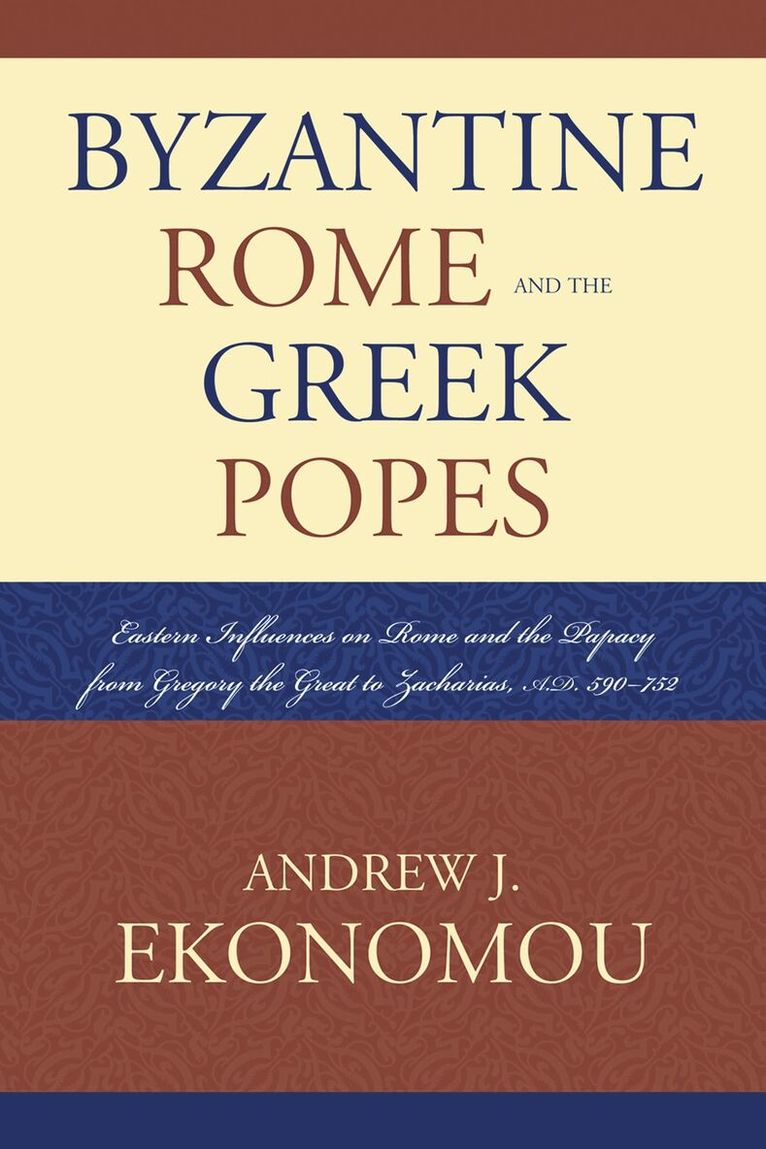
Byzantine Rome and the Greek Popes
Eastern Influences on Rome and the Papacy from Gregory the Great to Zacharias, A.D. 590-752
Inbunden, Engelska, 2007
1 719 kr
Skickas inom 5-8 vardagar
Byzantine Rome and the Greek Popes examines the scope and extent to which the East influenced Rome and the Papacy following the Justinian Reconquest of Italy in the middle of the sixth century through the pontificate of Zacharias and the collapse of the exarchate of Ravenna in 752.A combination of factors resulted in the arrival of significant numbers of easterners in Rome, and those immigrants had brought with them a number of eastern customs and practices previously unknown in the city. Greek influence became apparent in art, religious ceremonial and liturgics, sacred music, the rhetoric of doctrinal debate, the growth of eastern monastic communities, and charitable institutions, and the proliferation of the cults of eastern saints and ecclesiastical feast days and, in particular, devotion to the Theotokos or Mother of God. From the late seventh to the middle of the eighth century, eleven of the thirteen Roman pontiffs were the sons of families of eastern provenance.While conceding that over the course of the seventh century Rome indeed experienced the impact of an important Greek element, some scholars of the period have insisted that the degree to which Rome and the Papacy were "orientalized" has been exaggerated, while others argue that the extent of their "byzantinization" has not been fully appreciated. The question has also been raised as to whether Rome's oriental popes were responsible for sowing the seeds of separatism from Byzantium and laying the foundation for a future papal state, or whether they were loyal imperial subjects ever steadfast politically, although not always so in matters of the faith, to the reigning sovereign in Constantinople. Finally, there is the important issue of whether one could still speak of a single and undivided imperium Roman christianum in the seventh and early eighth centuries or whether the concept of imperial unity in the epoch following Gregory the Great was a quaint and fanciful fiction as East and West, ignoring and misunderstanding one ano
Byzantine Rome and the Greek Popes
Eastern Influences on Rome and the Papacy from Gregory the Great to Zacharias, A.D. 590-752
Häftad, Engelska, 2009
675 kr
Skickas inom 10-15 vardagar
Byzantine Rome and the Greek Popes examines the scope and extent to which the East influenced Rome and the Papacy following the Justinian Reconquest of Italy in the middle of the sixth century through the pontificate of Zacharias and the collapse of the exarchate of Ravenna in 752.A combination of factors resulted in the arrival of significant numbers of easterners in Rome, and those immigrants had brought with them a number of eastern customs and practices previously unknown in the city. Greek influence became apparent in art, religious ceremonial and liturgics, sacred music, the rhetoric of doctrinal debate, the growth of eastern monastic communities, and charitable institutions, and the proliferation of the cults of eastern saints and ecclesiastical feast days and, in particular, devotion to the Theotokos or Mother of God. From the late seventh to the middle of the eighth century, eleven of the thirteen Roman pontiffs were the sons of families of eastern provenance.While conceding that over the course of the seventh century Rome indeed experienced the impact of an important Greek element, some scholars of the period have insisted that the degree to which Rome and the Papacy were "orientalized" has been exaggerated, while others argue that the extent of their "byzantinization" has not been fully appreciated. The question has also been raised as to whether Rome's oriental popes were responsible for sowing the seeds of separatism from Byzantium and laying the foundation for a future papal state, or whether they were loyal imperial subjects ever steadfast politically, although not always so in matters of the faith, to the reigning sovereign in Constantinople. Finally, there is the important issue of whether one could still speak of a single and undivided imperium Roman christianum in the seventh and early eighth centuries or whether the concept of imperial unity in the epoch following Gregory the Great was a quaint and fanciful fiction as East and West, ignoring and misunderstanding one ano
1 314 kr
Skickas inom 10-15 vardagar
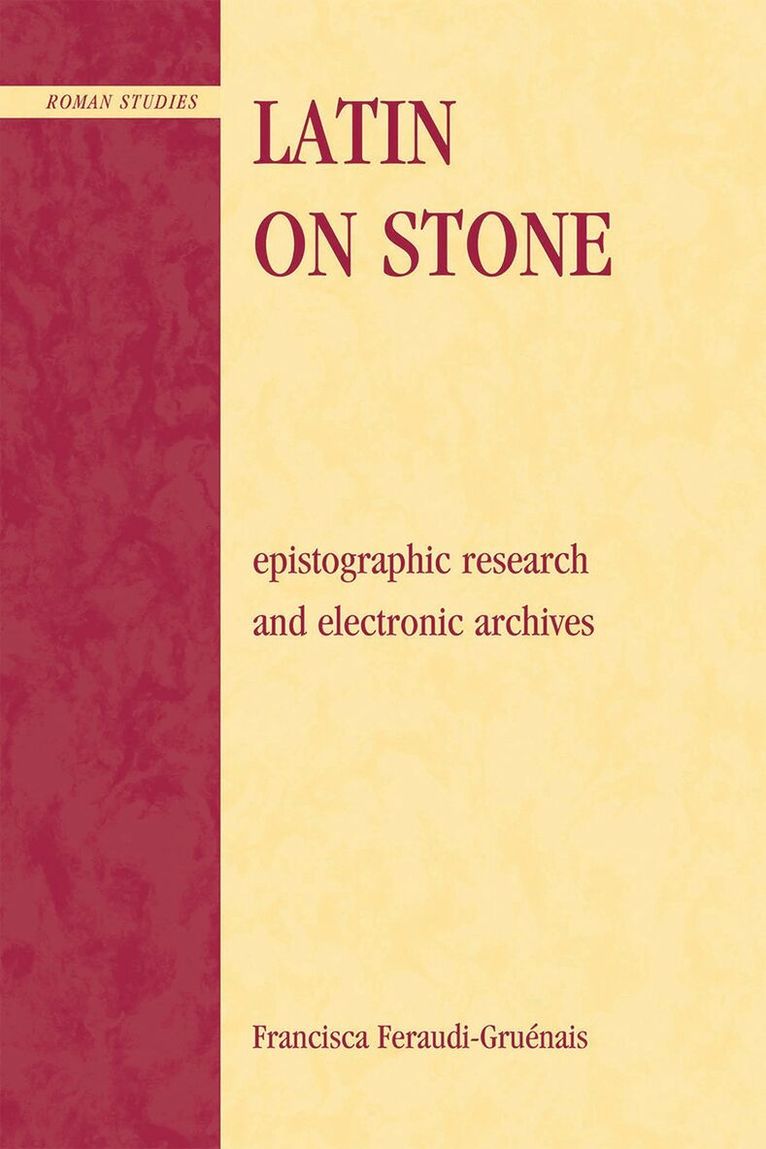
Latin on Stone brings together epigraphy scholars on both sides of the Atlantic, highlighting both their research in the field of ancient Latin inscriptions and the electronic technology of which they make use. These interdisciplinary essays reflect a contemporary reality, in which the possibilities and necessities of using modern electronic aids for research on ancient inscriptions can produce very differing results. Databases are an ideal means of making primary sources accessible and allowing scholars to draw well-founded conclusions in a short space of time, but their usefulness depends, of course, on the quality and accuracy of the data entered into them. The trend towards cooperation has been increasingly evident, in Latin epigraphy at least, over the last few years. Alongside these complex synergies, on the rise are interdisciplinary associations based on web-based data transfer. All of the new visions and achievements discussed in the volume can only be fully realized, however, if the traditional roots of epigraphy are maintained. Rather than being blinded by a sort of "electronic madness," scholars must recall the rich heritage of epigraphic transmission as a source of information that has yet to be exhausted. This volume is not only a plea for an increased use of modern (electronic) technology but also a warning against putting trust solely in such technology. It should come as no surprise, given the continuing process of globalization, that the contributors are drawn from both Europe and America. Each scholar is engaged in an attempt not only to scrutinize epigraphic culture afresh, but also to search for common denominators among such a variety of material. Their efforts will increase the diversity of the cross-linking of, and the search possibilities in, the data provided by epigraphic source material. It is a matter of strengthening, increasing, and contextualizing both the epigraphic sources and the data decoded from them.