Semiotics of Religion – Serie
Visar alla böcker i serien Semiotics of Religion. Handla med fri frakt och snabb leverans.
3 produkter
3 produkter
1 486 kr
Skickas inom 5-8 vardagar
The aim of this study is to present, as far as possible, a general description of the theory of the sign and signification in Augustine of Hippo (354-430 AD), with a view to its evaluation and implications for the study of semiotics. Accurate studies for subject, discipline, and significance have not yet given an organic and systematic vision of Augustine’s theory of the sign. The underlying aspiration is that such an endeavour will prove to be beneficial to the scholars of Augustine’s thought as well as to those with a keen interest in the history of semiotics. The study uses Augustine’s own accounts to investigate and interpret the philosophical problem of the sign. The focus lies on the first decade of Augustine’s literary production. The De dialectica, is taken as the terminus ad quo of the study, and the De doctrina christiana is the terminus ad quem. The selected texts show an explicit engagement with poignant discussion on the nature and structure of the sign, the variety of signs and their uses. Although Augustine’s intention never was to establish a theory of meaning as an independent field of study, he largely employed a theory of signs. Thus, Augustine’s approach to signs is intrinsically meaningful.
1 409 kr
Skickas inom 5-8 vardagar
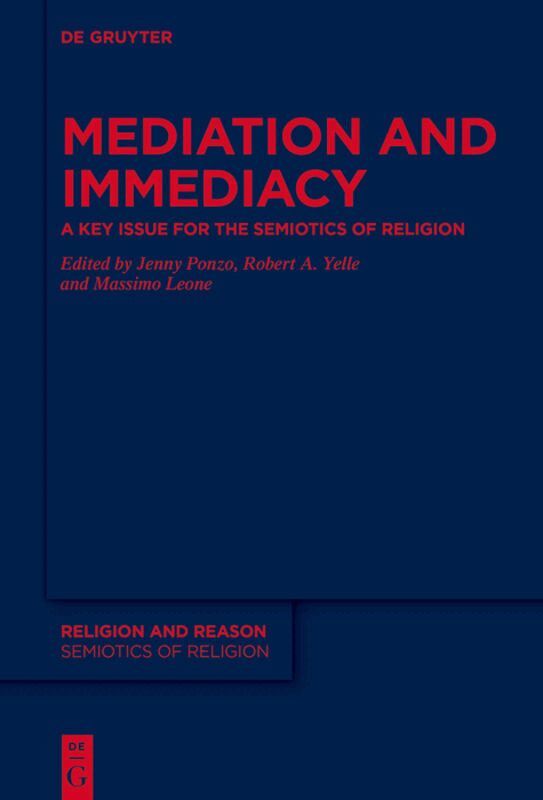
Religion, like any other domain of culture, is mediated through symbolic forms and communicative behaviors, which allow the coordination of group conduct in ritual and the representation of the divine or of tradition as an intersubjective reality. While many traditions hold out the promise of immediate access to the divine, or to some transcendent dimension of experience, such promises depend for their realization as well on the possibility of mediation, which is necessarily conducted through channels of communication and exchange, such as prayers or sacrifices. An understanding of such modes of semiosis is therefore necessary even and especially when mediation is denied by a tradition in the name of the 'ineffability" of the deity or of mystical experience. This volume models and promotes an interdisciplinary dialogue and cross-cultural perspective on these issues by asking prominent semioticians, historians of religion and of art, linguists, sociologists of religion, and philosophers of law to reflect from a semiotic perspective on the topic of mediation and immediacy in religious traditions.
Acts of Interpretation
Ancient Religious Semiotic Ideologies and Their Modern Echoes
Inbunden, Engelska, 2022
1 455 kr
Skickas inom 5-8 vardagar
Ancient authors debated proper verbal and non-verbal signs as representations of divinity. These understanding of signs were based on ideas drawn from language and thus limited due to a their partial understanding of the multi-functionality of signs. Charles S. Peirce’s semiotics, as adapted by anthropological linguists including Michael Silverstein, better explains the contextual linkages ("performativity") of ancient religious signs such as divine names. Sign meaning is always dependent on processes of interpretation and is always open to reinterpretation. Focusing on these processes permits a more detailed analysis of the ancient evidence. Examples are drawn from ancient Israelite verbal and non-verbal divine representation, the apostle Paul’s linguistic letter/spirit model, Christian debates about the limits of language to best represent the deity, Josephus’ aniconic advertisement of Jewish rites, the multi-layered divine representations in the Dura-Europos synagogue, the diverse "performativity" of Jewish ascent liturgies, and—the single modern example—the role of art at Burning Man. Divine representation is the basis for ritual efficacy even as sign meaning is a constant source of contention.