Sloan Technology - Böcker
Visar alla böcker i serien Sloan Technology. Handla med fri frakt och snabb leverans.
3 produkter
3 produkter
956 kr
Skickas inom 5-8 vardagar
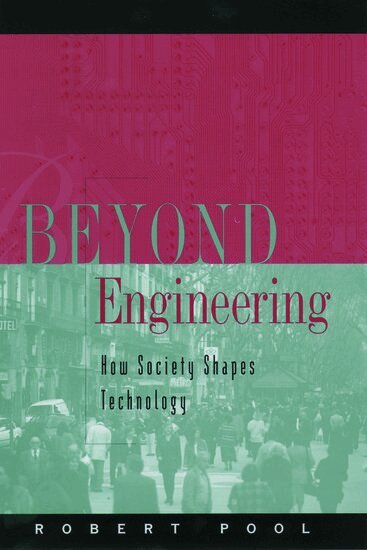
We have long recognized technology as a driving force behind much historical and cultural change. The invention of the printing press initiated the Reformation. The development of the compass ushered in the Age of Exploration and the discovery of the New World. The cotton gin created the conditions that led to the Civil War. Now, in Beyond Engineering, science writer Robert Pool turns the question around to examine how society shapes technology. Drawing on such disparate fields as history, economics, risk analysis, management science, sociology, and psychology, Pool illuminates the complex, often fascinating interplay between machines and society, in a book that will revolutionize how we think about technology. We tend to think that reason guides technological development, that engineering expertise alone determines the final form an invention takes. But if you look closely enough at the history of any invention, says Pool, you will find that factors unrelated to engineering seem to have an almost equal impact. In his wide-ranging volume, he traces developments in nuclear energy, automobiles, light bulbs, commercial electricity, and personal computers, to reveal that the ultimate shape of a technology often has as much to do with outside and unforeseen forces. For instance, Pool explores the reasons why steam-powered cars lost out to internal combustion engines. He shows that the Stanley Steamer was in many ways superior to the Model T--it set a land speed record in 1906 of more than 127 miles per hour, it had no transmission (and no transmission headaches), and it was simpler (one Stanley engine had only twenty-two moving parts) and quieter than a petrol engine--but the steamers were killed off by factors that had little or nothing to do with their engineering merits, including the Stanley twins' lack of business acumen and an outbreak of hoof-and-mouth disease. Pool illuminates other aspects of technology as well. He traces how seemingly minor decisions made early along the path of development can have profound consequences further down the road, and perhaps most important, he argues that with the increasing complexity of our technological advances--from nuclear reactors to genetic engineering--the number of things that can go wrong multiplies, making it increasingly difficult to engineer risk out of the equation. Citing such catastrophes as Bhopal, Three Mile Island, the Exxon Valdez, the Challenger, and Chernobyl, he argues that is it time to rethink our approach to technology. The days are gone when machines were solely a product of larger-than-life inventors and hard-working engineers. Increasingly, technology will be a joint effort, with its design shaped not only by engineers and executives but also psychologists, political scientists, management theorists, risk specialists, regulators and courts, and the general public. Whether discussing bovine growth hormone, molten-salt reactors, or baboon-to-human transplants, Beyond Engineering is an engaging look at modern technology and an illuminating account of how technology and the modern world shape each other.
1 888 kr
Skickas inom 5-8 vardagar
Fiber optic technology is revolutionizing telecommunications and thus our lives. Networks of opitcal fibers have spread around the world, opening the door to the possibility of a new information age, and spurring telephone and cable television companies into a billion-dollar race for control over the next generation of services and equipment. The story of this technology is fascinating complex, and largely untold. Hecht tells this story, from its beginning in 19th-century attempts to guide light, for purposes of illuminating the insides of the human body, to today's mysterious, ubiquitous communications technologies. We hear the crucial conversation in 1951 that led to the realization that optical fibers might conduct light if coated with a layer of transparent material. Hecht also describes the medical technologies developed in the 1960's, which allowed doctors to see inside patients' stomachs and better understand gastric disorders. And we learn of the race to develop fiber-optic technology that could control the laser, the brilliant concentrated beam that captured the imagination of the physics community. This history is meticulously detailed from beginning to end, allowing for explorations of experiments that now seem strange and even humorous, but nonetheless illuminate the origins of the technology. We get the whole story, including the huge range of contributing characters, accidents, and revolutionary ideas. The book is infused with the spirit of fascination and fun, and the reader will enjoy the story for its own sake, as well for the historical picture it provides of a technology on which we all depend.
278 kr
Skickas inom 5-8 vardagar
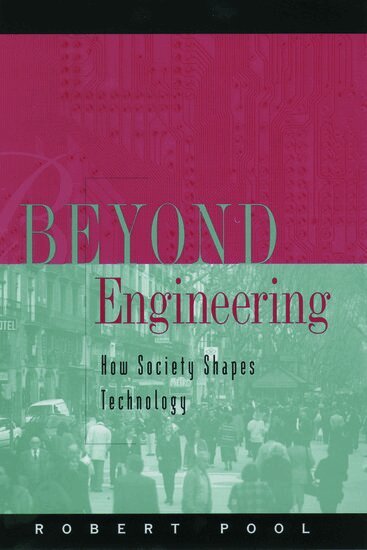
We have long recognized technology as a driving force behind much historical and cultural change. The invention of the printing press initiated the Reformation. The development of the compass ushered in the Age of Exploration and the discovery of the New World. The cotton gin created the conditions that led to the Civil War. Now, in Beyond Engineering, science writer Robert Pool turns the question around to examine how society shapes technology. Drawing on such disparate fields as history, economics, risk analysis, management science, sociology, and psychology, Pool illuminates the complex, often fascinating interplay between machines and society, in a book that will revolutionize how we think about technology. We tend to think that reason guides technological development, that engineering expertise alone determines the final form an invention takes. But if you look closely enough at the history of any invention, says Pool, you will find that factors unrelated to engineering seem to have an almost equal impact. In his wide-ranging volume, he traces developments in nuclear energy, automobiles, light bulbs, commercial electricity, and personal computers, to reveal that the ultimate shape of a technology often has as much to do with outside and unforeseen forces. For instance, Pool explores the reasons why steam-powered cars lost out to internal combustion engines. He shows that the Stanley Steamer was in many ways superior to the Model T--it set a land speed record in 1906 of more than 127 miles per hour, it had no transmission (and no transmission headaches), and it was simpler (one Stanley engine had only twenty-two moving parts) and quieter than a petrol engine--but the steamers were killed off by factors that had little or nothing to do with their engineering merits, including the Stanley twins' lack of business acumen and an outbreak of hoof-and-mouth disease. Pool illuminates other aspects of technology as well. He traces how seemingly minor decisions made early along the path of development can have profound consequences further down the road, and perhaps most important, he argues that with the increasing complexity of our technological advances--from nuclear reactors to genetic engineering--the number of things that can go wrong multiplies, making it increasingly difficult to engineer risk out of the equation. Citing such catastrophes as Bhopal, Three Mile Island, the Exxon Valdez, the Challenger, and Chernobyl, he argues that is it time to rethink our approach to technology. The days are gone when machines were solely a product of larger-than-life inventors and hard-working engineers. Increasingly, technology will be a joint effort, with its design shaped not only by engineers and executives but also psychologists, political scientists, management theorists, risk specialists, regulators and courts, and the general public. Whether discussing bovine growth hormone, molten-salt reactors, or baboon-to-human transplants, Beyond Engineering is an engaging look at modern technology and an illuminating account of how technology and the modern world shape each other.