SpringerBriefs in Entrepreneurship and Innovation – serie
Visar alla böcker i serien SpringerBriefs in Entrepreneurship and Innovation. Handla med fri frakt och snabb leverans.
10 produkter
10 produkter
Häftad, Engelska, 2014
610 kr
Skickas inom 10-15 vardagar
This book provides a concise introduction to important aspects of contemporary innovation policy, with particular emphasis on its impact on economic growth and development. It addresses a non-specialist audience interested in quickly building background knowledge, getting familiar with the terminology, and understanding core concerns and debates in this area of policy. The book has its origins in a more extensive report to the World Bank prepared to impart background information to middle- and upper-level policy decision-makers and analysts as well as stakeholders from industry and universities from developing countries prior to engaging in intensive “how-to” policy training. Our audience also includes upper-level undergraduate and graduate students embarking on the study of innovation policy.Featuring contributions from leading scholars and policy experts, this volume references critical readings presents a wide array of data, on the following topics:Fundamentals of Innovation Policy for Growth and Development University Entrepreneurship Strategic Alliances / Knowledge-Intensive Partnerships Clusters / Science Parks / Knowledge Business Incubators High Risk Finance Intellectual Property, Standards
Häftad, Engelska, 2019
556 kr
Skickas inom 10-15 vardagar
This volume examines the involvement of minority- or women-owned businesses in technology-based research, with particular focus on the differences in research outcomes in achieving commercialization.
Häftad, Engelska, 2019
646 kr
Skickas inom 10-15 vardagar
Using the automotive, healthcare and telecommunication industries as case studies, the authors create the value roadmap using five factors: market drivers, product features, technology features, enablers and resources.
Häftad, Engelska, 2020
556 kr
Skickas inom 10-15 vardagar
The concept of industry 4.0 is spreading worldwide and readiness models exist to determine organizational or national maturity. This book identifies the regional aspect of industry 4.0 and provides a regional (NUTS 2 classified) industry 4.0 indicator system model that is based on open data sources.
Häftad, Engelska, 2025
484 kr
Skickas inom 5-8 vardagar
In addition, a broad overview of contemporary entrepreneurial activities in the tourism industry in Ladakh is presented, underscoring the importance of indigenous knowledge and cultural traditions for developing sustainable tourism.
Häftad, Engelska, 2025
592 kr
Skickas inom 10-15 vardagar
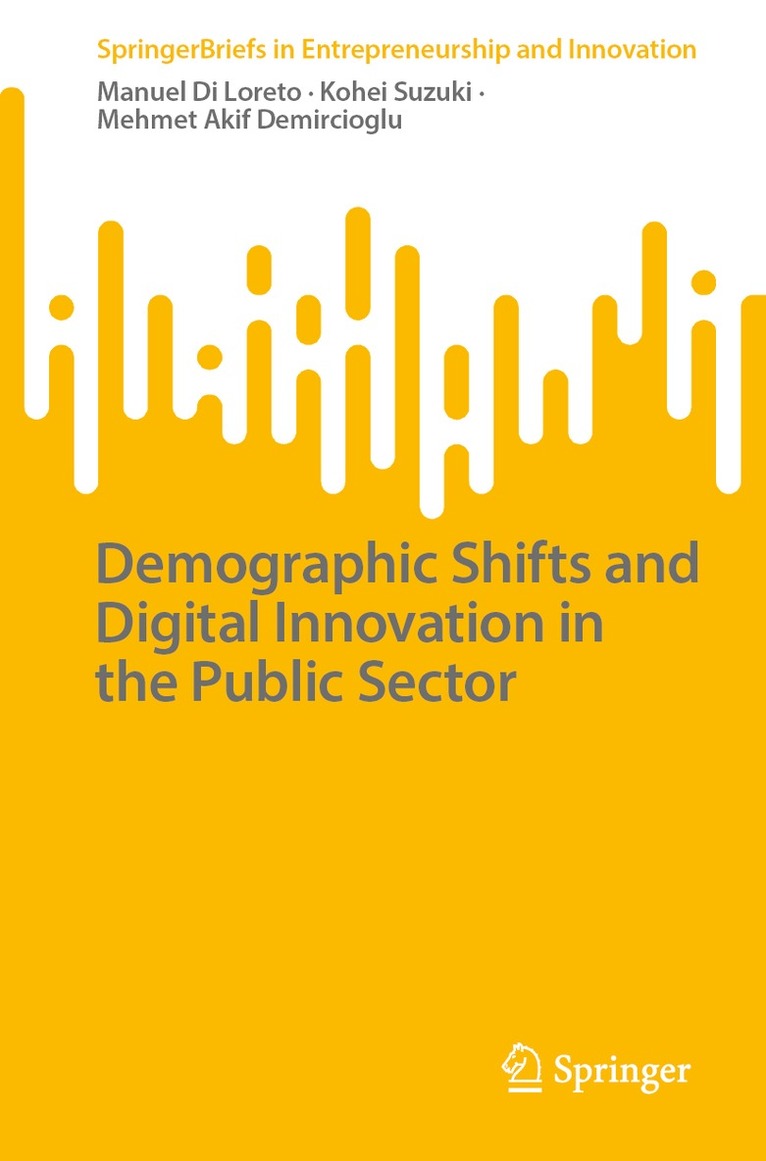
This book examines the impact of demographic decline on digital innovation in the public sector.
Häftad, Engelska, 2025
473 kr
Skickas inom 10-15 vardagar
This book explores the theoretical connections between time perspective (TP) and strategic and entrepreneurial cognition and entrepreneurial orientation. The author challenges the dominance of objective time (clock time) in management research, advocating for a focus on subjective time (psychological time) and individual-level analysis.
Häftad, Engelska, 2026
556 kr
Skickas inom 10-15 vardagar
The book serves as both a practical guide for managers looking to implement Open Innovation strategies and an authoritative reference for scholars conducting research in the field. Drawing on nearly two decades of combined academic and practitioner experience in entrepreneurship and open innovation, the authors offer a comprehensive, 360-degree perspective on the topic. Specifically, the book offers a fresh, up-to-date, and practice-driven perspective on how large corporations are implementing open innovation today, with a particular focus on startup collaboration and the most recent, real-world best practices.Leveraging privileged access to Mind the Bridge’s extensive activities - including proprietary research data, C-level executive interviews, and global events - this book offers strategies based on an analysis of various companies across sectors, and geographies that have started, scaled, evolved, reshaped, or even abandoned their open innovation journeys. The book helps corporate and startup executives/founders design, refine, and adapt their own open innovation strategies; identify the models that best fit their needs; understand the organizational and cultural conditions required; and, ultimately, track and measure results in a meaningful way.
Häftad, Engelska, 2014
665 kr
Skickas inom 10-15 vardagar
Today in most scientific and technical fields more than 90% of research studies and publications are collaborative, often resulting in high-impact research and development of commercial applications, as reflected in patents. Nowadays in many areas of science, collaboration is not a preference but, literally, a work prerequisite. The purpose of this book is to review and critique the burgeoning scholarship on research collaboration. The authors seek to identify gaps in theory and research and identify the ways in which existing research can be used to improve public policy for collaboration and to improve project-level management of collaborations using Scientific and Technical Human Capital (STHC) theory as a framework.Broadly speaking, STHC is the sum of scientific and technical and social knowledge, skills and resources embodied in a particular individual. It is both human capital endowments, such as formal education and training and social relations and network ties that bind scientists and the users of science together. STHC includes the human capital which is the unique set of resources the individual brings to his or her own work and to collaborative efforts. Generally, human capital models have developed separately from social capital models, but in the practice of science and the career growth of scientists, the two are not easily disentangled.Using a multi-factor model, the book explores various factors affecting collaboration outcomes, with particular attention on institutional factors such as industry-university relations and the rise of large-scale university research centers.
Häftad, Engelska, 2017
556 kr
Skickas inom 10-15 vardagar
This book examines the complex relationship between corruption and entrepreneurship in countries of varying levels of economic development. The authors explore the ways in which social welfare policies have changed in current economic and political environments as well as key challenges faced by the welfare policies. In addition, this book addresses three key questions with regard to the impact of corruption on institutions and social welfare:• Is corruption an additional burden in extensive regulatory environment on different types of entrepreneurship---necessity entrepreneurship, opportunity entrepreneurship, total entrepreneurial activity, self-employment, and newly registered firms? • Is corruption helpful for entrepreneurs who have aspiration to operate outside their home country border in highly regulated environment?• How does corruption affect income distribution generated through entrepreneurial activity? Entrepreneurship is an important factor for local and national economies as it generates employment and income that are crucial for economic development. Corruption can significantly influence the nature of decisions made by entrepreneurs, with profound effects on business creation, institutional development, and economic performance. For example, an entrepreneur with resources and networks might be able to influence the regulatory agencies to overlook violations, expedite permits, or bribe corrupt program administrators to violate the rules of distribution, exacerbating income inequality and obstructing economic growth and development. While corruption is not a new phenomenon, the current globalized economy has introduced trade into the corruption question as globalization puts pressure on countries to open borders to attract investments and gain a competitive advantage. However, many country level institutions do not always change as fast as the economic activity across borders, which can encourage corruption in order to bypass inefficient regulations and to successfully engage in entrepreneurship. The authors of the book examine this phenomenon. Featuring policy implications and case studies, this book will appeal to graduate students, academics, professionals, practitioners, and researchers in entrepreneurship, international business and public policy.