Barry Bozeman – författare
1 352 kr
Skickas inom 3-6 vardagar
693 kr
Läs direkt efter köp
632 kr
Skickas
1 043 kr
Skickas inom 10-15 vardagar
371 kr
Skickas inom 5-8 vardagar
305 kr
Skickas inom 5-8 vardagar
2 183 kr
Skickas inom 10-15 vardagar
667 kr
Skickas inom 10-15 vardagar
University-Industry R&D Collaboration in the United States, the United Kingdom, and Japan
1 086 kr
Skickas inom 10-15 vardagar
1 633 kr
Skickas inom 10-15 vardagar
1 432 kr
Skickas inom 5-8 vardagar
241 kr
Läs direkt efter köp
263 kr
Skickas inom 5-8 vardagar
241 kr
Läs direkt efter köp
790 kr
Läs direkt efter köp
790 kr
Läs direkt efter köp
485 kr
Läs direkt efter köp
Once upon a time, it was the lone scientist who achieved brilliant breakthroughs. No longer. Today, science is done in teams of as many as hundreds of researchers who may be scattered across continents and represent a range of hierarchies. These collaborations can be powerful, but they demand new ways of thinking about scientific research. When three hundred people make a discovery, who gets credit? How can all collaborators’ concerns be adequately addressed? Why do certain STEM collaborations succeed while others fail?Focusing on the nascent science of team science,The Strength in Numbers synthesizes the results of the most far-reaching study to date on collaboration among university scientists to provide answers to such questions. Drawing on a national survey with responses from researchers at more than one hundred universities, anonymous web posts, archival data, and extensive interviews with active scientists and engineers in over a dozen STEM disciplines, Barry Bozeman and Jan Youtie set out a framework to characterize different types of collaboration and their likely outcomes. They also develop a model to define research effectiveness, which assesses factors internal and external to collaborations. They advance what they have found to be the gold standard of science collaborations: consultative collaboration management. This strategy—which codifies methods of consulting all team members on a study’s key points and incorporates their preferences and values—empowers managers of STEM collaborations to optimize the likelihood of their effectiveness.The Strength in Numbers is a milestone in the science of team science and an indispensable guide for scientists interested in maximizing collaborative success.
467 kr
Skickas inom 5-8 vardagar
1 580 kr
Skickas inom 10-15 vardagar
1 992 kr
Läs direkt efter köp
443 kr
Skickas inom 5-8 vardagar
482 kr
Skickas inom 5-8 vardagar
467 kr
Läs direkt efter köp
Economic individualism and market-based values dominate today''s policymaking and public management circles—often at the expense of the common good. In his new book, Barry Bozeman demonstrates the continuing need for public interest theory in government. Public Values and Public Interest offers a direct theoretical challenge to the "utility of economic individualism," the prevailing political theory in the western world.
The book''s arguments are steeped in a practical and practicable theory that advances public interest as a viable and important measure in any analysis of policy or public administration. According to Bozeman, public interest theory offers a dynamic and flexible approach that easily adapts to changing situations and balances today''s market-driven attitudes with the concepts of common good advocated by Aristotle, Saint Thomas Aquinas, John Locke, and John Dewey.
In constructing the case for adopting a new governmental paradigm based on what he terms "managing publicness," Bozeman demonstrates why economic indices alone fail to adequately value social choice in many cases. He explores the implications of privatization of a wide array of governmental services—among them Social Security, defense, prisons, and water supplies. Bozeman constructs analyses from both perspectives in an extended study of genetically modified crops to compare the policy outcomes using different core values and questions the public value of engaging in the practice solely for the sake of cheaper food.
Thoughtful, challenging, and timely, Public Values and Public Interest shows how the quest for fairness can once again play a full part in public policy debates and public administration.
677 kr
Skickas inom 10-15 vardagar
896 kr
Läs direkt efter köp
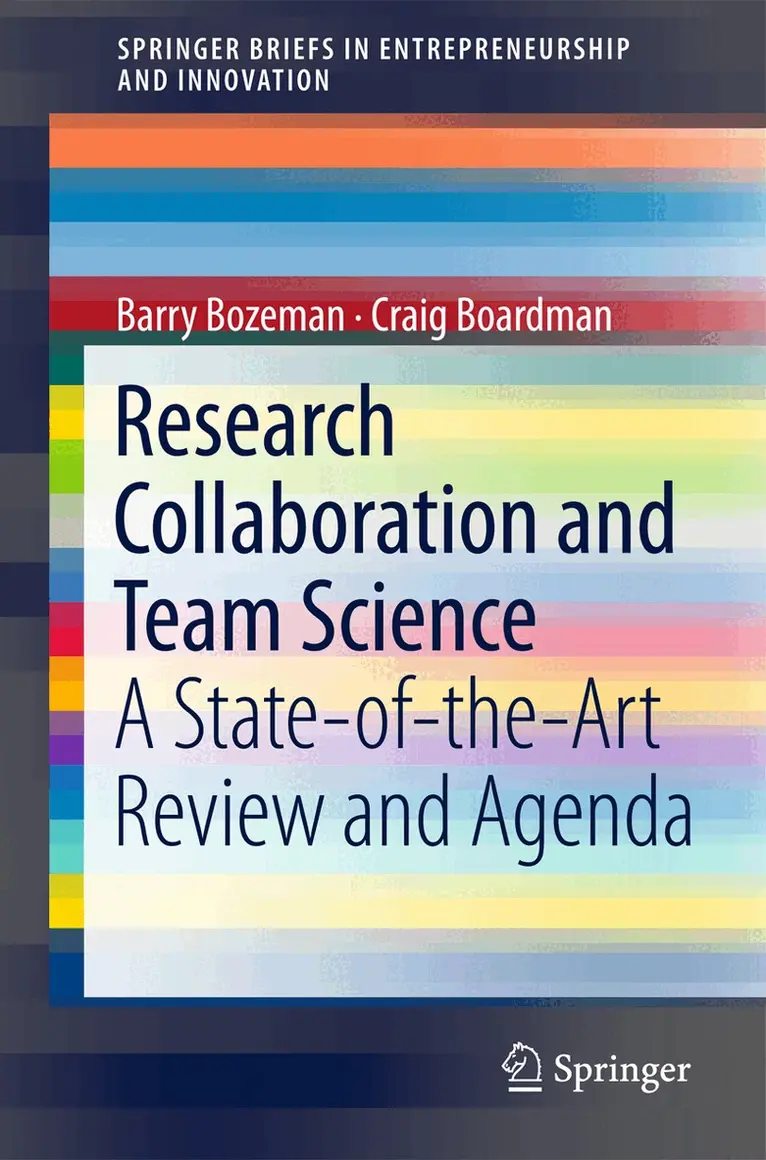
Today in most scientific and technical fields more than 90% of research studies and publications are collaborative, often resulting in high-impact research and development of commercial applications, as reflected in patents. Nowadays in many areas of science, collaboration is not a preference but, literally, a work prerequisite. The purpose of this book is to review and critique the burgeoning scholarship on research collaboration. The authors seek to identify gaps in theory and research and identify the ways in which existing research can be used to improve public policy for collaboration and to improve project-level management of collaborations using Scientific and Technical Human Capital (STHC) theory as a framework.
Broadly speaking, STHC is the sum of scientific and technical and social knowledge, skills and resources embodied in a particular individual. It is both human capital endowments, such as formal education and training and social relations and network ties that bind scientists and the users of science together. STHC includes the human capital which is the unique set of resources the individual brings to his or her own work and to collaborative efforts. Generally, human capital models have developed separately from social capital models, but in the practice of science and the career growth of scientists, the two are not easily disentangled.
Using a multi-factor model, the book explores various factors affecting collaboration outcomes, with particular attention on institutional factors such as industry-university relations and the rise of large-scale university research centers.
University-Industry R&D Collaboration in the United States, the United Kingdom, and Japan
1 060 kr
Skickas inom 10-15 vardagar
1 328 kr
Läs direkt efter köp