Stockholm Slavic studies – serie
Visar alla böcker i serien Stockholm Slavic studies. Handla med fri frakt och snabb leverans.
4 produkter
4 produkter
Del 38 - Stockholm Slavic studies
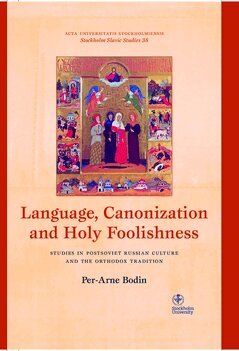
Language, canonization and holy foolishness : studies in Postsoviet Russian culture and the orthodox tradition
Häftad, Engelska, 2015
165 kr
Skickas inom 5-8 vardagar
What happens when the Russian Orthodox tradition meets post-Soviet Russia? This is the general question which will be in the focus of this study of the Orthodox discourse in post-Soviet Russian culture. It will be analyzed both in its own right and as a constituent of memory, a conservative or imperialist political attitude and postmodernism. One issue addressed is the debate over the use of Church Slavonic as the liturgical language. Another involves the nature of the canonizations that have taken place in the Orthodox Church in recent years and attempts to canonize the soldier Evgenij Rodionov and Stalin. A third topic is jurodstvo, or holy foolishness, for centuries a special and recurring theme in the Orthodox Church that has re-emerged after the fall of the Soviet Union. A chapter is devoted to Ksenija of Petersburg, a peculiar and much beloved holy fool of that city. A final issue concerns the significance of the Orthodox tradition in recent Russian art and poetry. Per-Arne Bodin is Professor of Slavic Languages at the Department of Slavic Languages and Literatures, Stockholm University.
Del 39 - Stockholm Slavic studies
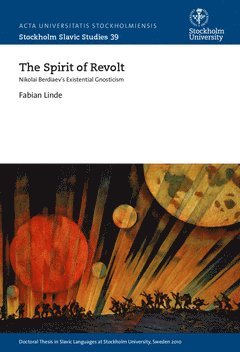
The spirit of revolt : Nikolai Berdiaev's existential gnosticism
Häftad, Engelska, 2015
133 kr
Skickas inom 5-8 vardagar
This is a study of the Russian religious philosopher Nikolai Berdiaev (1874-1948). Although practically forgotten in the West, Berdiaev is remembered in his country of origin as one of those brilliant and inspired proponents of the Orthodox revival that took place at the beginning of the 20th century, and also as a critic of Marxism. The aim of the thesis is to re-examine the alleged gnostic subtext in Berdiaev's thought by exploring a number of interrelated motifs in his world outlook, teaching on man and theory of knowledge. An interpretive framework, based on Hans Jonas's phenomenological elucidation of ancient Gnosticism, is used to investigate the topic. The results of the study suggest both affinities and divergences in the relationship between Berdiaev's thought and the framework used. It is argued that a suggestive affinity exists between Berdiaev's thought and ancient Gnosticism in the shared existential attitude towards self and world.
192 kr
Skickas inom 5-8 vardagar
The materials examined here consist of 121 Russian letters dating from 1700-1715. The present study aims to define a stage in linguistic evolution and analyze the morphological heterogeneity in the textual corpus. The letters are divided into three categories: private, semiofficial, and official. All nomina (substantives, adjectives, pronouns, and numerals) are registered and their occurrences processed statistically case by grammatical case. The focus is on linguistic features where a choice is possible and variation is in evidence. Conservatism asserts itself primarily in strongly standardized texts such as the official correspondence, while phonetic spelling reflecting akanie and dialectally influenced syncretism between different cases (e.g., the GDLsg) is observable mainly in the private letters, which consitute the least standardized category. There is a trend break among u-genitives and u-locatives, where our findings indicate that the u-ending is losing ground. A statistically established correlation between declensional type and the presence/absence of a coordinated adjunct is noted in the instrumental plural of masculine o-, jo-stems. The choice of the archaizing Ipl-ending suggests that repetition of the -mi- element is perceived to be redundant. In the singular paradigm of the adjective the feminine instrumental forms are strongly conservative, and the modern short ending occurs in only a few instances. In the nominative plural the modern ending -ye, -ie dominates for all cases and in all letter categories. The use of samyj for the comparative degree is not particularly prominent in these 18th-century letters. Because this descriptive comparison type developed in the 17th century, its use could have been expected to rise in the 18th, but our materials do not indicate any such increase. With few exceptions, pronouns generally display forms corresponding to modern usage. One notable deviation is the occurrence of a pronoun with an adjectival ending in the genitive singular (tago), but it is an idiosyncratic feature. Numerals for the most part correspond to modern usage, although their low frequency does not invite generalizations.
Del 41 - Stockholm Slavic Studies
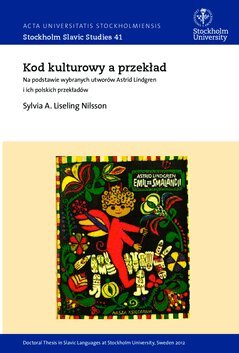
Kod kulturowy a przekład : na podstawie wybranych utworów Astrid Lindgren i ich polskich przekładów = The cultural code and translation : the case of selected works by Astrid Lindgren into Polish
Häftad, Polska, 2015
183 kr
Skickas inom 5-8 vardagar
Discussion about translation has a long tradition stretching back to antiquity, pursued in later ages, it still remains highly topical today. In the dissertation The Cultural Code and Translation the author continues the tradition and examines how the Swedish cultural code, contained in books by Astrid Lindgren, was transferred into the Polish linguistic and cultural domain. The research of Sylvia A. Liseling Nilsson reveals how the Polish cultural lter affects the image of Swedish reality shown in the translations. The following aspects are taken into consideration: folklore and popular beliefs, intertextuality, use of diminutives, transcriptions of colloquial language and dialect in which the various social classes communicate in the original texts, verba dicendi, the language of individual protagonists, children's folklore including the translation of offensive words, paratextual elements as well as the transfer of the visual aspect of the cultural elements in literature written for children.