SUNY series in Advances in Applied Anthropology - Böcker
Visar alla böcker i serien . Handla med fri frakt och snabb leverans.
3 produkter
3 produkter
1 057 kr
Tillfälligt slut
The authors of this book share a common assumption about anthropology-that replicable and systematic procedures of data collection and analysis are essential requirements for building useful cultural theory. They view cultural theory as both an aid to understanding sociocultural phenomena, and as an aid in changing existing social conditions.This book focuses on five specific themes representing a set of principles for conducting research: the importance of intra-cultural variation; the blending of qualitative and quantitative approaches; the search for micro/macro levels of generalization; the innovative matching of methodology to research problems; and the practical or applied merit of systematically generated and evaluated theory. It contributes to scientific anthropology and shows that the credibility and utility of anthropological research in policy matters is enhanced by scientific research methodology.
Politics of Public Memory
Tourism, History, and Ethnicity in Monterey, California
Häftad, Engelska, 1993
524 kr
Skickas inom 3-6 vardagar
This book examines American public culture and the means by which communities in the U.S. reconstruct the past and reinterpret the present in the development of tourism. Norkunas shows how public culture is not confined to just museums or monuments, but can be constructed on many different levels and in different settings, such as community ethnicity, natural setting (environment), literary landscape, and history. In her case study of Monterey, the author explores the particular ideologies that prompt the community to represent itself in tourism, and that also act to legitimate the current social structure.
566 kr
Skickas inom 3-6 vardagar
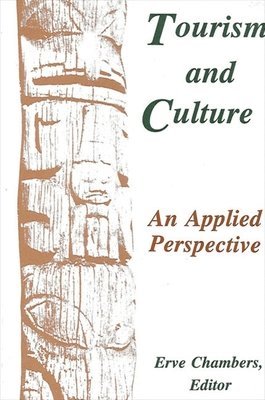
Essays and case studies by anthropologists provide insight into what measures might be necessary to mitigate the potentially harmful effects of tourism on host communities.Anthropologists and other social scientists have only recently undertaken systematic studies of modern tourism. The need for such research is apparent given the fact that the travel and tourism industry has become one of the largest industries in the world. Major cities, entire countries, and even some of the most seemingly remote places on the globe, have become increasingly dependent on attracting tourists to their locales. The transformations that are occurring as a result of tourism are not solely economic—tourism can bring about profound cultural changes, can have important consequences for a region's ethnic and historic identity, and can produce significant social and political transformations to host communities. Few human activities have such great potential as does tourism for exposing on a personal level the considerable inequalities that do exist between people, particularly between people of different countries and different color.Tourism and Culture provides detailed case studies that explore the complexity of modern tourism relationships. The book challenges the often assumed primacy of the relationships between "hosts" and their "guests," arguing that virtually all forms of tourism are mediated by parties who stand outside of such immediate relationships. Individual contributions to the book describe tourism developments in specific locales, offering a variety of perspectives on both positive and negative human consequences of the industry. Another unique feature of the book is its focus on applied anthropology, with many of the contributors describing their direct involvement in the critical assessment or development of tourism activities in different parts of the world.