Thinking Out Loud - Böcker
Visar alla böcker i serien Thinking Out Loud. Handla med fri frakt och snabb leverans.
8 produkter
8 produkter
871 kr
Skickas inom 10-15 vardagar
Secular criticism is a term invented by Edward Said to denote not a theory but a practice that counters the tendency of much modern thinking to reach for a transcendentalist comfort zone, the very space philosophy wrested away from religion in the name of modernity. Using this notion as a compass, this book reconfigures recent secularism debates on an entirely different basis, by showing (1) how the secular imagination is closely linked to society's radical poiesis, its capacity to imagine and create unprecedented forms of worldly existence; and (2) how the space of the secular animates the desire for a radical democratic politics that overturns inherited modes of subjugation, whether religious or secularist.Gourgouris's point is to disrupt the co-dependent relation between the religious and the secular—hence, his rejection of fashionable languages of postsecularism—in order to engage in a double critique of heteronomous politics of all kinds. For him, secular criticism is a form of political being: critical, antifoundational, disobedient, anarchic, yet not negative for negation's sake but creative of new forms of collective reflection, interrogation, and action that alter not only the current terrain of dominant politics but also the very self-conceptualization of what it means to be human.Written in a free and combative style and given both to close readings of texts and to gazing off into the broad horizon, these essays cover a range of issues—historical and philosophical, archaic and contemporary, literary and political—that ultimately converge in the significance of contemporary radical politics: the assembly movements we have seen in various parts of the world in recent years. The secular imagination demands a radical pedagogy and unlearning a great many established thought patterns. Its most important dimension is not battling religion per se but dismantling theological politics of sovereignty in favor of radical conditions for social autonomy.
347 kr
Skickas inom 10-15 vardagar
Secular criticism is a term invented by Edward Said to denote not a theory but a practice that counters the tendency of much modern thinking to reach for a transcendentalist comfort zone, the very space philosophy wrested away from religion in the name of modernity. Using this notion as a compass, this book reconfigures recent secularism debates on an entirely different basis, by showing (1) how the secular imagination is closely linked to society's radical poiesis, its capacity to imagine and create unprecedented forms of worldly existence; and (2) how the space of the secular animates the desire for a radical democratic politics that overturns inherited modes of subjugation, whether religious or secularist.Gourgouris's point is to disrupt the co-dependent relation between the religious and the secular—hence, his rejection of fashionable languages of postsecularism—in order to engage in a double critique of heteronomous politics of all kinds. For him, secular criticism is a form of political being: critical, antifoundational, disobedient, anarchic, yet not negative for negation's sake but creative of new forms of collective reflection, interrogation, and action that alter not only the current terrain of dominant politics but also the very self-conceptualization of what it means to be human.Written in a free and combative style and given both to close readings of texts and to gazing off into the broad horizon, these essays cover a range of issues—historical and philosophical, archaic and contemporary, literary and political—that ultimately converge in the significance of contemporary radical politics: the assembly movements we have seen in various parts of the world in recent years. The secular imagination demands a radical pedagogy and unlearning a great many established thought patterns. Its most important dimension is not battling religion per se but dismantling theological politics of sovereignty in favor of radical conditions for social autonomy.
747 kr
Skickas inom 7-10 vardagar
In the contemporary world of neoliberalism, efficiency is treated as the vehicle of political and economic health. State bureaucracy, but not corporate bureaucracy, is seen as inefficient, and privatization is seen as a magic cure for social ills. In Public Things: Democracy in Disrepair, Bonnie Honig asks whether democracy is possible in the absence of public services, spaces, and utilities. In other words, if neoliberalism leaves to democracy merely electoral majoritarianism and procedures of deliberation while divesting democratic states of their ownership of public things, what will the impact be?Following Tocqueville, who extolled the virtues of "pursuing in common the objects of common desires," Honig focuses not on the demos but on the objects of democratic life. Democracy, as she points out, postulates public things—infrastructure, monuments, libraries—that citizens use, care for, repair, and are gathered up by. To be "gathered up" refers to the work of D. W. Winnicott, the object relations psychoanalyst who popularized the idea of "transitional objects"—the toys, teddy bears, or favorite blankets by way of which infants come to understand themselves as unified selves with an inside and an outside in relation to others. The wager of Public Things is that the work transitional objects do for infants is analogously performed for democratic citizens by public things, which press us into object relations with others and with ourselves.Public Things attends also to the historically racial character of public things: public lands taken from indigenous peoples, access to public goods restricted to white majorities. Drawing on Hannah Arendt, who saw how things fabricated by humans lend stability to the human world, Honig shows how Arendt and Winnicott—both theorists of livenesss—underline the material and psychological conditions necessary for object permanence and the reparative work needed for a more egalitarian democracy.
221 kr
Skickas
In the contemporary world of neoliberalism, efficiency is treated as the vehicle of political and economic health. State bureaucracy, but not corporate bureaucracy, is seen as inefficient, and privatization is seen as a magic cure for social ills. In Public Things: Democracy in Disrepair, Bonnie Honig asks whether democracy is possible in the absence of public services, spaces, and utilities. In other words, if neoliberalism leaves to democracy merely electoral majoritarianism and procedures of deliberation while divesting democratic states of their ownership of public things, what will the impact be?Following Tocqueville, who extolled the virtues of "pursuing in common the objects of common desires," Honig focuses not on the demos but on the objects of democratic life. Democracy, as she points out, postulates public things—infrastructure, monuments, libraries—that citizens use, care for, repair, and are gathered up by. To be "gathered up" refers to the work of D. W. Winnicott, the object relations psychoanalyst who popularized the idea of "transitional objects"—the toys, teddy bears, or favorite blankets by way of which infants come to understand themselves as unified selves with an inside and an outside in relation to others. The wager of Public Things is that the work transitional objects do for infants is analogously performed for democratic citizens by public things, which press us into object relations with others and with ourselves.Public Things attends also to the historically racial character of public things: public lands taken from indigenous peoples, access to public goods restricted to white majorities. Drawing on Hannah Arendt, who saw how things fabricated by humans lend stability to the human world, Honig shows how Arendt and Winnicott—both theorists of livenesss—underline the material and psychological conditions necessary for object permanence and the reparative work needed for a more egalitarian democracy.
254 kr
Skickas
The new geological epoch we call the Anthropocene is not just a scientific classification. It marks a radical transformation in the background conditions of life on Earth, one taken for granted by much of who we are and what we hope for. Never before has a species possessed both a geological-scale grasp of the history of the Earth and a sober understanding of its own likely fate. Our situation forces us to confront questions both philosophical and of real practical urgency. We need to rethink who "we" are, what agency means today, how to deal with the passions stirred by our circumstances, whether our manner of dwelling on Earth is open to change, and, ultimately, "What is to be done?" Our future, that of our species, and of all the fellow travelers on the planet depend on it.The real-world consequences of climate change bring new significance to some very traditional philosophical questions about reason, agency, responsibility, community, and man's place in nature. The focus is shifting from imagining and promoting the "good life" to the survival of the species. Deep Time, Dark Times challenges us to reimagine ourselves as a species, taking on a geological consciousness. Drawing promiscuously on the work of Nietzsche, Heidegger, Foucault, Derrida, Deleuze, and other contemporary French thinkers, as well as the science of climate change, David Wood reflects on the historical series of displacements and de-centerings of both the privilege of the Earth, and of the human, from Copernicus through Darwin and Freud to the declaration of the age of the Anthropocene. He argues for the need to develop a new temporal phronesis and to radically rethink who "we" are in respect to solidarity with other humans, and responsibility for the nonhuman stakeholders with which we share the planet. In these brief, lively chapters, Wood poses a range of questions centered on our individual and collective political agency. Might not human exceptionalism be reborn as a sort of hyperbolic responsibility rather than privilege?
964 kr
Skickas inom 10-15 vardagar
The new geological epoch we call the Anthropocene is not just a scientific classification. It marks a radical transformation in the background conditions of life on Earth, one taken for granted by much of who we are and what we hope for. Never before has a species possessed both a geological-scale grasp of the history of the Earth and a sober understanding of its own likely fate. Our situation forces us to confront questions both philosophical and of real practical urgency. We need to rethink who "we" are, what agency means today, how to deal with the passions stirred by our circumstances, whether our manner of dwelling on Earth is open to change, and, ultimately, "What is to be done?" Our future, that of our species, and of all the fellow travelers on the planet depend on it.The real-world consequences of climate change bring new significance to some very traditional philosophical questions about reason, agency, responsibility, community, and man's place in nature. The focus is shifting from imagining and promoting the "good life" to the survival of the species. Deep Time, Dark Times challenges us to reimagine ourselves as a species, taking on a geological consciousness. Drawing promiscuously on the work of Nietzsche, Heidegger, Foucault, Derrida, Deleuze, and other contemporary French thinkers, as well as the science of climate change, David Wood reflects on the historical series of displacements and de-centerings of both the privilege of the Earth, and of the human, from Copernicus through Darwin and Freud to the declaration of the age of the Anthropocene. He argues for the need to develop a new temporal phronesis and to radically rethink who "we" are in respect to solidarity with other humans, and responsibility for the nonhuman stakeholders with which we share the planet. In these brief, lively chapters, Wood poses a range of questions centered on our individual and collective political agency. Might not human exceptionalism be reborn as a sort of hyperbolic responsibility rather than privilege?
337 kr
Skickas inom 7-10 vardagar
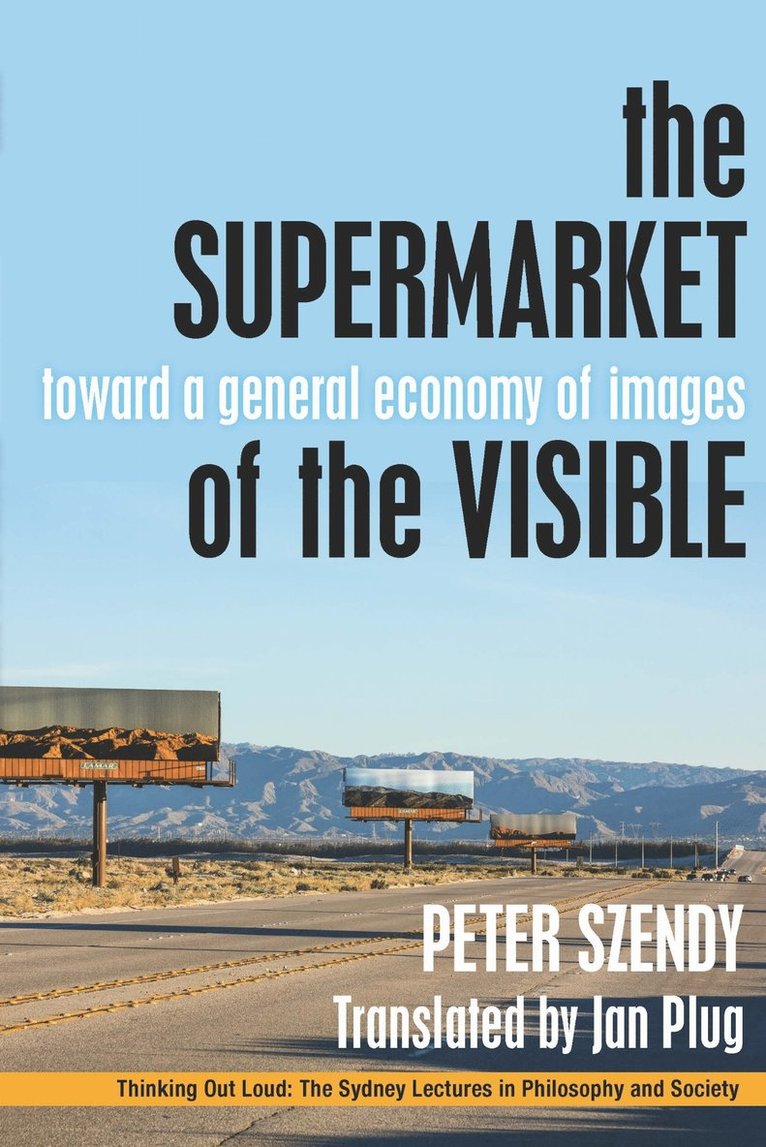
Already in 1929, Walter Benjamin described "a one hundred per cent image-space." Such an image space saturates our world now more than ever, constituting the visibility in which we live. The Supermarket of the Visible analyzes this space and the icons that populate it as the culmination of a history of the circulation and general commodification of images and gazes. From the first elevators and escalators (tracking shots avant la lettre) to cinema (the great conductor of gazes), all the way down to contemporary eye-tracking techniques that monitor the slightest saccades of our eyes, Peter Szendy offers an entirely novel theory of the intersection of the image and economics.The Supermarket of the Visible elaborates an economy proper to images, icons, in other words, an iconomy. Deleuze caught a glimpse of this when he wrote that "money is the back side of all the images that cinema shows and edits on the front." Since "cinema," for Deleuze, is synonymous with "universe," Szendy argues that this sentence must be understood in its broadest dimension and that a reading of key works in the history of cinema allows us a unique vantage point upon the reverse of images, their monetary implications. Paying close attention to sequences in Hitchcock, Bresson, Antonioni, De Palma, and The Sopranos, Szendy shows how cinema is not a uniquely commercial art form among other, purer arts, but, more fundamentally, helps to elaborate what might be called, with Bataille, a general iconomy.Moving deftly and lightly between political economy, aesthetic theory, and popular movies and television, The Supermarket of the Visible will be a necessary book for anyone concerned with media, philosophy, politics, or visual culture.
1 133 kr
Skickas inom 10-15 vardagar
Already in 1929, Walter Benjamin described "a one hundred per cent image-space." Such an image space saturates our world now more than ever, constituting the visibility in which we live. The Supermarket of the Visible analyzes this space and the icons that populate it as the culmination of a history of the circulation and general commodification of images and gazes. From the first elevators and escalators (tracking shots avant la lettre) to cinema (the great conductor of gazes), all the way down to contemporary eye-tracking techniques that monitor the slightest saccades of our eyes, Peter Szendy offers an entirely novel theory of the intersection of the image and economics.The Supermarket of the Visible elaborates an economy proper to images, icons, in other words, an iconomy. Deleuze caught a glimpse of this when he wrote that "money is the back side of all the images that cinema shows and edits on the front." Since "cinema," for Deleuze, is synonymous with "universe," Szendy argues that this sentence must be understood in its broadest dimension and that a reading of key works in the history of cinema allows us a unique vantage point upon the reverse of images, their monetary implications. Paying close attention to sequences in Hitchcock, Bresson, Antonioni, De Palma, and The Sopranos, Szendy shows how cinema is not a uniquely commercial art form among other, purer arts, but, more fundamentally, helps to elaborate what might be called, with Bataille, a general iconomy.Moving deftly and lightly between political economy, aesthetic theory, and popular movies and television, The Supermarket of the Visible will be a necessary book for anyone concerned with media, philosophy, politics, or visual culture.