Unicorn Press – serie
Visar alla böcker i serien Unicorn Press. Handla med fri frakt och snabb leverans.
11 produkter
11 produkter
Häftad, Engelska, 2017
295 kr
Skickas inom 5-8 vardagar
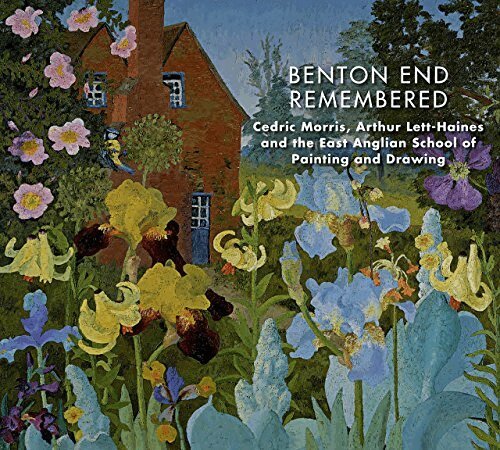
In 1940, Cedric Morris and Arthur Lett-Haines, both established artists with international reputations who had become disillusioned with the commercial aspects of the art world, moved to Benton End, overlooking the River Brett on the outskirts of Hadleigh, Suffolk. What they found there was a somewhat ramshackle but capacious sixteenth-century farmhouse, standing in over three acres of walled gardens lost beneath brambles and elder trees; the house had not been lived in for fifteen years. But Benton End became both their home and the new premises of the East Anglian School of Painting and Drawing which, in 1937, they had founded together in Dedham, Essex. From 1940 until Lett Haines died in 1978 and Cedric Morris in 1982, Benton End was an exotic world apart where art, literature, good food, gardening and lively conversation combined to produce an extraordinarily stimulating environment for amateurs and professionals alike. Ronald Blythe recalls that 'there was a whiff of garlic and wine in the air. The atmosphere ...was robust and coarse, and exquisite and tentative all at once. Rough and ready and fine mannered. Also faintly dangerous.'The sharply contrasting characters and interests of Morris and Lett Haines ensured the widest range of contacts and visitors to Benton End who included Francis Bacon, Ronald Blythe, Benjamin Britten and Peter Pears, David Carr, Beth Chatto, Randolph Churchill, Elizabeth David, Lucian Freud, Kathleen Hale, Maggi Hambling, Lucy Harwood, Glyn Morgan, John Nash, and Vita Sackville-West. There was no formal teaching and students were left free to pursue their own enthusiasms and to show their work to Morris or Lett Haines for advice. Without formal teaching, they were free to pursue their own enthusiasms, while Morris's skill as a plantsman and noted breeder of irises, contrasted with Lett Haines's intellectual sophistication, interest in food and wine, artistic experimentation, and a general lack of enthusiasm for the outdoors.
Inbunden, Engelska, 2025
325 kr
Skickas
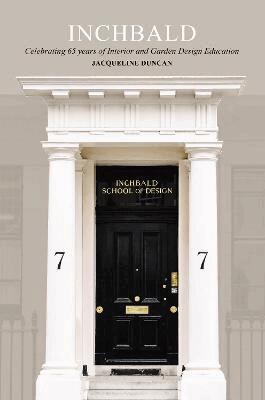
Jacqueline Duncan founded The Inchbald School of Interior Design in 1960, and the Inchbald School of Garden Design in 1972. War-time experiences as a young evacuee living in grand English country houses kindled her fascination with buildings and gardens before she met and married Michael Inchbald, aleading interior decorator.Britain had no equivalent of the Parsons School of Design, in the USA, so Jacqueline Duncan became determined to establish a school in London.An important component of Inchbald courses is Interior Design history, which Jacqueline Duncan outlines, explaining how the profession developed out of associated trades and gift ed amateurism. Many distinguished Interior Designers and Garden Designers are Inchbald graduates. Examples of theirwork are included in an appendix.
Inbunden, Engelska, 2025
196 kr
Kommande
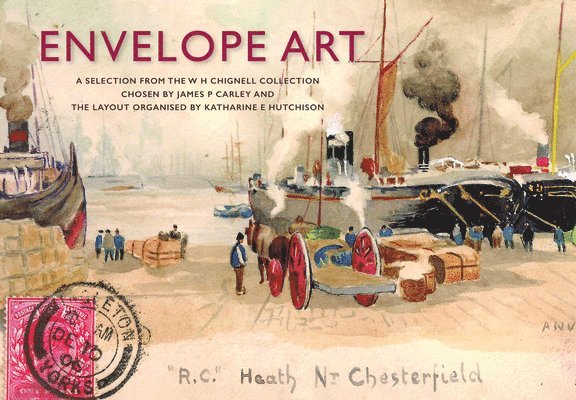
Living in a time of instant access through electronic communication, it is hard to remember the importance of letters in the past. For those with family living abroad, the post office was a lifeline. Normally the envelope had no more than an address but for some few individuals there was more involved. The hundreds of envelopes executed by W.H. Chignell (1841-1933), never before published, excel in this eld: indeed they are artistic endeavours in their own right.Chignell began married life as an organist and choir master rather than a professional artist. He was the father of seven children and after the break-up of the family home, several emigrated abroad and others moved to disparate parts of the UK. They kept diaries, wrote journals or in one case published a book on life in Papua New Guinea. These contain descriptions of what it was like to receive letters and perhaps even more exciting to have 'home thoughts from abroad' evoked on the envelopes. It is wonderfully fortuitous that so many survive, a selection of which are published in this volume.
Inbunden, Engelska, 2019
340 kr
Skickas inom 5-8 vardagar
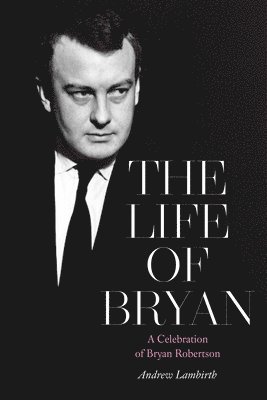
Bryan Robertson (1925-2002) was the greatest director the Tate Gallery never had. In 1952, at the age of 27, and against formidable competition (which included David Sylvester and Lawrence Gowing), he became Director of the Whitechapel Gallery, a post he held until 1969. While there he effected a revolution in the British museum world, bringing the more innovative and radical American and European contemporary artists to the UK, as well as programming a series of exhibitions devoted to British artists in mid-career. He was the first to show Pollock, Rothco, Rauschenberg and Johns in England, matching this withhistorical re-evaluations of Turner, Stubbs, Bellotto and Rowlandson. Among Europeans he showed Mondrian, de Stäel, Malevich and Poliakoff , and the English artists included Barbara Hepworth, Alan Davie, Ceri Richards and Keith Vaughan. Among younger painters and sculptors he identified the New Generation of Caro, Hoyland, Riley, Jones and Caulfield, and stage-managed a flow of exhibitions which transformed the Whitechapel and made it the gallery to visit. Robertson was a man of vision and flair, and this book celebrates his lasting infl uence over the way we look at and think about art, as witnessed through the words of his friends and contemporaries and in excerpts from his own written works.
Inbunden, Engelska, 2020
407 kr
Skickas inom 5-8 vardagar
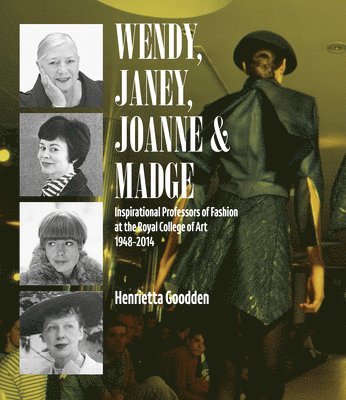
Madge Garland, Janey Ironside, Joanne Brogden and Wendy Dagworthy, a quartet of remarkable educators and doyennes of style and skill, encouraged their students with rigorous determination to produce nothing but the best. Garland, previously FashionEditor of Vogue magazine and a brave pioneer when the educational establishment regarded fashion as ‘frippery’, laid foundations on which Ironside, the sparkling innovator built. Then Brogden took the School into a more competitive commercial world with fashion becoming a major economic force. When Dagworthy took over in the final decade of the 20th century, she guided her students into a new era while still respecting the inheritance of her predecessors.Today’s markets demand high-fashion-ready-to-wear, with the RCA School of Fashion’s reputation second to none for innovation in design and manufacturing techniques, and its alumni now in positions of influence throughout the world. From retail and industrial connections forged in the 1950s, RCA designers such as Ossie Clark and Zandra Rhodes, established their reputations, and top world-wide brands including Kenzo, Givenchy, Gucci , Louis Vuitton and Calvin Klein, clamoured to employ star RCA students.
Inbunden, Engelska, 2021
236 kr
Tillfälligt slut
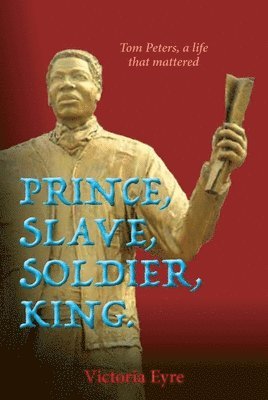
For diversity, energy, hardship and tenacity Tom Peters’ life was exceptional. Enslaved in 1760, and escaping for a third time in 1775 when the Dunmore Proclamation offered fugitive slaves emancipation in return for military service, he enlisted in the British Army. Promoted to sergeant, he served in the Black Pioneers until 1783. Subsequent settlement of the Africans in Nova Scotia was a failure; it resulted in Tom visiting London in 1791 to meet abolitionist MPs and in 1792 15 ships carried the Africans to a prepared settlement in Sierra Leone where arriving in May that year, Tom Peters died of fever three months later.Some events have been omitted, but among people who featured were General Sir Henry Clinton; Granville Sharp; William Wilberforce; Tom’s wife, Sally, and his children, Clairie and John; Sir John Parr the Governor of Nova Scotia; Sir Guy Carleton, Governor General of Canada; and John Clarkson and William Dawes, Governors of Sierra Leone. Rumours surround his life, including his audience with Queen Victoria. Part one is fiction: Tom was born in Yorubaland (Nigeria) not in Ashanti (Ghana). But parts two, three and four are historically more accurate. Conversations throughout are imaginary.
Inbunden, Engelska, 2019
333 kr
Tillfälligt slut
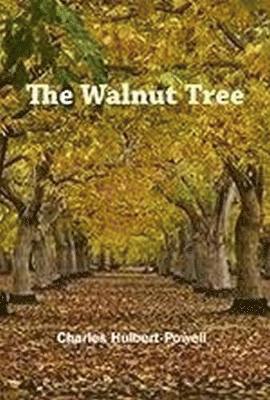
Text with fully-integrated illustrations which are mainly photographs showing different varieties and habitats, the nuts in their different stages of growth; processing for oil; uses of the timber; the walnut in art; culinary use including a collection of recipes. Practical advice on choosing, planting, maintaining and pruning walnut trees. Approx 80 colour illustrations plus b&w archive prints and drawings. Further reading list. Suppliers. Index.
Inbunden, Engelska, 2018
161 kr
Tillfälligt slut
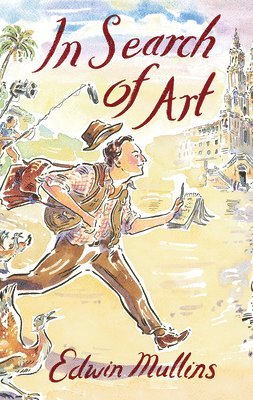
Edwin Mullins has had a long and distinguished career as both an arts journalist and a presenter of TV arts programmes. In Search of Art is a collection of vividly told recollections of both his extraordinary adventures, visiting famous artists, and the discoveries he made when on assignments for indulgent newspaper editors in the days of generous budgets. Blessed with a prodigious memory, and fully armed with the notebooks and diaries he has always kept, he has included in this collection of true stories, some accounts which resemble very closely some of the situations in which William Boot found himself in Evelyn Waugh's Scoop.
Inbunden, Engelska, 2021
304 kr
Tillfälligt slut
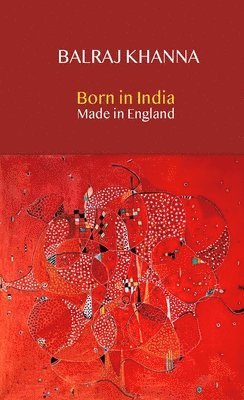
Balraj Khanna witnessed as a child in the Punjab, the cataclysmic Partition of India in 1947, when Hindus and Muslims who had lived peacefully together for generations, succumbed to blood-soaked enmity. At school and university a love of English language and culture took him to London in the bitter winter of 1962, where Goanese painter, Francis Newton Souza, warnedof the ‘pitiless prejudice, indifference and scorn’ he would meet. In London Balraj’s career as a painter blossomed. He met the critic and novelist Mulk Raj Anand; the painter Avanash Chandra; and the distinguished Keeper of the Indian Collection at the Victoria and Albert Museum, W.G. Archer, who in 1968 arranged for the 28-year old Balraj to be given a solo exhibition at the Ashmolean Museum in Oxford. Balraj joined The Indian Painters Collective and met diplomat, Salman Haidar, who promoted Indian artists and arranged exhibitions. Balraj lectured on Indian Art in universities: Cambridge, Manchester, Oxford, the Royal College of Art, St Martin’s, SOAS, and exhibited at the Hayward Gallery, Serpentine Gallery, Victoria and Albert Museum, Brighton and Hove Museum and Bradford Museum. In 1971–72 he became a Foreign Correspondent during the India-Pakistan War. He met and married Francine and lived in France. Balraj’s novel, Nation of Fools, was awarded the Royal Society of Literature’s Winifred Holtby Prize for a Firstnovel in 1984. Until then best known for his painting, Born in India Made in England tells his story ‘warts and all’: in the first part evoking the atmosphere of the India of his youth; in the second part describing with telling observation England and the English he encountered in the 1960s. As Francis Souza succinctly reflected at the time: ‘Godfuck racist place full of pansies’.
Inbunden, Engelska, 2019
664 kr
Tillfälligt slut
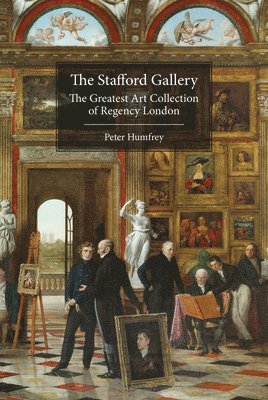
The book will provides the first detailed history of the Bridgewater collection. The story extends from the 3rd Duke of Bridgewater's purchases in Rome in the 1750s, then on to the major acquisitions of the 1790s (especially from the Orleans collection), then through the incorporation of the collection into the Stafford Gallery by the 2nd Marquess of Stafford (1st Duke of Sutherland), and finally to its reinstallation by Lord Francis Egerton in the new Bridgewater House in 1851.As well as providing a detailed account of the personalities and differing motives of three generations of collectors and owners, the book examines the ways in which the collection was arranged and displayed. It also discusses reactions to it by contemporaries, from sophisticated critics such as William Hazlitt, to the general public, and analyses major publications on it such as the four-volume illustrated catalogue by William Young Ottley of 1818.The illustrations will include many works sold from the collection aft er 1946 and now widely dispersed.
Inbunden, Engelska, 2020
379 kr
Tillfälligt slut
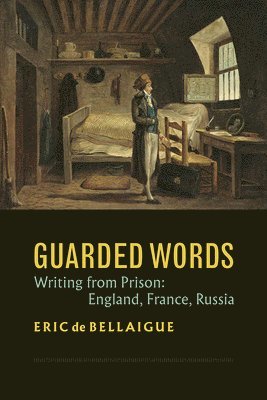
In Guarded Words Eric de Bellaigue has attempted to answer questions inspired by his reading of Isaac D'Israeli's short essay 'Imprisonment of Learned', from that author's Curiosities of Literature.He asks: 'Can prison writing lay claim to a distinctive chapter in histories of literature? Is there a thread linking prisoners' output across the centuries? Can confinement provide the ideal environment for literary creativity? Is there common ground among the subjects treated? Alternatively, does diversity ride rough-shod over the shared experiences of imprisonment?'The author's Preface explains the self-imposed restrictions that have determined his choice of writers and how the sequence of chapters has largely been governed by geography and chronology. The main sections of the book are: Incarceration in England; Incarceration in France; Incarceration in Russia; Convicted Murderers. Texts need to have been composed within the prisons themselves, and memoirs written after release have been excluded. With three exceptions the writings are in English or French with the year 1500 as a starting point.The writers who make their appearance here are a mixed bag. Where common ground is apparent it is at the personal level, notably in the causes of imprisonment which include:* For religious views: John Bunyan; Clement Marot; Anne Askew; Thomas More; John Hart.* For reasons of State: Walter Ralegh; William Prynne; Antoine Lavoisier; Madame Roland; Andre Chenier; Jean-Antoine Roucher; the Earl of Surrey; Charles I ; Richard Lovelace.* As victims of civil action: William Combe; Theodore von Neuhoff, King of Corsica; Mirabeau; Voltaire.* For Murder: Pierre Francois Lacenaire; William Chester Minor.* For dissidence in Russia: Alexander Solzhenitsyn; Lev Mishchenko ; Irina Ratushinskaya. An appendix, 'Snapshots of Prison Writing', provides short notes about each writer. There are also textual notes, a bibliography and an index.Illustrations: approximately 30 b&w illustrations of writers and the places where they were incarcerated.