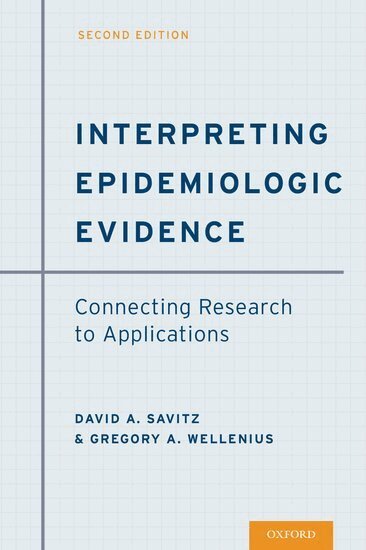
Interpreting Epidemiologic Evidence
Connecting Research to Applications
AvDavid A. Savitz,Gregory A. Wellenius
796 kr
Beställningsvara. Skickas inom 5-8 vardagar. Fri frakt över 249 kr.
Beskrivning
Produktinformation
- Utgivningsdatum:2016-08-18
- Mått:231 x 155 x 10 mm
- Vikt:363 g
- Format:Häftad
- Språk:Engelska
- Antal sidor:240
- Upplaga:2
- Förlag:OUP USA
- ISBN:9780190243777
Utforska kategorier
Mer om författaren
David A. Savitz, PhD, is Professor of Epidemiology and Obstetrics and Gynecology at Brown University. He has held leadership positions at the University of North Carolina (Chair of the Department of Epidemiology) and at Brown University (Vice President for Research), as well as in a number of professional organizations. His research is focused primarily on reproductive and environmental epidemiology. He was elected to the National Academy of Medicine in 2007.Gregory A. Wellenius, ScD, is Associate Professor of Epidemiology at Brown University. His research focuses on the effects of our environment on cardiovascular health, with an emphasis on the adverse health effects of air pollution and the built environment. He has taught advanced graduate courses in epidemiologic methods, provided invited expert testimony before the US House of Representatives and US Senate, and mentored a number of undergraduate, medical, masters, and doctoral students.
Recensioner i media
Highly relevant to any practicing epidemiologist.
Innehållsförteckning
- Interpreting Epidemiologic Evidence: Connecting Research to Applications 1. Introduction Synopsis Learning Objectives Perspective Approach to the Evaluation of Evidence Organization of Book 2. The Nature of Epidemiologic Evidence SynopsisLearning Objectives Goals of Epidemiologic Research Measurement of Causal Relations Between Exposure and Disease Applications of Epidemiologic Research Framework for Examining Epidemiologic Evidence Relationship of Epidemiology to Health Policy Exercise: Critical Assessment of Study Methods, Results, and Applications 3. Causal Diagrams for Epidemiologic Inference Synopsis Learning Objectives Introduction Causal Diagrams in Epidemiology Purpose and Terminology DAGs Encode Our Assumptions Statistical Associations Connection to Data Analyses Depicting Passage of Time Direct vs. Indirect Effects Concluding Thoughts Recommended Additional Readings Exercise: Application of Causal Diagrams for Epidemiologic Inference 4. Strategy for Drawing Inferences from Epidemiologic Evidence SynopsisLearning Objectives Conceptual Framework for the Evaluation of Error Estimation of Measures of Association Systematic Evaluation of Sources of ErrorObjective Evaluation of Sources of ErrorIdentifying the Most Important Sources of ErrorSpecifying Bias ScenariosExercise: Specifying Scenarios of Bias5. Confounding I: Theoretical ConsiderationsSynopsisLearning ObjectivesDefinition Identifying Potential Confounders Traditional Approach to Assessing Confounding Modern Approach to Assessing Confounding Inappropriate AdjustmentsAssessing the Direction and Magnitude of Potential ConfoundingMethods of Controlling Confounding Randomization Selection of Study Setting Free of Confounding Restrict Study Groups to Enhance Comparability Statistical Adjustment for ConfoundingRecommended Additional ReadingsExercise: Conceptual Basis of Confounding 6. Confounding II: Practical Considerations Synopsis Learning Objectives Evaluating the Presence and Impact of Confounding Specifying Scenarios of Confounding Assessing Whether Confounding is Present Consider Potential for Complete Confounding Assess Consequences of Inaccurate Confounder Measurement Applying Knowledge of Confounding Based on Other Studies Assessing Confounding When Risk Factors are UnknownDose-Response Gradients and Potential for ConfoundingIntegrated Assessment of Potential Confounding Exercise: Connecting Conceptual and Statistical Assessment of Confounding 7. Selection Bias and Confounding Resulting from Selection in Cohort Studies SynopsisLearning ObjectivesStudy DesignsDefinition and Examples of Selection BiasSelection Bias Versus Confounding Evaluation of Bias in Cohort Studies Compare Those Included to Those Not Included Compare Disease Rates Among Unexposed to External Populations Assess Whether Expected Patterns of Disease are Present Assess Pattern of Results in Relation to Markers of Susceptibility to Bias Due to Participant Selection Assess Rates for Diseases Known Not to Be Affected by the ExposureIntegrated Assessment of Potential for Bias in Cohort Studies Exercise: Assessment of Bias Due to Selection in Cohort Studies 8. Selection Bias in Case-Control Studies SynopsisLearning ObjectivesControl Selection Participant Selection in Case-Control and Cohort Studies Selection of Controls from the Source Population Coherence of Cases and ControlsEvaluation of Selection Bias in Case-Control Studies Temporal Coherence of Cases and Controls Discretionary Health Care of Cases and Controls Compare Exposure Prevalence in Controls to an External Population Determine Whether Exposure Prevalence Varies as Expected Among Controls Examine Markers of Potential Selection Bias in Relation to Measures of Association Adjust Measures of Association for Known Sources of Non- Comparability Determine Whether Established Associations Can Be Confirmed Integrated Assessment of Potential for Selection Bias in Case-Control Studies Exercise: Assessing Selection Bias in Case-Control Studies 9. Bias Due to Loss of Study Participants Synopsis Learning Objectives Conceptual Framework for Examining Bias Due to Loss of Study Participants Evaluation of Bias Due to Loss of Study Participants Characterize Nonparticipants Consider Gradient of Difficulty in Recruitment Stratify Study Base by Markers of Participation Impute Information for Nonparticipants Integrated Assessment of Potential for Bias Due to Loss of Study ParticipantsExercise: Examining Implications of Non-Participation 10. Measurement and Classification of Exposure SynopsisLearning ObjectivesIntroductionIdeal Versus Operational Measures of Exposure Biologically Relevant Exposure Temporally Relevant Exposure Optimal Level of Exposure Aggregation Comparison of Optimal to Operational Measures of ExposureDoes Exposure Misclassification Differ by Disease Status? Definitions Mechanisms of Differential Exposure MisclassificationEvaluation of Exposure Misclassification Compare Routine Measure to Superior Measures Examine Multiple Indicators of Exposure Examine Subsets of the Population with Differing Exposure Data Quality Evaluate Known Predictors of Exposure Evaluate Known Consequences of Exposure Examine Dose-Response Gradients Evaluate Whether Exposure Misclassification Differs by Disease Status Identification of Subgroups with Nondifferential Exposure MisclassificationIntegrated Assessment of Bias Due to Exposure Misclassification Exercise: Assessing the Presence and Impact of ExposureMisclassification 11. Measurement and Classification of Disease SynopsisLearning ObjectivesFramework for Evaluating Disease Misclassification Sources of Disease Misclassification Impact of Differential and Nondifferential Disease Misclassification Evaluation of Disease Misclassification Verify Diagnostic Accuracy for Subset of Study Participants Examine Results Across Levels of Diagnostic CertaintyEvaluate Alternate Methods of Disease Grouping Determine Whether Misclassification is Differential by Exposure Status Create Subgroups with Accurate Ascertainment or Non-Differential Underascertainment Restrict Inference to Disease Outcome That Can Be Ascertained AccuratelyIntegrated Assessment of Potential for Bias Due to Disease Misclassification Exercise: Assessing the Presence and Impact of Disease Misclassification 12. Random Error SynopsisLearning ObjectivesNature of Random VariationSequential Approach to Considering Random and Systematic Error Special Considerations in Evaluating Random Error in Observational Studies Statistical Significance Testing Interpretation of Confidence Intervals Multiple Comparisons and Related Issues Integrated Assessment of Random ErrorExercise: Assessing Random Error 13. Integration of Evidence Across Studies SynopsisLearning ObjectivesIntroduction Systematic Evidence Reviews Data Pooling and Comparative Analyses Meta-Analysis Interpreting Consistency and Inconsistency Among Studies Inconsistent Findings Consistent FindingsEvolution of Epidemiologic ResearchIntegrated Assessment from Combining Evidence Across Studies Exercise: Interpreting Evidence from a Collection of Studies 14. Characterization and Communication of Conclusions SynopsisLearning ObjectivesPresenting Clear, Objective, and Informed ConclusionsApplications of EpidemiologyIntegration of Epidemiologic Evidence with Other Information Identification of Key Concerns Controversy over InterpretationThe Case Against Algorithms for Interpreting Epidemiologic Evidence Exercise: Communicating Summary Assessment of Epidemiologic Evidence
Mer från samma författare
Assessment of Long-Term Health Effects of Antimalarial Drugs When Used for Prophylaxis
and Medicine National Academies of Sciences, Engineering, Health and Medicine Division, Board on Population Health and Public Health Practice, Anne N. Styka, David A. Savitz
1 084 kr
Complementary Feeding Interventions for Infants and Young Children Under Age 2
and Medicine National Academies of Sciences, Engineering, Health and Medicine Division, Food and Nutrition Board, Committee on Complementary Feeding Interventions for Infants and Young Children Under Age 2, Katherine M. Delaney, David A. Savitz
366 kr
Du kanske också är intresserad av
Complementary Feeding Interventions for Infants and Young Children Under Age 2
and Medicine National Academies of Sciences, Engineering, Health and Medicine Division, Food and Nutrition Board, Committee on Complementary Feeding Interventions for Infants and Young Children Under Age 2, Katherine M. Delaney, David A. Savitz
366 kr
Assessment of Long-Term Health Effects of Antimalarial Drugs When Used for Prophylaxis
and Medicine National Academies of Sciences, Engineering, Health and Medicine Division, Board on Population Health and Public Health Practice, Anne N. Styka, David A. Savitz
1 084 kr
- -30%
- Signerad!
- Signerad!
SIGNERAD - Där färgen får styra : En berättelse i akvarell
Maximilian Svensson, Linda Newnham
319 kr
- -22%
- Signerad!
- Nyhet
Hjärnans akilleshälar : hur din hjärna lurar dig, och vad du kan göra åt det
Anders Hansen
289 kr
- Nyhet