Beställningsvara. Skickas inom 5-8 vardagar. Fri frakt över 249 kr.
Beskrivning
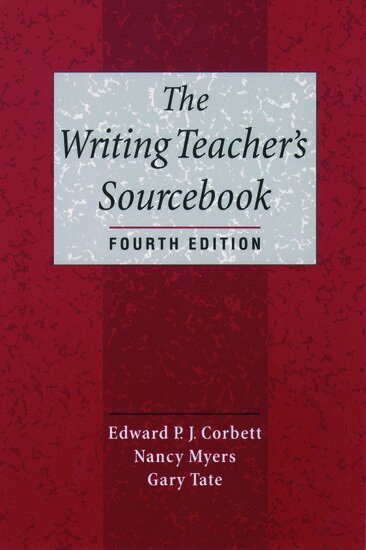
The Writing Teacher's Sourcebook is a collection of professional essays on the teaching of writing. It is assigned in graduate courses on the teaching of composition. The authors Tate, Corbett, and Myers are widely respected for their work in rhetoric and composition. The authors have added eleven new essays to the fourth edition and have deleted some essays from the previous edition.
"A great resource for writing teachers and writing program administrators. It provides ready access to current discussions about teaching writing, and does so succinctly."--Brian Whaley, University of Oregon"An excellent overview. This book would be useful not only for composition scholars and instructors, but for anyone in any field who feels obligated to teach his or her students how to write."--Tom Philion, University of Illinois-Chicago"Provides a broad-based awareness of contemporary perspectives on composition pedagogy."--Jerie Weasmer, Eastern Illinois UniversityPraise for the previous edition (first 4 quotes): "A classic introduction to the profession, for which the editors have selected a series of essays whose focus is openly practical and pedagogical--thus adamantly reasserting the close connection of our scholarship with the classroom. A wide-ranging and useful collection of essays for teachers, both beginning and experienced."--College Composition and Communication"Still the best casebook for new writing teachers."--Patrick Scott, University of South Carolina"Each edition of the book is stronger than the previous one. Both within and among chapters there is appropriate balance of theory and practice--just what new teachers need."--Duane H. Roen, Arizona State University"Ideal for a course in teaching College Comp!"--Russ Larson, Eastern Michigan University
Innehållsförteckning
Preface1. THE CONTEXTS OF TEACHINGPERSPECTIVESRichard Fulkerson: Four Philosophies of CompositionJames Berlin: Rhetoric and Ideology in the Writing ClassEdward P.J. Corbett: Rhetoric, the Enabling DisciplineMin-Zhan Lu and Bruce Horner: The Problematic of Experience: Redefining Critical Work in Ethnography and PedagogyTEACHERSPeter Elbow: Embracing Contraries in the Teaching ProcessDonald M. Murray: The Listening Eye: Reflections on the Writing ConferenceLad Tobin: Reading Students, Reading Ourselves: Revising the Teacher's Role in the Writing ClassDan Morgan: Ethical Issues Raised by Students' Personal WritingSTUDENTSMina P. Shaughnessy: Diving In: An Introduction to Basic WritingVivian Zamel: Strangers in Academia: The Experiences of Faculty and ESL Students Across the CurriculumTodd Taylor: The Persistence of Difference in Networked Classrooms: Non-Negotiable Difference and the African American Student BodyLOCATIONSHephzibah Roskelly: The Risky Business of Group WorkGail E. Hawisher and Cynthia L. Selfe: The Rhetoric of Technology and the Electronic Writing ClassMuriel Harris: Talking in the Middle: Why Writers Need Writing TutorsAPPROACHESMin-Zhan Lu: Redefining the Legacy of Mina Shaughnessy: A Critique of the Politics of Linguistic InnocenceMariolina Salvatori: Conversations with Texts: Reading in the Teaching of CompositionGary Tate: A Place for Literature in Freshman CompositionCarolyn Matalene: Experience as Evidence: Teaching Students to Write Honestly and Knowledgeably about Public Issues2. THE TEACHING OF WRITINGASSIGNINGMike Rose: Remedial Writing Courses: A Critique and a ProposalDavid Peck, Elizabeth Hoffman, and Mike Rose: A Comment and Response on "Remedial Writing Courses"Richard L. Larson: The "Research Paper" in the Writing Course: A Non-Form of WritingJeanne Fahnestock and Marie Secor: Teaching Argument: A Theory of TypesCatherine E. Lamb: Beyond Argument in Feminist CompositionRESPONDING AND ASSESSINGBrooke K. Horvath: The Components of Written Response: A Practical Synthesis of Current ViewsDavid Bartholomae: The Study of ErrorJerry Farber: Learning How to Teach: A Progress ReportCOMPOSING AND REVISINGNancy Sommers: Between the DraftsJames A. Reither: Writing and Knowing: Toward Redefining the Writing ProcessDavid Bleich: Collaboration and the Pedagogy of DisclosureAUDIENCESDouglas B. Park: The Meanings of "Audience"Lisa Ede and Andrea Lunsford: Audience Addressed/Audience Invoked: The Role of Audience in Composition Theory and PedagogyPeter Elbow: Closing My Eyes as I Speak: An Argument for Ignoring AudienceSTYLESRobert J. Connors: Static Abstractions and CompositionWinston Weathers: Teaching Style: A Possible AnatomyElizabeth D. Rankin: Revitalizing Style: Toward a New Theory and PedagogyRichard Ohmann: Use Definite, Specific, Concrete Language