• Fri frakt över 249 kr
  • •
  • Snabba leveranser
  • •
  • Billiga böcker
Kundservice

Du är på sajten för privatpersoner.

Företag, bibliotek eller offentlig verksamhet?

Du handlar på classic.bokus.com, där alla dina funktioner finns intakta.
Till classic.bokus.com
Bokus logotyp. Gå till startsidan.
  • Erbjudanden
  • Student
  • Topplistor
  • Barn & ungdom
  • Bokus Play
  • E-böcker
  • Ljudböcker
  • Pocketböcker
  • Spel och pussel

Pocketfynda! Hundratals böcker för 49 kr/st →

Sidfot

Mina sidor

    Hjälp

    • Kundservice
    • Vanliga frågor och svar
    • Frakt och leverans
    • Retur vid ångerrätt
    • Reklamera vara
    • Betalning
    • Köpvillkor
    • Allmänna villkor
    • Information om webbplatsens tillgänglighet

    Om Bokus

    • Om oss
    • Pressrum
    • För studenter
    • För företag
    • För bibliotek och offentlig verksamhet
    • För leverantörer
    • Hållbarhet

    Populärt

    • Aktuella erbjudanden
    • Presentkort
    • Studentlitteratur
    • Nya böcker
    • Topplistor
    • Signerade böcker
    • Engelska böcker

    Inspiration

    • Boktips
    • BookTok
    • Barnbokskaraktärer
    • Populära författare
    Logotyp för Bokus
    Följ oss på Facebook (extern länk)Följ oss på Instagram (extern länk)Följ oss på YouTube (extern länk)Följ oss på TikTok (extern länk)
    bokus @ CookiesAnpassa cookiesIntegritetspolicyKöpvillkor
    Till Citymail hemsida (extern länk)Till Budbee hemsida (extern länk)Till Postnord hemsida (extern länk)Till Schenker hemsida (extern länk)Till Early Bird hemsida (extern länk)Till Walleys hemsida (extern länk)
    1. Filosofi och religion
    2. Filosofi
    3. Filosofiska discipliner

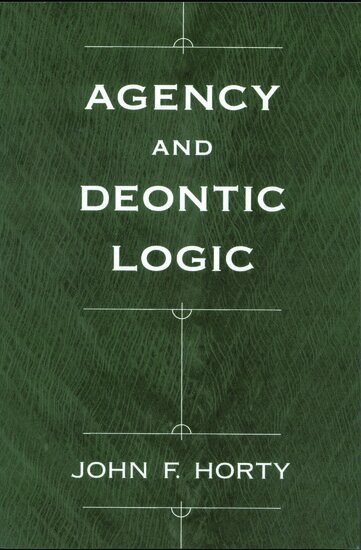
    Agency and Deontic Logic

    AvJohn Horty

    Häftad, Engelska, 2009

    593 kr

    Beställningsvara. Skickas inom 7-10 vardagar. Fri frakt över 249 kr.

    Beskrivning

    John Horty effectively develops deontic logic (the logic of ethical concepts like obligation and permission) against the background of a formal theory of agency. He incorporates certain elements of decision theory to set out a new deontic account of what agents ought to do under various conditions over extended periods of time. Offering a conceptual rather than technical emphasis, Horty's framework allows a number of recent issues from moral theory to be set out clearly and discussed from a uniform point of view.

    Produktinformation

    • Utgivningsdatum:2009-11-05
    • Mått:234 x 155 x 17 mm
    • Vikt:326 g
    • Format:Häftad
    • Språk:Engelska
    • Antal sidor:208
    • Förlag:OUP USA
    • ISBN:9780195391985

    Utforska kategorier

    • Filosofiska discipliner inom Filosofi och religion

    Mer om författaren

    John Horty is a Professor in the Philosophy Department and the Institute for Advanced Computer Studies at the University of Maryland. He is the author of Frege on Definitions (Oxford, 2007) as well as papers on a variety of topics in logic, philosophy, and computer science.

    Recensioner i media

    "Agency and Deontic Logic represents a major advance in the field, developing fresh ideas for thinking about longstanding internal problems and making significant connections with external areas of research, most notably decision theory and utilitarian ethical theory. Although the book is technically sophisticated, the discussion is exceptionally clear and readable and benefits greatly from numerous examples and diagrams. Agency and Deontic Logic should interest an audience that includes logicians, computer scientists, and those working in decision theory, game theory, and ethics, as well as applications of these disciplines.

    Innehållsförteckning

    • 1. OVERVIEW ; 2. INDETERMINISM AND AGENCY ; 2.1 Branching time ; 2.1.1 Frames and Models ; 2.1.2 2.1.2 Propositions ; 2.2 Individual agency ; 2.2.1 Agents and choices ; 2.2.2 Stit operators ; 2.2.3 Some logical considerations ; 2.3 Individual ability ; 2.3.1 Kenny's objections ; 2.3.2 Brown's theory ; 2.3.3 Refraining and ability ; 2.4 Group agency and ability ; 2.4.1 Group actions ; 2.4.2 A group agency operator ; 3. OUGHT TO BE ; 3.1 The standard theory ; 3.2 A utilitarian theory ; 3.2.1 General models ; 3.2.2 Utilitarian models ; 3.2.3 Logic of the utilitarian ought ; 3.3 The Meinong/Chisholm analysis ; 3.3.1 The analysis ; 3.3.2 Some logical features ; 3.4 Evaluating the analysis ; 3.4.1 Agency in the complement ; 3.4.2 The gambling problem ; 4. OUGHT TO DO ; 4.1 Dominance ; 4.1.1 Ordering the propositions ; 4.1.2 A sure-thing argument ; 4.1.3 Ordering the actions ; 4.2 Dominance act utilitarianism ; 4.2.1 Optimal actions ; 4.2.2 The finite choice condition ; 4.3 A new deontic operator ; 4.3.1 The definition ; 4.3.2 Deontic logic and act utilitarianism ; 4.3.3 Logic of the dominance ought ; 4.4 Independence ; 4.4.1 Independence and conditionals ; 4.4.2 Conditionals and sure-thing reasoning ; 4.4.3 Refining the analysis ; 5. CONDITIONAL OUGHTS ; 5.1 Conditionally optimal actions ; 5.2 A conditional operator ; 5.2.1 The definition ; 5.2.2 Some logical considerations ; 5.3 Two patterns of argument ; 5.3.1 The action argument ; 5.3.2 The ought argument ; 5.4 Orthodox act utilitarianism ; 5.4.1 An example ; 5.4.2 The definition ; 5.4.3 An orthodox deontic operator ; 6. GROUP OUGHTS ; 6.1 Optimal group actions ; 6.2 Individual and group act utilitarianism ; 6.3 Deontic operators for group oughts ; 6.3.1 Definitions ; 6.3.2 Some logical points ; 6.4 Rule utilitarianism ; 6.4.1 Formulating the theory ; 6.4.2 Act and rule utilitarianism ; 7. STRATEGIC OUGHTS ; 7.1 Strategies ; 7.1.1 Basic idea ; 7.1.2 Limiting the range ; 7.2 Strategies and choices ; 7.2.1 Agency ; 7.2.2 Ability ; 7.3 Strategic dominance and optimality ; 7.3.1 Dominance ; 7.3.2 Optimality ; 7.4 A strategic ought operator ; 7.4.1 The definition ; 7.4.2 Logical points ; 7.4.3 Actualism and possibilism ; A. Proofs of validities and propositions ; A.1 Validities ; A.2 Propositions ; Bibliography ; Index