• Fri frakt över 249 kr
  • •
  • Snabba leveranser
  • •
  • Billiga böcker
Kundservice

Du är på sajten för privatpersoner.

Företag, bibliotek eller offentlig verksamhet?

Du handlar på classic.bokus.com, där alla dina funktioner finns intakta.
Till classic.bokus.com
Bokus logotyp. Gå till startsidan.
  • Erbjudanden
  • Student
  • Topplistor
  • Barn & ungdom
  • Bokus Play
  • E-böcker
  • Ljudböcker
  • Pocketböcker
  • Spel & pussel

Upp till 25% på utvalda nyheter →

Sidfot

Mina sidor

    Hjälp

    • Kundservice
    • Vanliga frågor och svar
    • Frakt och leverans
    • Retur vid ångerrätt
    • Reklamera vara
    • Betalning
    • Köpvillkor
    • Allmänna villkor
    • Information om webbplatsens tillgänglighet

    Om Bokus

    • Om oss
    • Pressrum
    • För studenter
    • För företag
    • För bibliotek och offentlig verksamhet
    • För leverantörer
    • Hållbarhet

    Populärt

    • Aktuella erbjudanden
    • Presentkort
    • Studentlitteratur
    • Nya böcker
    • Topplistor
    • Signerade böcker
    • Engelska böcker

    Inspiration

    • Boktips
    • BookTok
    • Populära bokserier
    • Barnbokskaraktärer
    • Populära författare
    Logotyp för Bokus
    Följ oss på Facebook (extern länk)Följ oss på Instagram (extern länk)Följ oss på YouTube (extern länk)Följ oss på TikTok (extern länk)
    bokus @ CookiesAnpassa cookiesIntegritetspolicyKöpvillkor
    Till Citymail hemsida (extern länk)Till Budbee hemsida (extern länk)Till Postnord hemsida (extern länk)Till Schenker hemsida (extern länk)Till Early Bird hemsida (extern länk)Till Walleys hemsida (extern länk)
    1. Psykologi och pedagogik
    2. Psykologi
    3. Psykologiska teorier och skolor

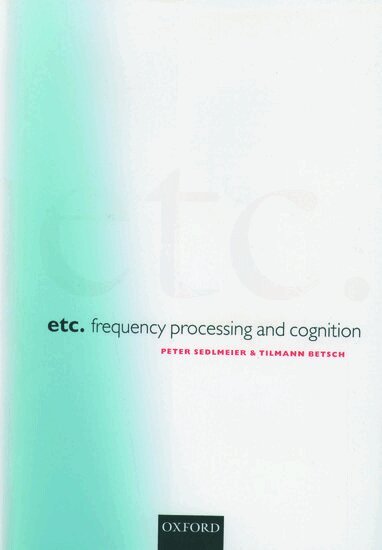
    Etc.

    Frequency Processing and Cognition

    AvSEDLMEIER,Peter Sedlmeier

    Inbunden, Engelska, 2002

    3 507 kr

    Beställningsvara. Skickas inom 5-8 vardagar. Fri frakt över 249 kr.

    Beskrivning

    From childhood, each of us develops our own personal set of theories and beliefs about the world in which we live. Given the impossibility of knowing about every event that can ever take place, we use cognitive short cuts to try to predict and make sense of the world around us. One of the fundamental pieces of information we use to predict future events, and make sense of past events, is 'frequency' - how often has such an event happened to us, or how often have we observed a particular event? With such information we will make inferences about the likelihood of its future appearance. We will make judgements, assess risk, or even consumer decisions, on the basis of this information. We also form associations between events that frequently occur together, and even (often incorrectly) attribute causality between one event and the other as a result of their simultaneous appearance. How is it though that we process such information? How does our brain deal with information on frequencies? How does such information influence our behaviour, beliefs, and judgements? Important new findings on this topic have come from research within both social and cognitive psychology, though until now, never brought together in a single volume. This is the first book to bring together two disparate literatures on this topic - drawing on research from both cognitive psychology and social psychology. Including contributions from world leaders in the field, this is a timely, and long overdue volume on this topic.

    Produktinformation

    • Utgivningsdatum:2002-08-15
    • Mått:175 x 247 x 23 mm
    • Vikt:686 g
    • Format:Inbunden
    • Språk:Engelska
    • Antal sidor:332
    • Förlag:OUP OXFORD
    • ISBN:9780198508632

    Utforska kategorier

    • Psykologiska teorier och skolor inom Psykologi och pedagogik
    • Kognitiv psykologi inom Psykologi och pedagogik
    • Socialpsykologi och gruppsykologi inom Psykologi och pedagogik

    Recensioner i media

    This excellent collection provides the reader with a comprehensive coverage of findings and theories about how people encode and summarize frequency information. While it is a smorgasbord of self-contained chapters with little cross-referencing (or elaboration of disagreements), the high quality of the vast majority of these chapters yields a cognitive feast. They are written by eminent researchers who have opted to present both recent results and summaries of their most important work - certainly not the feared secondary idea or paper submitted because it would be easier to publish in an edited volume than in critically peer reviewed journal.

    Innehållsförteckning

    • 1. Frequency Processing and Cognition: Introduction and Overview ; THEORETICAL MODELS AND PERSPECTIVES ; 2. Frequency processing: A twenty-five year perspective ; 3. Encoding, representing and estimating event frequencies: A multiple strategy perspective ; 4. In the year 2054: Innumeracy defeated ; 5. Frequency judgements and retrieval structures: Splitting, zooming and merging the units of the empirical world ; 6. Experiential and contextual heuristics in frequency judgement: Ease of recall and response scales ; 7. Tversky and Kahneman's availability approach to frequency judgement: a critical analysis ; 8. A memory models approach to frequency and probability judgement: Applications of Minerva 2 and Minerva-DM ; 9. Associative learning and frequency judgements: The PASS model ; 10. Frequency, contingency and the information processing theory of conditioning ; ESSENTIAL EMPIRICAL RESULTS ; 11. Effects of processing fluency on estimates of probability and frequency ; 12. Frequency judgements of emotions: The cognitive basis of personality assessment ; 13. Online strategies versus memory-based strategies in frequency estimation ; 14. Frequency learning and order effects in belief updating ; 15. The psychophysics metaphor in calibration research ; PRACTICAL IMPLICATIONS ; 16. Frequency effects in consumer decision making ; 17. Free word associations and the frequency of co-occurrence in language use ; 18. Technology needs Psychology: How natural frequencies foster insight in medical and legal experts ; 19. Frequency processing and cognition: Stock-taking and outlook