• Fri frakt över 249 kr
  • •
  • Snabba leveranser
  • •
  • Billiga böcker
Kundservice

Du är på sajten för privatpersoner.

Företag, bibliotek eller offentlig verksamhet?

Du handlar på classic.bokus.com, där alla dina funktioner finns intakta.
Till classic.bokus.com
Bokus logotyp. Gå till startsidan.
  • Erbjudanden
  • Student
  • Topplistor
  • Barn & ungdom
  • Bokus Play
  • E-böcker
  • Ljudböcker
  • Pocketböcker
  • Spel & pussel

Upp till 25% på utvalda nyheter →

Sidfot

Mina sidor

    Hjälp

    • Kundservice
    • Vanliga frågor och svar
    • Frakt och leverans
    • Retur vid ångerrätt
    • Reklamera vara
    • Betalning
    • Köpvillkor
    • Allmänna villkor
    • Information om webbplatsens tillgänglighet

    Om Bokus

    • Om oss
    • Pressrum
    • För studenter
    • För företag
    • För bibliotek och offentlig verksamhet
    • För leverantörer
    • Hållbarhet

    Populärt

    • Aktuella erbjudanden
    • Presentkort
    • Studentlitteratur
    • Nya böcker
    • Topplistor
    • Signerade böcker
    • Engelska böcker

    Inspiration

    • Boktips
    • BookTok
    • Populära bokserier
    • Barnbokskaraktärer
    • Populära författare
    Logotyp för Bokus
    Följ oss på Facebook (extern länk)Följ oss på Instagram (extern länk)Följ oss på YouTube (extern länk)Följ oss på TikTok (extern länk)
    bokus @ CookiesAnpassa cookiesIntegritetspolicyKöpvillkor
    Till Citymail hemsida (extern länk)Till Budbee hemsida (extern länk)Till Postnord hemsida (extern länk)Till Schenker hemsida (extern länk)Till Early Bird hemsida (extern länk)Till Walleys hemsida (extern länk)
    1. Data och IT
    2. Programmeringsböcker
    3. Programvaruutveckling

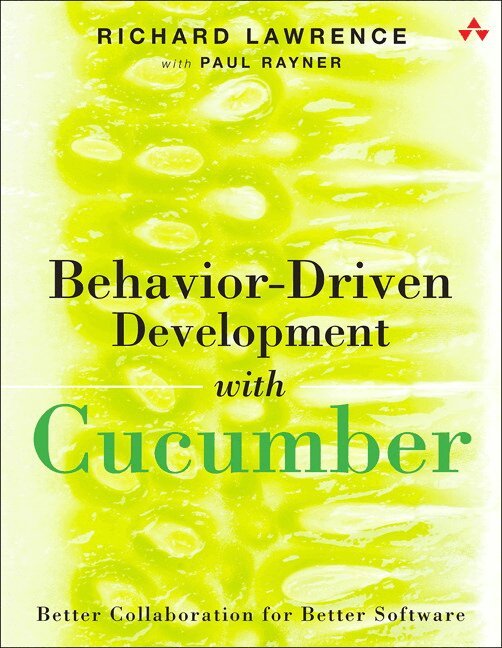
    Behavior-Driven Development with Cucumber

    Better Collaboration for Better Software

    AvRichard Lawrence,Paul Rayner

    Häftad, Engelska, 2019

    245 kr

    Beställningsvara. Skickas inom 7-10 vardagar. Fri frakt över 249 kr.

    Beskrivning

    Master BDD to deliver higher-value software more quickly


    To develop high-value products quickly, software development teams need better ways to collaborate. Agile methods like Scrum and Kanban are helpful, but they’re not enough. Teams need better ways to work inside each sprint or work item. Behavior-driven development (BDD) adds just enough structure for product experts, testers, and developers to collaborate more effectively.


    Drawing on extensive experience helping teams adopt BDD, Richard Lawrence and Paul Rayner show how to explore changes in system behavior with examples through conversations, how to capture your examples in expressive language, and how to flow the results into effective automated testing with Cucumber. Where most BDD resources focus on test automation, this guide goes deep into how BDD changes team collaboration and what that collaboration looks like day to day. Concrete examples and practical advice will prepare you to succeed with BDD, whatever your context or role.


    ·         Learn how to collaborate better by using concrete examples of system behavior

    ·         Identify your project’s meaningful increment of value so you’re always working on something important

    ·         Begin experimenting with BDD slowly and at low risk

    ·         Move smoothly from informal examples to automated tests in Cucumber

    ·         Use BDD to deliver more frequently with greater visibility

    ·         Make Cucumber scenarios more expressive to ensure you’re building the right thing

    ·         Grow a Cucumber suite that acts as high-value living documentation

    ·         Sustainably work with complex scenario data

    ·         Get beyond the “mini-waterfalls” that often arise on Scrum teams 

    Produktinformation

    • Utgivningsdatum:2019-06-28
    • Mått:180 x 230 x 10 mm
    • Vikt:342 g
    • Format:Häftad
    • Språk:Engelska
    • Antal sidor:208
    • Upplaga:1
    • Förlag:Pearson Education
    • ISBN:9780321772633

    Utforska kategorier

    • Programvaruutveckling inom Data och IT
    • Programmeringsböcker inom Data och IT

    Mer om författaren

    Richard Lawrence is co-owner of the consulting firm Agile For All. He trains and coaches people to collaborate more effectively with other people to solve complex, meaningful problems. He draws on a diverse background in software development, engineering, anthropology, and political science. Richard was an early adopter of behavior-driven development and led the development of the first .NET version of Cucumber, Cuke4Nuke. He is a popular speaker at conferences on BDD and Agile software development. Paul Rayner co-founded and co-leads DDD Denver. He regularly speaks at local user groups and at regional and international conferences. If you are looking for an expert hands-on team coach and design mentor in domain-driven design (DDD), BDD with Cucumber, or lean/agile processes, Paul is available for consulting and training through his company, Virtual Genius LLC.

    Innehållsförteckning

    • Chapter 1: Focusing on Value When Scrum Isn’t EnoughFinding a High-Value Feature to Start WithBefore You Start with CucumberFinding the First MMFSlicing an MMF into User StoriesSummaryReferenceChapter 2: Exploring with ExamplesBDD Is a Cooperative GameBDD Is a Whole Team ThingAllow Time and Space to LearnFlesh Out the Happy Path FirstUse Real ExamplesExample Mapping Gives the Discussion StructureOptimizing for DiscoveryAddressing Some ConcernsTreat Resistance as a ResourcePlaying the BDD GameOpeningExploringClosingSummaryReferencesChapter 3: Formalizing Examples into ScenariosMoving from Examples to ScenariosFeature Files as Collaboration PointsBDD Is Iterative, Not LinearFinding the Meaningful VariationsGherkin: A Language for Expressive ScenariosSummaryResourcesChapter 4: Automating ExamplesThe Test Automation StackAdjusting to Working Test-FirstAnnotating Element Names in MockupsHow Does User Experience Design Fit In to This?Did They Really Just Hard Code Those Results?Anatomy of a Step DefinitionSimple Cucumber ExpressionsRegular ExpressionsAnchorsWildcards and QuantifiersCapturing and Not CapturingJust EnoughCustom Cucumber Expressions Parameter TypesBeyond RubySlow Is Normal (at First)Choose Cucumber Based on Audience, Not ScopeSummaryChapter 5: Frequent Delivery and VisibilityHow BDD Changes the Tester’s RoleExploratory TestingBDD and Automated BuildsFaster Stakeholder FeedbackHow Getting to Done More Often Changes All Sorts of ThingsFrequent Visibility and Legacy SystemsDocumentation: Integrated and LivingAvoiding Mini-Waterfalls and Making the Change StickSummaryReferencesChapter 6: Making Scenarios More ExpressiveFeedback About ScenariosHow to Make Your Scenarios More ExpressiveFinding the Right Level of AbstractionIncluding the Appropriate DetailsExpressive Language in the StepsRefactoring ScenariosGood Scenario TitlesSummaryReferencesChapter 7: Growing Living DocumentationWhat Is Living Documentation and Why Is It Better?Cucumber Features and Other DocumentationAvoid Gherkin in User Story DescriptionsThe Unexpected Relationship Between Cucumber Features and User StoriesStable ScenariosGrowing and Splitting FeaturesSplit When Backgrounds DivergeSplit When a New Domain Concept EmergesSecondary Organization Using TagsStructure Is EmergentSummaryChapter 8: Succeeding with Scenario DataCharacteristics of Good ScenariosIndependentRepeatableResearchableRealisticRobustMaintainableFastSharing DataWhen to Share DataRaising the Level of Abstraction with Data PersonasData CleanupSummaryReferenceChapter 9: Conclusion    9780321772633   TOC   4/22/2019