• Fri frakt över 249 kr
  • •
  • Snabba leveranser
  • •
  • Billiga böcker
Kundservice

Du är på sajten för privatpersoner.

Företag, bibliotek eller offentlig verksamhet?

Du handlar på classic.bokus.com, där alla dina funktioner finns intakta.
Till classic.bokus.com
Bokus logotyp. Gå till startsidan.
  • Erbjudanden
  • Student
  • Topplistor
  • Barn & ungdom
  • Bokus Play
  • E-böcker
  • Ljudböcker
  • Pocketböcker
  • Spel och pussel

Pocketfynda! Hundratals böcker för 49 kr/st →

Sidfot

Mina sidor

    Hjälp

    • Kundservice
    • Vanliga frågor och svar
    • Frakt och leverans
    • Retur vid ångerrätt
    • Reklamera vara
    • Betalning
    • Köpvillkor
    • Allmänna villkor
    • Information om webbplatsens tillgänglighet

    Om Bokus

    • Om oss
    • Pressrum
    • För studenter
    • För företag
    • För bibliotek och offentlig verksamhet
    • För leverantörer
    • Hållbarhet

    Populärt

    • Aktuella erbjudanden
    • Presentkort
    • Studentlitteratur
    • Nya böcker
    • Topplistor
    • Signerade böcker
    • Engelska böcker

    Inspiration

    • Boktips
    • BookTok
    • Barnbokskaraktärer
    • Populära författare
    Logotyp för Bokus
    Följ oss på Facebook (extern länk)Följ oss på Instagram (extern länk)Följ oss på YouTube (extern länk)Följ oss på TikTok (extern länk)
    bokus @ CookiesAnpassa cookiesIntegritetspolicyKöpvillkor
    Till Citymail hemsida (extern länk)Till Budbee hemsida (extern länk)Till Postnord hemsida (extern länk)Till Schenker hemsida (extern länk)Till Early Bird hemsida (extern länk)Till Walleys hemsida (extern länk)
    1. Naturvetenskap och teknik
    2. Teknik och industri
    3. Elektronik och kommunikationer

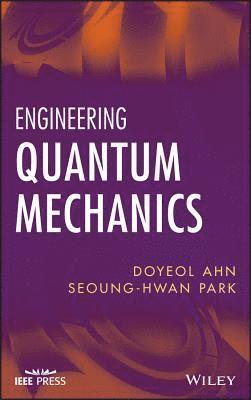
    Engineering Quantum Mechanics

    AvDoyeol Ahn,Seoung-Hwan Park

    Inbunden, Engelska, 2011

    Del i serien IEEE Press

    1 709 kr

    Beställningsvara. Skickas inom 5-8 vardagar. Fri frakt över 249 kr.

    Beskrivning

    There has been growing interest in the model of semiconductor lasers with non-Markovian relaxation. Introducing senior and graduate students and research scientists to quantum mechanics concepts, which are becoming an essential tool in modern engineering, Engineering Quantum Mechanics develops a non-Markovian model for the optical gain of semiconductor, taking into account the rigorous electronic band-structure and the non-Markovian relaxation using the quantum statistical reduced-density operator formalism. Example programs based on Fortran 77 are provided for band-structures of zinc-blende and wurtzite quantum wells.

    Produktinformation

    • Utgivningsdatum:2011-08-05
    • Mått:160 x 244 x 23 mm
    • Vikt:603 g
    • Format:Inbunden
    • Språk:Engelska
    • Serie:IEEE Press
    • Antal sidor:314
    • Förlag:John Wiley & Sons Inc
    • ISBN:9780470107638

    Utforska kategorier

    • Elektronik och kommunikationer inom Naturvetenskap och teknik
    • Fysik inom Naturvetenskap och teknik

    Mer om författaren

    DOYEOL AHN, PHD, is WB Distinguished Professor of Quantum Electronics in the Department of Electrical and Computer Engineering at the University of Seoul (Korea). A Fellow of the American Physical Society and an IEEE Fellow, he has coauthored more than 190 refereed journal papers and three book chapters, and holds seven U.S. patents to date. SEOUNG-HWAN PARK, PHD, is Professor in the Department of Electronics Engineering at the Catholic University of Daegu (Korea). He has written two book chapters and coauthored more than 160 refereed journal and conference papers.

    Recensioner i media

    “The present book is intended for advanced undergraduate and graduate students in electrical engineering, physics, and material science. It also provides the necessary theoretical back-ground for researchers in optoelectronics or semiconductor devices.”  (Zentralblatt MATH, 2012)"Ahn (quantum electronics, U. of Seoul) and Park (electronic engineering, Catholic U. of Daegu, Korea) present a textbook for graduate and advanced undergraduate students in electrical engineering, physics, and materials science and engineering on quantum mechanics as it is increasingly being used in these fields. It also provides the necessary theoretical background for researchers in optoelectronics or semiconductor devices." (Book News, 1 October 2011)

    Innehållsförteckning

    • Preface vii PART I Fundamentals 11 Basic Quantum Mechanics 31.1 Measurements and Probability 31.2 Dirac Formulation 41.3 Brief Detour to Classical Mechanics 81.4 A Road to Quantum Mechanics 141.5 The Uncertainty Principle 211.6 The Harmonic Oscillator 221.7 Angular Momentum Eigenstates 291.8 Quantization of Electromagnetic Fields 351.9 Perturbation Theory 38Problems 41References 432 Basic Quantum Statistical Mechanics 452.1 Elementary Statistical Mechanics 452.2 Second Quantization 512.3 Density Operators 542.4 The Coherent State 582.5 The Squeezed State 622.6 Coherent Interactions Between Atoms and Fields 682.7 The Jaynes–Cummings Model 69Problems 71References 723 Elementary Theory of Electronic Band Structure in Semiconductors 733.1 Bloch Theorem and Effective Mass Theory 733.2 The Luttinger–Kohn Hamiltonian 843.3 The Zinc Blende Hamiltonian 1053.4 The Wurtzite Hamiltonian 1143.5 Band Structure of Zinc Blende and Wurtzite Semiconductors 1233.6 Crystal Orientation Effects on a Zinc Blende Hamiltonian 1353.7 Crystal Orientation Effects on a Wurtzite Hamiltonian 152Problems 168References 169PART II Modern Applications 1714 Quantum Information Science 1734.1 Quantum Bits and Tensor Products 1734.2 Quantum Entanglement 1754.3 Quantum Teleportation 1784.4 Evolution of the Quantum State: Quantum Information Processing 1804.5 A Measure of Information 1834.6 Quantum Black Holes 184Appendix A: Derivation of Equation (4.82) 202Appendix B: Derivation of Equations (4.93) and (4.106) 203Problems 204References 2055 Modern Semiconductor Laser Theory 2075.1 Density Operator Description of Optical Interactions 2095.2 The Time-Convolutionless Equation 2115.3 The Theory of Non-Markovian Optical Gain in Semiconductor Lasers 2235.4 Optical Gain of a Quantum Well Laser with Non-Markovian Relaxation and Many-Body Effects 2325.5 Numerical Methods for Valence Band Structure in Nanostructures 2355.6 Zinc Blende Bulk and Quantum Well Structures 2525.7 Wurtzite Bulk and Quantum Well Structures 2585.8 Quantum Wires and Quantum Dots 265Appendix: Fortran 77 Code for the Band Structure 274Problems 286References 287Index 289