- Nyhet
Del 27 i serien Adaptive and Cognitive Dynamic Systems: Signal Processing, Learning, Communications and Control
1 833 kr
Beställningsvara. Skickas inom 7-10 vardagar. Fri frakt över 249 kr.
Beskrivning
Produktinformation
- Utgivningsdatum:2002-01-09
- Mått:162 x 238 x 22 mm
- Vikt:621 g
- Format:Inbunden
- Språk:Engelska
- Serie:Adaptive and Cognitive Dynamic Systems: Signal Processing, Learning, Communications and Control
- Antal sidor:368
- Förlag:John Wiley & Sons Inc
- ISBN:9780471406372
Utforska kategorier
Mer om författaren
STEVE MANN is Professor in the Department of Electrical Engineering and Computer Engineering at the University of Toronto.
Innehållsförteckning
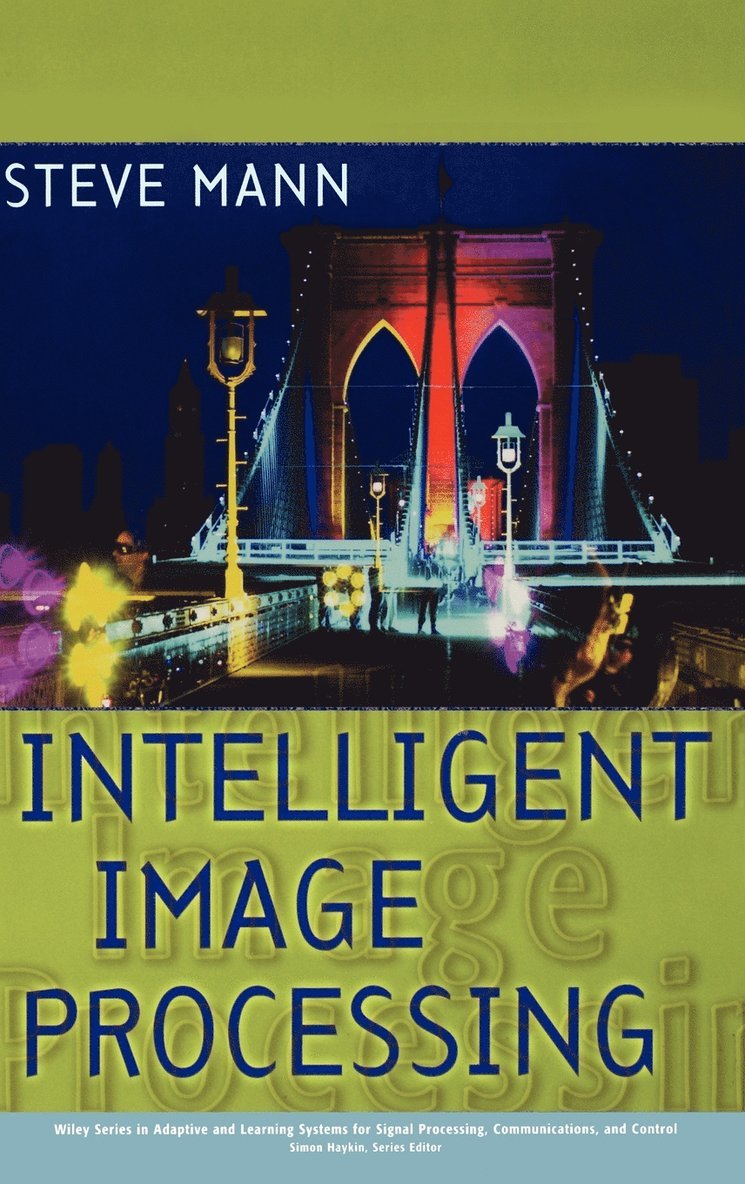
- Preface 1 Humanistic Intelligence as a Basis for Intelligent Image Processing 1.1 Humanistic Intelligence/ 1.2 "WearComp" as Means of Realizing Humanistic Intelligence 1.3 Practical Embodiments of Humanistic Intelligence 2 Where on the Body is the Best Place for a Personal Imaging System? 2.1 Portable Imaging Systems 2.2 Personal Handheld Systems 2.3 Concomitant Cover Activities and the Videoclips Camera System 2.4 The Wristwatch Videophone: A Fully Functional "Always Ready" Prototype 2.5 Telepointer: Wearable Hands-Free Completely Self-Contained Visual Augmented Reality 2.6 Portable Personal Pulse Doppler Radar Vision System Based on Time-Frequency Analysis and q-Chirplet Transform 2.7 When Both Camera and Display are Headworn: Personal Imaging and Mediated Reality 2.8 Partially Mediated Reality 2.9 Seeing "Eye-to-Eye" 2.10 Exercises, Problem Sets, and Homework 3 The EyeTap Principle: Effectively Locating the Camera Inside the Eye as an Alternative to Wearable Camera Systems 3.1 A Personal Imaging System for Lifelong Video Capture 3.2 The EyeTap Principle 3.3 Practical Embodiments of EyeTap 3.4 Problems with Previously Known Camera Viewfinders 3.5 The Aremac 3.6 The Foveated Personal Imaging System 3.7 Teaching the EyeTap Principle 3.8 Calibration of EyeTap Systems 3.9 Using the Device as a Reality Mediator 3.10 User Studies 3.11 Summary and Conclusions 3.12 Exercises, Problem Sets, and Homework 4 Comparametric Equations, Quantigraphic Image Processing, and Comparagraphic Rendering 4.1 Historical Background 4.2 The Wyckoff Principle and the Range of Light 4.3 Comparametric Image Processing: Comparing Differently Exposed Images of the Same Subject Matter 4.4 The Comparagram: Practical Implementations of Comparanalysis 4.5 Spatiotonal Photoquantigraphic Filters 4.6 Glossary of Functions 4.7 Exercises, Problem Sets, and Homework 5 Lightspace and Antihomomorphic Vector Spaces 5.1 Lightspace 5.2 The Lightspace Analysis Function 5.3 The "Spotflash" Primitive 5.4 LAF×LSF Imaging ("Lightspace") 5.5 Lightspace Subspaces 5.6 "Lightvector" Subspace 5.7 Painting with Lightvectors: Photographic/Videographic Origins and Applications of WearComp-Based Mediated Reality 5.8 Collaborative Mediated Reality Field Trials 5.9 Conclusions 5.10 Exercises, Problem Sets, and Homework 6 VideoOrbits: The Projective Geometry Renaissance 6.1 VideoOrbits 6.2 Background 6.3 Framework: Motion Parameter Estimation and Optical Flow 6.4 Multiscale Implementations in 2-D 6.5 Performance and Applications 6.6 AGC and the Range of Light 6.7 Joint Estimation of Both Domain and Range Coordinate Transformations 6.8 The Big Picture 6.9 Reality Window Manager 6.10 Application of Orbits: The Photonic Firewall 6.11 All the World's a Skinner Box 6.12 Blocking Spam with a Photonic Filter 6.13 Exercises, Problem Sets, and Homework Appendix A: Safety First! Appendix B: Multiambic Keyer for Use While Engaged in Other Activities B.1 Introduction B.2 Background and Terminology on Keyers B.3 Optimal Keyer Design: The Conformal Keyer B.4 The Seven Stages of a Keypress B.5 The Pentakeyer B.6 Redundancy B.7 Ordinally Conditional Modifiers B.8 Rollover B.8.1 Example of Rollover on a Cybernetic Keyer B.9 Further Increasing the Chordic Redundancy Factor: A More Expressive Keyer B.10 Including One Time Constant B.11 Making a Conformal Multiambic Keyer B.12 Comparison to Related Work B.13 Conclusion B.14 Acknowledgments Appendix C: WearCam GNUX Howto C.1 Installing GNUX on WearComps C.2 Getting Started C.3 Stop the Virus from Running C.4 Making Room for an Operating System C.5 Other Needed Files C.6 Defrag /323 C.7 Fips C.8 Starting Up in GNUX with Ramdisk Appendix D: How to Build a Covert Computer Imaging System into Ordinary Looking Sunglasses D.1 The Move from Sixth-Generation WearComp to Seventh-Generation D.2 Label the Wires! D.3 Soldering Wires Directly to the Kopin CyberDisplay D.4 Completing the Computershades Bibliography Index
Mer från samma författare
Using Video to Support Teacher Reflection and Development in ELT
Laura Baecher, Steve Mann, Cecilia Nobre
1 028 kr
Using Video to Support Teacher Reflection and Development in ELT
Laura Baecher, Steve Mann, Cecilia Nobre
366 kr
Mer från samma serie
Knowledge Based Radar Detection, Tracking and Classification
Fulvio Gini, Muralidhar Rangaswamy
1 917 kr
Nonlinear and Adaptive Control Design
Miroslav Krstic, Ioannis Kanellakopoulos, Petar V. Kokotovic
2 352 kr
Du kanske också är intresserad av
Adaptive Control of Systems with Actuator and Sensor Nonlinearities
Gang Tao, Petar V. Kokotovic
2 022 kr
Nonlinear and Adaptive Control Design
Miroslav Krstic, Ioannis Kanellakopoulos, Petar V. Kokotovic
2 352 kr
Nonlinear Dynamical Systems
Irwin W. Sandberg, James T. Lo, Craig L. Fancourt, José C. Principe, Shigeru Katagiri, Simon Haykin
1 983 kr
Knowledge Based Radar Detection, Tracking and Classification
Fulvio Gini, Muralidhar Rangaswamy
1 917 kr