• Fri frakt över 249 kr
  • •
  • Snabba leveranser
  • •
  • Billiga böcker
Kundservice

Du är på sajten för privatpersoner.

Företag, bibliotek eller offentlig verksamhet?

Du handlar på classic.bokus.com, där alla dina funktioner finns intakta.
Till classic.bokus.com
Bokus logotyp. Gå till startsidan.
  • Erbjudanden
  • Student
  • Topplistor
  • Barn & ungdom
  • Bokus Play
  • E-böcker
  • Ljudböcker
  • Pocketböcker
  • Spel och pussel

Pocketfynda! Hundratals böcker för 49 kr/st →

Sidfot

Mina sidor

    Hjälp

    • Kundservice
    • Vanliga frågor och svar
    • Frakt och leverans
    • Retur vid ångerrätt
    • Reklamera vara
    • Betalning
    • Köpvillkor
    • Allmänna villkor
    • Information om webbplatsens tillgänglighet

    Om Bokus

    • Om oss
    • Pressrum
    • För studenter
    • För företag
    • För bibliotek och offentlig verksamhet
    • För leverantörer
    • Hållbarhet

    Populärt

    • Aktuella erbjudanden
    • Presentkort
    • Studentlitteratur
    • Nya böcker
    • Topplistor
    • Signerade böcker
    • Engelska böcker

    Inspiration

    • Boktips
    • BookTok
    • Barnbokskaraktärer
    • Populära författare
    Logotyp för Bokus
    Följ oss på Facebook (extern länk)Följ oss på Instagram (extern länk)Följ oss på YouTube (extern länk)Följ oss på TikTok (extern länk)
    bokus @ CookiesAnpassa cookiesIntegritetspolicyKöpvillkor
    Till Citymail hemsida (extern länk)Till Budbee hemsida (extern länk)Till Postnord hemsida (extern länk)Till Schenker hemsida (extern länk)Till Early Bird hemsida (extern länk)Till Walleys hemsida (extern länk)
    1. Naturvetenskap och teknik
    2. Teknik och industri
    3. Elektronik och kommunikationer

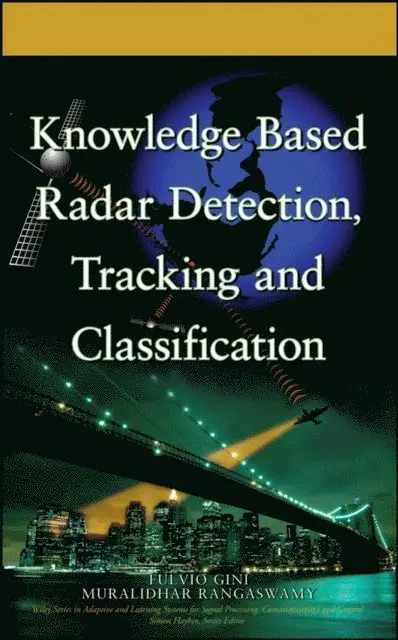
    Knowledge Based Radar Detection, Tracking and Classification

    AvFulvio Gini,Muralidhar Rangaswamy

    Inbunden, Engelska, 2008

    Del 52 i serien Adaptive and Cognitive Dynamic Systems: Signal Processing, Learning, Communications and Control

    1 958 kr

    Beställningsvara. Skickas inom 11-20 vardagar. Fri frakt över 249 kr.

    Beskrivning

    Discover the technology for the next generation of radar systems Here is the first book that brings together the key concepts essential for the application of Knowledge Based Systems (KBS) to radar detection, tracking, classification, and scheduling. The book highlights the latest advances in both KBS and radar signal and data processing, presenting a range of perspectives and innovative results that have set the stage for the next generation of adaptive radar systems.The book begins with a chapter introducing the concept of Knowledge Based (KB) radar.The remaining nine chapters focus on current developments and recent applications of KB concepts to specific radar functions. Among the key topics explored are: Fundamentals of relevant KB techniques KB solutions as they apply to the general radar problem KBS applications for the constant false-alarm rate processor KB control for space-time adaptive processing KB techniques applied to existing radar systems Integrated end-to-end radar signals Data processing with overarching KB control All chapters are self-contained, enabling readers to focus on those topics of greatest interest. Each one begins with introductory remarks, moves on to detailed discussions and analysis, and ends with a list of references. Throughout the presentation, the authors offer examples of how KBS works and how it can dramatically improve radar performance and capability. Moreover, the authors forecast the impact of KB technology on future systems, including important civilian, military, and homeland defense applications.With chapters contributed by leading international researchers and pioneers in the field, this text is recommended for both students and professionals in radar and sonar detection, tracking, and classification and radar resource management.

    Produktinformation

    • Utgivningsdatum:2008-06-06
    • Mått:162 x 240 x 19 mm
    • Vikt:533 g
    • Format:Inbunden
    • Språk:Engelska
    • Serie:Adaptive and Cognitive Dynamic Systems: Signal Processing, Learning, Communications and Control
    • Antal sidor:288
    • Förlag:John Wiley & Sons Inc
    • ISBN:9780470149300

    Utforska kategorier

    • Elektronik och kommunikationer inom Naturvetenskap och teknik
    • Systemvetenskap och AI inom Data och IT

    Mer om författaren

    Fulvio Gini, PhD, IEEE Fellow, is a Full Professor at the University of Pisa, Italy. He was the technical program cochairman of the 2006 EURASIP Signal and Image Processing Conference (Florence, Italy) and the 2008 IEEE Radar Conference (Rome, Italy). His research interests include radar signal processing; cyclostationary signal analysis; non-Gaussian signal modeling, detection, and estimation; and parameter estimation and data extraction from multichannel interferometric SAR data. Professor Gini has coauthored more than eighty refereed journal papers, more than eighty conference papers, and three book chapters. Muralidhar Rangaswamy, PhD, IEEE Fellow, is the Technical Advisor for the Radar Signal Processing Branch at the Sensors Directorate of the Air Force Research Laboratory (AFRL). His research interests include radar signal processing, spectrum estimation, modeling non-Gaussian interference phenomena, and statistical communication theory. Dr. Rangaswamy has coauthored more than eighty refereed journal and conference papers. In addition, he is a contributor to three books and a coinventor on two U.S. patents.

    Innehållsförteckning

    • Contributors xi1 Introduction 1Fulvio Gini and Muralidhar Rangaswamy1.1 Organization of the Book 3Acknowledgments 7References 72 Cognitive Radar 9Simon Haykin2.1 Introduction 92.2 Cognitive Radar Signal-Processing Cycle 102.3 Radar-Scene Analysis 122.3.1 Statistical Modeling of Statistical Representation of Clutter- and Target-Related Information 132.4 Bayesian Target Tracking 142.4.1 One-Step Tracking Prediction 162.4.2 Tracking Filter 162.4.3 Tracking Smoother 182.4.4 Experimental Results: Case Study of Small Target in Sea Clutter 192.4.5 Practical Implications of the Bayesian Target Tracker 202.5 Adaptive Radar Illumination 212.5.1 Simulation Experiments in Support of Adjustable Frequency Modulation 222.6 Echo-Location in Bats 232.7 Discussion 252.7.1 Learning 272.7.2 Applications 272.7.2.1 Multifunction Radars 272.7.2.2 Noncoherent Radar Network 28Acknowledgments 29References 293 Knowledge-Based Radar Signal and Data Processing: A Tutorial Overview 31Gerard T. Capraro, Alfonso Farina, Hugh D. Griffiths, and Michael C. Wicks3.1 Radar Evolution 323.2 Taxonomy of Radar 343.3 Signal Processing 353.4 Data Processing 373.5 Introduction to Artificial Intelligence 383.5.1 Why Robotics and Knowledge-Based Systems? 393.5.2 Knowledge Base Systems (KBS) 393.5.3 Semantic Web Technologies 403.6 A Global View and KB Algorithms 403.6.1 An Airborne Autonomous Intelligent Radar System (AIRS) 423.6.2 Filtering, Detection, and Tracking Algorithms and KB Processing 443.7 Future work 493.7.1 Target Matched Illumination 493.7.2 Spectral Interpolation 493.7.3 Bistatic Radar and Passive Coherent Location 503.7.4 Synthetic Aperture Radar 503.7.5 Resource Allocation in a Multifunction Phased Array Radar 503.7.6 Waveform Diversity and Sensor Geometry 51Acknowledgments 51References 514 An Overview of Knowledge-Aided Adaptive Radar at DARPA and Beyond 55Joseph R. Guerci and Edward J. Baranoski4.1 Introduction 564.1.1 Background on STAP 564.1.2 Examples of Real-World Clutter 604.2 Knowledge-Aided STAP (KA-STAP) 614.2.1 Knowledge-Aided STAP: Back to “Bayes-ics” 614.2.1.1 Case I: Intelligent Training and Filter Selection (ITFS) 624.2.1.2 Case II: Bayesian Filtering and Data Pre-Whitening 634.3 Real-Time KA-STAP: The DARPA KASSPER Program 674.3.1 Obstacles to Real-Time KA-STAP 674.3.2 Solution: Look-Ahead Scheduling 674.4 Applying KA Processing to the Adaptive MIMO Radar Problem 714.5 The Future: Next-Generation Intelligent Adaptive Sensors 72References 725 Space–Time Adaptive Processing for Airborne Radar: A Knowledge–Based Perspective 75Michael C. Wicks, Muralidhar Rangaswamy, Raviraj S. Adve, and Todd B. Hale5.1 Introduction 765.2 Problem Statement 775.3 Low Computation Load Algorithms 815.3.1 Joint Domain Localized Processing 825.3.2 Parametric Adaptive Matched Filter 845.3.3 Multistage Wiener Filter 855.4 Issues of Data Support 865.4.1 Nonhomogeneity Detection 875.4.2 Direct Data Domain Methods 895.4.2.1 Hybrid Approach 905.5 Knowledge-Aided Approaches 915.5.1 A Preliminary Knowledge-Based Processor 925.5.2 Numerical Example 945.5.3 A Long-Term View 985.6 Conclusions 99References 996 CFAR Knowledge-Aided Radar Detection and its Demonstration Using Measured Airborne Data 103Christopher T. Capraro, Gerard T. Capraro, Antonio De Maio, Alfonso Farina, and Michael C. Wicks6.1 Introduction 1036.2 Problem Formulation and Design Issues 1066.3 KA Data Selector 1076.4 2S-DSP Data Selection Procedure 1096.4.1 Two-Step Data Selection Procedure (2S-DSP) 1126.5 RP-ANMF Detector 1136.6 Performance Analysis 1146.7 Conclusions 123References 123Appendix 6A: Registration Geometry 1277 STAP via Knowledge-Aided Covariance Estimation and the FRACTA Meta-Algorithm 129Shannon D. Blunt, Karl Gerlach, Muralidhar Rangaswamy, and Aaron K. Shackelford7.1 Introduction 1307.2 The FRACTA Meta-Algorithm 1327.2.1 The General STAP Model 1327.2.2 FRACTA Description 1347.2.2.1 Reiterative Censoring 1357.2.2.2 CFAR Detector 1377.2.2.3 ACE Detector 1387.3 Practical Aspects of Censoring 1397.3.1 Global Censoring 1397.3.2 Censoring Stopping Criterion 1407.3.3 Fast Reiterative Censoring 1417.3.4 FRACTA Performance 1417.4 Knowledge-Aided FRACTA 1477.4.1 Knowledge-Aided Covariance Estimation 1477.4.2 Doppler-Sensitive ACE Detector 1497.4.3 Performance of Knowledge-Aided FRACTA 1517.5 Partially Adaptive FRACTA 1567.5.1 Reduced-Dimension STAP 1577.5.2 Multiwindow Post-Doppler STAP 1577.5.2.1 PRI-Staggered Post-Doppler STAP 1597.5.2.2 Adjacent-Bin Post-Doppler STAP 1607.5.3 Multiwindow Post-Doppler FRACTA 1607.5.4 Multiwindow Post-Doppler FRACTA þ KACE 1617.5.5 Performance of Partially Adaptive FRACTA þ KACE 1617.6 Conclusions 163References 1638 Knowledge-Based Radar Tracking 167Alessio Benavoli, Luigi Chisci, Alfonso Farina, Sandro Immediata, and Luca Timmoneri8.1 Introduction 1678.2 Architecture of the Tracking Filter 1698.2.1 Filtering 1698.2.2 Data Association 1728.2.3 Track Initiation 1748.3 Tracking with Geographical Information 1768.3.1 Processing of Geographical Maps 1788.3.2 Hard Classification 1798.3.3 Fuzzy Classification 1798.3.4 Application of the KB to the Tracking System 1808.3.5 Hard Classification: DMHC and Dtphc 1828.3.6 Fuzzy Classification: DMLR and a-NNCJPDA 1838.4 Knowledge-Based Target ID 1848.5 Tracking with Amplitude Information 1858.6 Performance Evaluation 1878.6.1 Aircraft Simulation Results 1898.6.2 Number of False Tracks and Tentative Tracks 1928.6.3 The Use of Amplitude Information 1938.7 Conclusions 194Acknowledgments 194References 1959 Knowledge-Based Radar Target Classification 197Igal Bilik and Joseph Tabrikian9.1 Introduction 1979.2 Database 2009.3 Target Recognition by Human Operator 2039.4 Classification Scheme 2039.4.1 Knowledge-Based Models 2059.4.2 Statistical Knowledge-Based Approach 2069.5 Physical Knowledge-Based Approach 2079.5.1 Physical Model Construction 2089.5.2 Indirect Concept 2139.5.3 Direct Concept 2149.6 Combined Approach 2159.7 Experimental Results 2159.7.1 Statistical Knowledge-Based Classifier for the Seven-Class Problem 2169.7.2 Physical Knowledge-Based Classifier for the Three-Class Problem 2189.8 Conclusions 222References 22310 Multifunction Radar Resource Management 225Sergio Luis de Carvalho Miranda, Chris J. Baker, Karl Woodbridge, and Hugh D. Griffiths10.1 Introduction 22510.2 Simulation Architecture 22910.2.1 Priority Assignment 23010.2.2 Surveillance Manager 23010.2.3 Track Manager 23010.2.4 Radar Functions 23110.2.5 Operator and Strategy 23110.3 The Schedulers 23110.3.1 Orman et al. Type Scheduler 23110.3.2 Butler-Type Scheduler 23210.4 Comparison of the Scheduling Algorithms 23210.4.1 Underload Situations 23410.4.2 Overload Situations 23810.5 Scheduling Issues 24310.6 Prioritization of Radar Tasks 24410.6.1 Prioritization of Tracking Tasks 24510.6.2 Prioritization of Sectors of Surveillance 24610.7 Examination of the Fuzzy Logic Method 24810.8 Comparison of the Different Prioritization Methods 25310.9 Prioritization Issues 26110.10 Summary and Conclusions 262References 262Index 265