• Fri frakt över 249 kr
  • •
  • Snabba leveranser
  • •
  • Billiga böcker
Kundservice

Du är på sajten för privatpersoner.

Företag, bibliotek eller offentlig verksamhet?

Du handlar på classic.bokus.com, där alla dina funktioner finns intakta.
Till classic.bokus.com
Bokus logotyp. Gå till startsidan.
  • Erbjudanden
  • Nyheter
  • Student
  • Topplistor
  • Barn & ungdom
  • Bokus Play
  • E-böcker
  • Pocketböcker
  • Spel & pussel

Må bättre, för mindre! Upp till 50% rabatt på hälsoböcker

Sidfot

Mina sidor

    Hjälp

    • Kundservice
    • Vanliga frågor och svar
    • Frakt och leverans
    • Retur vid ångerrätt
    • Reklamera vara
    • Betalning
    • Köpvillkor
    • Allmänna villkor
    • Information om webbplatsens tillgänglighet

    Om Bokus

    • Om oss
    • Pressrum
    • För studenter
    • För företag
    • För bibliotek och offentlig verksamhet
    • För leverantörer
    • Hållbarhet

    Populärt

    • Aktuella erbjudanden
    • Presentkort
    • Studentlitteratur
    • Nya böcker
    • Topplistor
    • Signerade böcker
    • Engelska böcker

    Inspiration

    • Boktips
    • BookTok
    • Populära bokserier
    • Barnbokskaraktärer
    • Populära författare
    Logotyp för Bokus
    Följ oss på Facebook (extern länk)Följ oss på Instagram (extern länk)Följ oss på YouTube (extern länk)Följ oss på TikTok (extern länk)
    bokus @ CookiesAnpassa cookiesIntegritetspolicyKöpvillkor
    Till Citymail hemsida (extern länk)Till Budbee hemsida (extern länk)Till Postnord hemsida (extern länk)Till Schenker hemsida (extern länk)Till Early Bird hemsida (extern länk)Till Walleys hemsida (extern länk)
    1. Samhälle och politik
    2. Politik och statsskick
    3. Statsskick och politiska processer

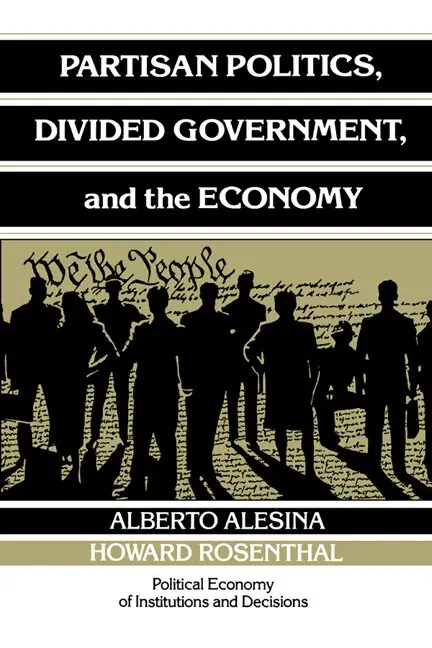
    Partisan Politics, Divided Government, and the Economy

    AvAlberto Alesina,Howard Rosenthal

    Häftad, Engelska, 1995

    Del i serien Political Economy of Institutions and Decisions

    463 kr

    Beställningsvara. Skickas inom 10-15 vardagar. Fri frakt över 249 kr.

    Beskrivning

    This book develops an integrated approach to understanding the American economy and national elections. Economic policy is generally seen as the result of a compromise between the President and Congress. Because Democrats and Republicans usually maintain polarised preferences on policy, middle-of-the-road voters seek to balance the President by reinforcing in Congress the party not holding the White House. This balancing leads, always, to relatively moderate policies and, frequently, to divided government. The authors outline the rational partisan business cycle, where Republican administrations begin with recessions, and Democratic ones with expansions, and the midterm cycle, where the President's party loses votes in the midterm congressional election. The book argues that both cycles are the result of uncertainty about the outcome of presidential elections. Other topics covered include retrospective voting on the economy, coat-tails, and incumbency advantage.

    Produktinformation

    • Utgivningsdatum:1995-01-27
    • Mått:153 x 228 x 23 mm
    • Vikt:460 g
    • Format:Häftad
    • Språk:Engelska
    • Serie:Political Economy of Institutions and Decisions
    • Antal sidor:300
    • Förlag:Cambridge University Press
    • ISBN:9780521436205

    Utforska kategorier

    • Statsskick och politiska processer inom Samhälle och politik

    Recensioner i media

    "...a challenging and important work...in this key area of interdisciplinary research, Alesina and Rosenthal's multi-faceted formal arguments and empirical tests are likely to set the standard for many years." Keith Krehbiel, Stanford University

    Innehållsförteckning

    • 1. Introduction; 2. Models of policy divergence; 3. A theory of institutional balancing; 4. The midterm cycle; 5. Diversity, persistence, and mobility; 6. Incumbency and moderation; 7. Partisan business cycles; 8. The President, Congress, and the economy; 9. Economic growth and national elections in the United States: 1915–88; 10. Partisan economic policy and divided government in parliamentary democracies.