• Fri frakt över 249 kr
  • •
  • Snabba leveranser
  • •
  • Billiga böcker
Kundservice

Du är på sajten för privatpersoner.

Företag, bibliotek eller offentlig verksamhet?

Du handlar på classic.bokus.com, där alla dina funktioner finns intakta.
Till classic.bokus.com
Bokus logotyp. Gå till startsidan.
  • Erbjudanden
  • Student
  • Topplistor
  • Barn & ungdom
  • Bokus Play
  • E-böcker
  • Ljudböcker
  • Pocketböcker
  • Spel och pussel

Pocketfynda! Hundratals böcker för 49 kr/st →

Sidfot

Mina sidor

    Hjälp

    • Kundservice
    • Vanliga frågor och svar
    • Frakt och leverans
    • Retur vid ångerrätt
    • Reklamera vara
    • Betalning
    • Köpvillkor
    • Allmänna villkor
    • Information om webbplatsens tillgänglighet

    Om Bokus

    • Om oss
    • Pressrum
    • För studenter
    • För företag
    • För bibliotek och offentlig verksamhet
    • För leverantörer
    • Hållbarhet

    Populärt

    • Aktuella erbjudanden
    • Presentkort
    • Studentlitteratur
    • Nya böcker
    • Topplistor
    • Signerade böcker
    • Engelska böcker

    Inspiration

    • Boktips
    • BookTok
    • Barnbokskaraktärer
    • Populära författare
    Logotyp för Bokus
    Följ oss på Facebook (extern länk)Följ oss på Instagram (extern länk)Följ oss på YouTube (extern länk)Följ oss på TikTok (extern länk)
    bokus @ CookiesAnpassa cookiesIntegritetspolicyKöpvillkor
    Till Citymail hemsida (extern länk)Till Budbee hemsida (extern länk)Till Postnord hemsida (extern länk)Till Schenker hemsida (extern länk)Till Early Bird hemsida (extern länk)Till Walleys hemsida (extern länk)
    1. Filosofi och religion
    2. Filosofi
    3. Filosofiska discipliner

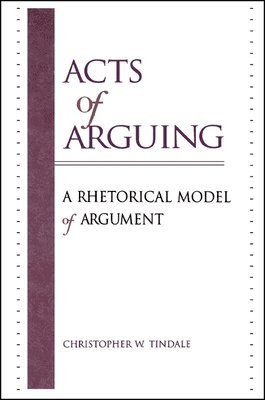
    Acts of Arguing

    A Rhetorical Model of Argument

    AvChristopher W. Tindale

    Häftad, Engelska, 1999

    Del i serien SUNY series in Logic and Language

    449 kr

    Beställningsvara. Skickas inom 5-8 vardagar. Fri frakt över 249 kr.

    Beskrivning

    Approaches recent innovations in argumentation theory from a primarily rhetorical perspective.The revival of argumentation theory in the past few decades has focused on its logical and dialectical dimensions, with less attention paid to rhetorical features. This book explores and then redresses this imbalance. Tindale examines important logical and dialectical innovations in recent argumentation theory and shows that they depend implicitly upon rhetorical features of argument that have been suppressed in the account. This is illustrated using two extended case studies, one looking at Shell International's defense of its actions in Nigeria after the death of Ken Saro-Wiwa, and the other exploring the uses of character-based argument and testimony in a Holocaust-denial text and legal trial.In addition to the case studies, two chapters treat serious problems that plague current argumentation theory. The first concerns the nature of fallacy; the second concerns the ties between traditional argumentation and a model of rationality that has been seriously critiqued by feminist and postmodernist scholars. In both instances, the discussion indicates how a rhetorical approach to argumentation offers fresh insights and suggests responses to the questions raised.

    Produktinformation

    • Utgivningsdatum:1999-11-04
    • Mått:152 x 229 x 15 mm
    • Vikt:363 g
    • Format:Häftad
    • Språk:Engelska
    • Serie:SUNY series in Logic and Language
    • Antal sidor:245
    • Förlag:State University of New York Press
    • ISBN:9780791443880

    Utforska kategorier

    • Filosofiska discipliner inom Filosofi och religion

    Mer om författaren

    Christopher W. Tindale is Professor of Philosophy at Trent University. He is the coauthor of Good Reasoning Matters: A Constructive Approach to Critical Thinking and is coeditor of Argumentation and Rhetoric.

    Recensioner i media

    "The importance of this book lies in Tindale's ability to synthesize existing insights—primarily those of Aristotle and Perelman, but many others as well—into a rhetorical theory of argumentation, all the while adding new elements which he has fashioned himself. What Tindale does is sketch, then elaborate a relatively comprehensive model of argument which is fundamentally rhetorical. And he does this well."—Michael Wreen, Marquette University

    Innehållsförteckning

    • Acknowledgments Introduction: The Case for Rhetorical Argumentation 1. Models of Argumentation2. Product, Procedure, and Process3. Habermas's Challenge4. The Case for the Rhetorical5. Origins in the Rhetoric6. Rhetorical Argument: Enthymeme7. Rhetorical Argumentation8. Contemporary Views9. Outline of the Study Chapter 1. Argument as Product: The Logical Perspective 1.1 Formal Logic and the Classical Root1.2 The Toulmin Transition1.3 Informal Logic1.4 Problems of the Product-oriented Perspective1.5 Rhetoric and Logic Chapter 2. Argumentation as Dialectical 2.1 Outline of the Pragma-Dialectical Approach2.2 Misunderstandings and Qualifications2.3 Pragma-Dialectics and Fallacies2.4 Walton's Functional Account2.5 A Critical Evaluation2.6 Rhetorical Elements: Audiences, Readers, and Third Parties Chapter 3. Contexts and Argument: An Introduction to the Rhetorical Perspective 3.1 The New Rhetoric3.2 Emotion and Argumentation3.3 Context3.4 Audiences3.5 The Universal Audience Chapter 4. Audiences and the Conditions for Adherence 4.1 Perelman's Relativism4.2 Relevance and Cognitive Environments4.3 Acceptability4.4 Blair and Johnson's Community of Model Interlocutors4.5 The Universal Audience Again4.6 Preliminary Examples Chapter 5. Case Studies in Rhetorical Argumentation 5.1 Case A Clear Thinking on Shell Oil, Nigeria and the Death of Ken Saro-Wiwa A.1 Background and LocaleA.2 Arguer and AudiencesA.3 Mode of ExpressionA.4 Dialectical ObligationsA.5 The Logical StructureA.6 The Reasonableness of the Argumentation 5.2 Case B Personality, Testimony, and Holocaust Denial B.1 The Initial TextB.2 Harwood's Use of Ethotic ArgumentsB.3 Testimony in the Zundel TrialB.4 Ethos and the LawB.5 The Role of Ethotic Arguments Chapter 6. Fallacy 6.1 Problems with Fallacies6.2 Senses of "Fallacy"6.3 Fallacy as Bad Product6.4 Fallacy as Bad Procedure6.5 Fallacy as Bad Process6.6 Crosswhite's Perelmanian Account6.7 The "Act" of Fallacy Chapter 7. Argumentation and the Critiques of Reason 7.1 Common Concerns7.2 Argument, Persuasion, and Critique7.3 Femininity, Emotion, and the Body7.4 Nye's Logics7.5 Post critique Faces of Argument7.6 Differences, Gestures, and the Good Conclusion: Summation and Prolepsis Notes References Index