• Fri frakt över 249 kr
  • •
  • Snabba leveranser
  • •
  • Billiga böcker
Kundservice

Du är på sajten för privatpersoner.

Företag, bibliotek eller offentlig verksamhet?

Du handlar på classic.bokus.com, där alla dina funktioner finns intakta.
Till classic.bokus.com
Bokus logotyp. Gå till startsidan.
  • Erbjudanden
  • Student
  • Topplistor
  • Barn & ungdom
  • Bokus Play
  • E-böcker
  • Ljudböcker
  • Pocketböcker
  • Spel och pussel

Pocketfynda! Hundratals böcker för 49 kr/st →

Sidfot

Mina sidor

    Hjälp

    • Kundservice
    • Vanliga frågor och svar
    • Frakt och leverans
    • Retur vid ångerrätt
    • Reklamera vara
    • Betalning
    • Köpvillkor
    • Allmänna villkor
    • Information om webbplatsens tillgänglighet

    Om Bokus

    • Om oss
    • Pressrum
    • För studenter
    • För företag
    • För bibliotek och offentlig verksamhet
    • För leverantörer
    • Hållbarhet

    Populärt

    • Aktuella erbjudanden
    • Presentkort
    • Studentlitteratur
    • Nya böcker
    • Topplistor
    • Signerade böcker
    • Engelska böcker

    Inspiration

    • Boktips
    • BookTok
    • Barnbokskaraktärer
    • Populära författare
    Logotyp för Bokus
    Följ oss på Facebook (extern länk)Följ oss på Instagram (extern länk)Följ oss på YouTube (extern länk)Följ oss på TikTok (extern länk)
    bokus @ CookiesAnpassa cookiesIntegritetspolicyKöpvillkor
    Till Citymail hemsida (extern länk)Till Budbee hemsida (extern länk)Till Postnord hemsida (extern länk)Till Schenker hemsida (extern länk)Till Early Bird hemsida (extern länk)Till Walleys hemsida (extern länk)
    1. Ekonomi och Ledarskap
    2. Nationalekonomi
    3. Ekonomisk historia

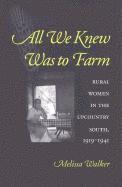
    All We Knew Was to Farm

    Rural Women in the Upcountry South, 1919-1941

    AvMelissa Walker

    Häftad, Engelska, 2002

    Del i serien Revisiting Rural America

    295 kr

    Tillfälligt slut

    Fler format och utgåvor

    Inbunden

    676 kr

    Beskrivning

    In the years after World War I, Southern farm women found their world changing. A postwar plunge in farm prices stretched into a twenty-year agricultural depression and New Deal programs eventually transformed the economy. Many families left their land to make way for larger commercial farms. New industries and the intervention of big government in once insular communities marked a turning point in the struggle of upcountry women-forcing new choices and the redefinition of traditional ways of life. Melissa Walker's All We Knew Was to Farm draws on interviews, archives, and family and government records to reconstruct the conflict between rural women and bewildering and unsettling change. Some women adapted by becoming partners in farm operations, adopting the roles of consumers and homemakers, taking off-farm jobs, or leaving the land. The material lives of rural upcountry women improved dramatically by midcentury-yet in becoming middle class, Walker concludes, the women found their experiences both broadened and circumscribed.

    Produktinformation

    • Utgivningsdatum:2002-09-16
    • Mått:152 x 229 x 18 mm
    • Vikt:476 g
    • Format:Häftad
    • Språk:Engelska
    • Serie:Revisiting Rural America
    • Antal sidor:344
    • Förlag:Johns Hopkins University Press
    • ISBN:9780801869242
    • Utmärkelser:Winner of Southern Association for Women Historians Willie Lee Rose Prize 2001 (United States)

    Utforska kategorier

    • Ekonomisk historia inom Ekonomi och Ledarskap
    • Genusvetenskap inom Samhälle och politik
    • Amerikas historia inom Historia och arkeologi

    Mer om författaren

    Melissa Walker is an associate professor of history at Converse College in Spartanburg, South Carolina.

    Recensioner i media

    An engaging study... For upcountry southern women, the years 1919-1941 were indicative of the economic, political, and social chaos existing throughout segregated America... Walker capably demonstrates how families were forced by the limitations of race and class to choose situations that provided little or no real opportunity, but she also brilliantly illustrates how some rural people were able to adapt to change. -- Valerie Grim Journal of American History Voices of ordinary women who experienced extraordinary changes resonate in Melissa Walker's incisive study of twentieth-century transformations of southern agricultural communities. -- Elizabeth D. Schafer H-SAWH, H-Net Reviews Melissa Walker has done an admirable job of mining oral interviews, TVA records, letters, diaries, and farming magazines to piece together the story of how women contributed to the family income... Walker deftly negotiates the intersection of race, class, and gender. -- Gaul Graham Journal of East Tennessee History Walker shows how women adapted to rapid change with courage, strength, creativity, and persistence... Walker's fine regional study will be useful to historians of women, the South, Appalachia, rural life, and labor issues. A valuable addition to the growing number of works on women in the early-twentieth-century South. -- Suzanne Marshall History: Reviews of New Books Historian Melissa Walker provides an account of changes in women's labor practices and economic activity in the upcountry South during the inter-war years... Readable, credible, and well-researched. -- Shaunna L. Scott Journal of Appalachian Studies The theme of the study is to show how the status of farm women changes from 1919-1941 in a period of economic crisis. Changing from a region of subsistence farming to one of commercial farming and interference by government action during the depression and New Deal years, women learned to cope... [Walker's] descriptions of rural ways and beliefs are true to form. -- Cline E. Hall South Carolina Historical Magazine Walker does a particularly good job of emphasizing the ambivalence that upcountry farm women felt about leaving the farms... All We Knew Was to Farm makes an extremely important contribution to rural literature by gendering the transformation of the upland South. -- Rebecca Sharpless Georgia Historical Quarterly Walker provides a much needed account of the South that should be of interest to all those who study the twentieth century. -- Kathleen Mapes Journal of Social History 2005

    Innehållsförteckning

    • Contents:List of Figures List of Tables AcknowledgementsIntroduction: "All We Knew Was to Farm" 1. Rural Life in the Upcountry South: The Scene in 1920 2. Making Do and Doing Without: Farm Women Cope with the Economic Crisis, 1920-1941 3. "Grandma Would Find Some Way to Make Some Money": Farm Women's Cash Incomes 4. Mixed Messages: Home Extension Work among Upcountry Farm Women in the 1920s and 1930s 5. Government Relocation and Upcountry Women 6. Rural Women and Industrialization 7. Farm Wives and Commercial Farming 8. "The Land of Do Without": The Changing Face of Sevier County, Tennessee, 1908-1940 Epilogue: The Persistence of Rural ValuesAbbreviations Notes Bibliographical Essay Index