• Fri frakt över 249 kr
  • •
  • Snabba leveranser
  • •
  • Billiga böcker
Kundservice

Du är på sajten för privatpersoner.

Företag, bibliotek eller offentlig verksamhet?

Du handlar på classic.bokus.com, där alla dina funktioner finns intakta.
Till classic.bokus.com
Bokus logotyp. Gå till startsidan.
  • Erbjudanden
  • Student
  • Topplistor
  • Barn & ungdom
  • Bokus Play
  • E-böcker
  • Ljudböcker
  • Pocketböcker
  • Spel & pussel

Upp till 25% på utvalda nyheter →

Sidfot

Mina sidor

    Hjälp

    • Kundservice
    • Vanliga frågor och svar
    • Frakt och leverans
    • Retur vid ångerrätt
    • Reklamera vara
    • Betalning
    • Köpvillkor
    • Allmänna villkor
    • Information om webbplatsens tillgänglighet

    Om Bokus

    • Om oss
    • Pressrum
    • För studenter
    • För företag
    • För bibliotek och offentlig verksamhet
    • För leverantörer
    • Hållbarhet

    Populärt

    • Aktuella erbjudanden
    • Presentkort
    • Studentlitteratur
    • Nya böcker
    • Topplistor
    • Signerade böcker
    • Engelska böcker

    Inspiration

    • Boktips
    • BookTok
    • Populära bokserier
    • Barnbokskaraktärer
    • Populära författare
    Logotyp för Bokus
    Följ oss på Facebook (extern länk)Följ oss på Instagram (extern länk)Följ oss på YouTube (extern länk)Följ oss på TikTok (extern länk)
    bokus @ CookiesAnpassa cookiesIntegritetspolicyKöpvillkor
    Till Citymail hemsida (extern länk)Till Budbee hemsida (extern länk)Till Postnord hemsida (extern länk)Till Schenker hemsida (extern länk)Till Early Bird hemsida (extern länk)Till Walleys hemsida (extern länk)
    1. Ekonomi och Ledarskap
    2. Nationalekonomi
    3. Ekonomisk politik

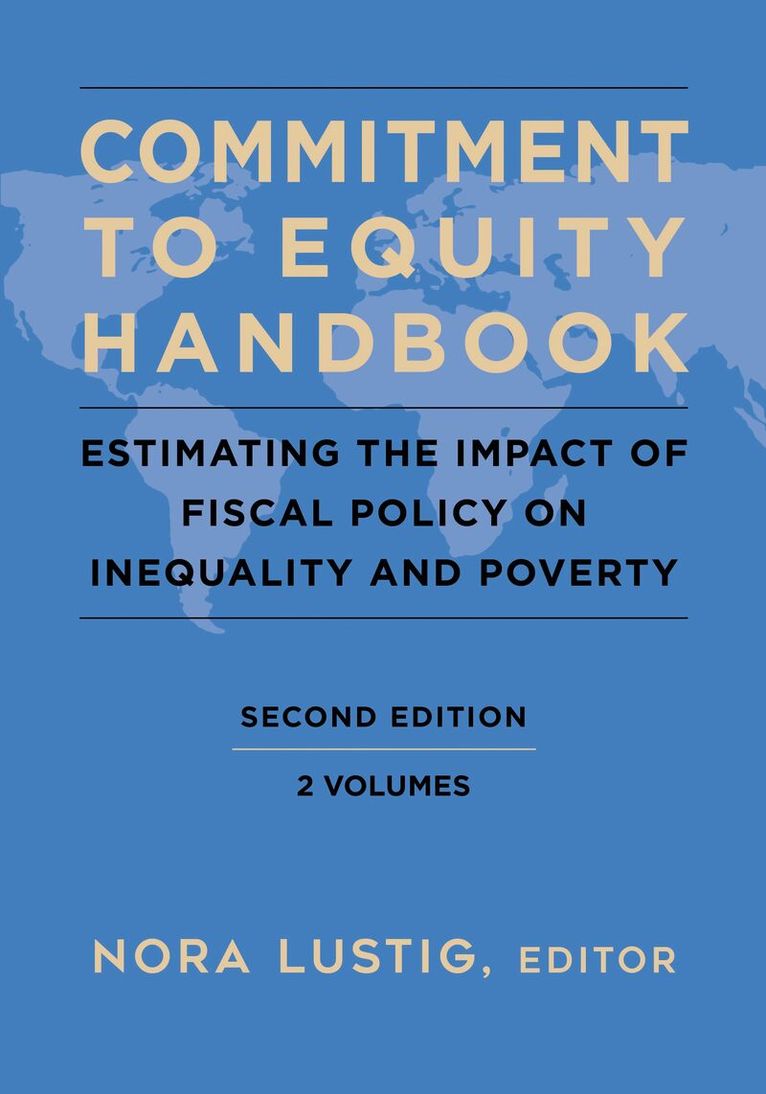
    Commitment to Equity Handbook

    Estimating the Impact of Fiscal Policy on Inequality and Poverty

    AvNora Lustig

    Häftad, Engelska, 2023

    1 376 kr

    Beställningsvara. Skickas inom 5-8 vardagar. Fri frakt över 249 kr.

    Beskrivning

    Edited by Nora Lustig, the Commitment to Equity Handbook: Estimating the Impact of Fiscal Policy on Inequality and Poverty (Brookings Institution Press and CEQ Institute-Tulane University, 2nd edition, 2022) is a unique manual on the theory and practical methods to estimate the impact of taxation and public spending on inequality and poverty. In addition, the second edition covers frontier topics such as alternative approaches to measure the redistributive effect of education, health, and infrastructure spending. Policymakers, social planners, and economists are provided with a step-by-step guide to applying fiscal incidence analysis, illustrated by country studies. The 2nd edition of the Handbook has two volumes. Volume 1 is comprised of Part I, Methodology, describes what a CEQ Assessment© is and presents the theoretical underpinnings of fiscal incidence analysis and the indicators used to assess the distributive impact and effectiveness of fiscal policy. Part II, Implementation, presents the methodology on how taxes, subsidies, and social spending should be allocated. It includes a step-by step guide to completing the CEQ Master Workbook©, a multi-sheet Excel file that houses detailed information on the country’s fiscal system and the results used as inputs for policy discussions, academic papers, and policy reports. Part III, “Applications,” presents applications of the CEQ framework to low- and middle-income countries and includes simulations of policy reforms. In this 2nd edition, chapters 1, 6, and 8 have been significantly updated and two new country studies have been added to Part III. Parts IV (updated), V (new), and VI (new) are available online only. Part IV contains the CEQ Assessment’s main tools. Part V includes the databases housed in the CEQ Data Center on Fiscal Redistribution. Part VI contains the CEQ Institute’s microsimulation tools. Volume 2 (new) includes a collection of chapters whose purpose is to expand the knowledge and methodological frontiers to sharpen even further the analysis of fiscal policy’s redistributive impact. Topics include: alternative approaches to value in-kind education and health services; alternative methods to evaluate spending on infrastructure; corporate taxes and taxation on capital incomes; inter-temporal fiscal incidence and the redistributive consequences of social insurance pensions; fiscal redistribution, macroeconomic stability and growth; and, the political economy of fiscal redistribution.

    Produktinformation

    • Utgivningsdatum:2023-05-01
    • Mått:182 x 249 x 67 mm
    • Vikt:2 377 g
    • Format:Häftad
    • Språk:Engelska
    • Antal sidor:1 438
    • Upplaga:2
    • Förlag:Bloomsbury Publishing Plc
    • ISBN:9780815740469

    Utforska kategorier

    • Ekonomisk politik inom Ekonomi och Ledarskap
    • Finansiering inom Ekonomi och Ledarskap
    • Sociologi inom Samhälle och politik

    Mer om författaren

    Nora Lustig is Samuel Z. Stone Professor of Latin American Economics and founding Director of the Commitment to Equity Instituteat Tulane University where she researches the impact of taxation and social spending on inequality and poverty, and the determinants of inequality. Her more recent work has focused on the short- and long-term impacts of COVID-19 on educational mobility, inequality, and poverty.

    Recensioner i media

    The CEQ Handbook is unique in its conceptual clarity and methodological comprehensiveness. It is indispensable reading for anyone interested in how taxation and public expenditure affect poverty and inequality in developing countries.

    Innehållsförteckning

    • VOLUME 1List of Illustrations Foreword François BourguignonAcknowledgmentsCEQ Handbook Nora LustigAbstracts Introduction1 About Volume 1: Fiscal Incidence Analysis: Methodology, Implementation, and Applications2 The Relevance of Fiscal Incidence Analysis in Today’s World3 Fiscal Incidence in Practice: The Commitment to Equity (CEQ) Assessment4 Main Messages 5 Organization of Volume 1 6 Implementing a CEQ Assessment: How to Use Volume 17 CEQ Assessment: Data Requirements 8 About Volume 2: Methodological Frontiers in Fiscal Incidence Analysis9 About the CEQ Institute10 About the CEQ Data Center on Fiscal RedistributionVOLUME 2List of IllustrationsAbstracts Alternative Methods to Value Transfers in Kind:Health, Education, and InfrastructureChapter 1: The Effect of Government Health Expenditure on IncomeDistribution: A Comparison of Valuation Methods in Ghanaby Jeremy Barofsky and Stephen D. YoungerIntroduction1 What’s Wrong with the Cost of Provision? 2 Using Healthcare Consumers’ Choices to Estimate the Compensating Variation for Public Healthcare Expenditures 3 The Health Outcomes Approach 4 Summary: Choosing among the Options5 Insurance Value of Financial Risk Reduction 6 ConclusionAppendix 1A 1 Using the Spectrum Policy Models Software 2 Financial Risk Protection with Consumption Floor Proportional to Income 3 Concentration Curves by Valuation Method4 Using Willingness and Ability to Pay by Matching Publicly Funded Health Services to Private Health Services5 Data and Do-Files for ReplicationChapter 2: The Market Value of Public Education: A Comparison ofThree Valuation Methodsby Sergei SoaresIntroduction 1 First Method: Schooling Is Worth What It Costs the State to Provide It 2 Second Method: Schooling Is Worth What the Labor Market Says It Is Worth 3 Third Method: Schooling Is Worth What the Private Education Market Says It Is Worth4 Comparison of Results5 Conclusion Chapter 3: Redistribution through Education: Assessing the Long-TermImpact of Public Spending by Sergio UrzuaIntroduction 1 The Conceptual Framework 2 The Value of Public Education Spending to Its Beneficiaries 3 Chile and Ghana: Differences and Similarities 774 Empirical Analysis5 Conclusions 105Appendix 3A Dynamic Fiscal Incidence of Public Spendingin Education 1111 The Recursive Problem2 Intertemporal Fiscal Incidence AnalysisAppendix 3B Instrumental VariableChapter 4: The Market Value of Owner-Occupied Housing and Public Infrastructure Servicesby Sergei SoaresIntroduction 1 Literature2 Methodology 3 Imputing Rents and Public Infrastructure Services for 2015 4 Comparisons with 2005 and 19955 Conclusions Fiscal Incidence of Corporate TaxesChapter 5: Taxes, Transfers, and Income Distribution in Chile: Incorporating Undistributed Profits by Bernardo Candia and Eduardo EngelIntroduction 1 Tax Regime and Social Spending in Chile 2 Data, Methodology, and Assumptions 3 Results 4 Marginal Contribution and Shapley Value 5 Distributive Effects of the 2014 Tax Reform6 Conclusions Redistributive Impact of Contributory PensionsChapter 6: The Within-System Redistribution of Contributory Pension Systems: A Conceptual Framework and Empirical Method of Estimationby Carlos GrushkaIntroduction 1 Are Pension Systems Tax-Transfers or Deferred Wages Schemes? 2 Redistribution, Neutrality, and Actuarial Fairness 3 Social Security Pensions in Argentina 4 How Redistribution Works for Social Security Pensions in Argentina5 An Alternative Methodological Framework 6 Conclusion Fiscal Redistribution and SustainabilityChapter 7: Intertemporal Sustainability of Fiscal Redistribution: A Methodological Framework by Jose Maria FanelliIntroduction 1 Income Concepts, Fiscal Redistributions, and Sustainability 2 Fiscal Redistributions, Demography, and Wealth Constraints 3 Fiscal Redistributions and Income Strata4 Concluding Remarks Appendix 7A Pensions as Deferred Income 1 Income Strata and Deferred Income 2 Private Wealth and Forced Savings 3 Demography and Wealth Appendix 7B NomenclatureChapter 8: Fiscal Redistribution, Sustainability, and Demography in Latin Americaby Ramiro Albrieu and Jose Maria FanelliIntroduction 1 Fiscal Policy and Redistribution Outcomes 2 Fiscal Redistributions and Debt Sustainability 3 The Future Sustainability of Fiscal Policy in Aging Societies4 Conclusion Political Economy of RedistributionChapter 9: On the Political Economy of Redistribution and Provision of Public Goodsby Stefano Barbieri and Koray CaglayanIntroduction 1 The Meltzer and Richard (1981) Pure Redistribution Model 2 Assumptions of Linear Tax Rates and the Importance of Public Provision 3 The Provision of Public Goods Using a Median Voter Framework 4 Extension to Nonlinear Tax Schemes 5 The Provision of Public Goods Financed with a Flat Tax with Exemptions6 Taxation and Redistribution Models without Functional Form Assumptions 7 ConclusionAppendix 9A Technical Derivations of the Meltzer and Richard (1981) Model 1 Response of Consumption to Government Transfers 2 Response of Pretax Income to Productivity Appendix 9B Technical Derivations of Lambert (2001) About the Authors Index