• Fri frakt över 249 kr
  • •
  • Snabba leveranser
  • •
  • Billiga böcker
Kundservice

Du är på sajten för privatpersoner.

Företag, bibliotek eller offentlig verksamhet?

Du handlar på classic.bokus.com, där alla dina funktioner finns intakta.
Till classic.bokus.com
Bokus logotyp. Gå till startsidan.
  • Erbjudanden
  • Student
  • Topplistor
  • Barn & ungdom
  • Bokus Play
  • E-böcker
  • Ljudböcker
  • Pocketböcker
  • Spel och pussel

Pocketfynda! Hundratals böcker för 49 kr/st →

Sidfot

Mina sidor

    Hjälp

    • Kundservice
    • Vanliga frågor och svar
    • Frakt och leverans
    • Retur vid ångerrätt
    • Reklamera vara
    • Betalning
    • Köpvillkor
    • Allmänna villkor
    • Information om webbplatsens tillgänglighet

    Om Bokus

    • Om oss
    • Pressrum
    • För studenter
    • För företag
    • För bibliotek och offentlig verksamhet
    • För leverantörer
    • Hållbarhet

    Populärt

    • Aktuella erbjudanden
    • Presentkort
    • Studentlitteratur
    • Nya böcker
    • Topplistor
    • Signerade böcker
    • Engelska böcker

    Inspiration

    • Boktips
    • BookTok
    • Barnbokskaraktärer
    • Populära författare
    Logotyp för Bokus
    Följ oss på Facebook (extern länk)Följ oss på Instagram (extern länk)Följ oss på YouTube (extern länk)Följ oss på TikTok (extern länk)
    bokus @ CookiesAnpassa cookiesIntegritetspolicyKöpvillkor
    Till Citymail hemsida (extern länk)Till Budbee hemsida (extern länk)Till Postnord hemsida (extern länk)Till Schenker hemsida (extern länk)Till Early Bird hemsida (extern länk)Till Walleys hemsida (extern länk)
    1. Ekonomi och Ledarskap
    2. Nationalekonomi
    3. Mikroekonomi

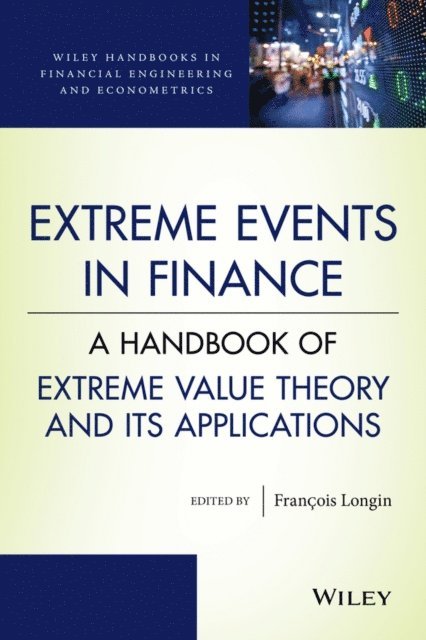
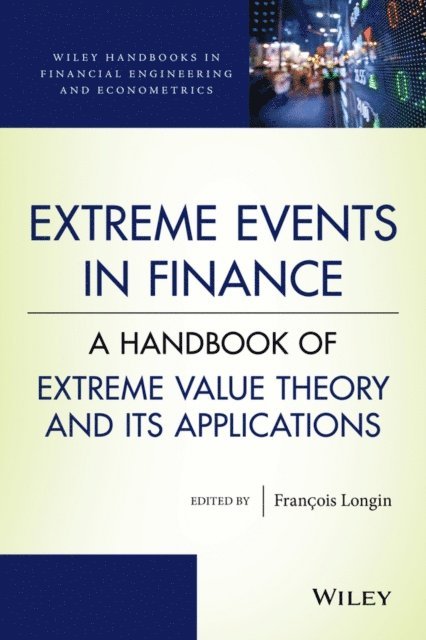
    Extreme Events in Finance

    A Handbook of Extreme Value Theory and its Applications

    AvFrancois Longin

    Inbunden, Engelska, 2016

    Del i serien Wiley Handbooks in Financial Engineering and Econometrics

    1 815 kr

    Beställningsvara. Skickas inom 11-20 vardagar. Fri frakt över 249 kr.

    Beskrivning

    A guide to the growing importance of extreme value risk theory, methods, and applications in the financial sectorPresenting a uniquely accessible guide, Extreme Events in Finance: A Handbook of Extreme Value Theory and Its Applications features a combination of the theory, methods, and applications of extreme value theory (EVT) in finance and a practical understanding of market behavior including both ordinary and extraordinary conditions.Beginning with a fascinating history of EVTs and financial modeling, the handbook introduces the historical implications that resulted in the applications and then clearly examines the fundamental results of EVT in finance. After dealing with these theoretical results, the handbook focuses on the EVT methods critical for data analysis. Finally, the handbook features the practical applications and techniques and how these can be implemented in financial markets. Extreme Events in Finance: A Handbook of Extreme Value Theory and Its Applications includes: Over 40 contributions from international experts in the areas of finance, statistics, economics, business, insurance, and risk managementTopical discussions on univariate and multivariate case extremes as well as regulation in financial marketsExtensive references in order to provide readers with resources for further studyDiscussions on using R packages to compute the value of risk and related quantitiesThe book is a valuable reference for practitioners in financial markets such as financial institutions, investment funds, and corporate treasuries, financial engineers, quantitative analysts, regulators, risk managers, large-scale consultancy groups, and insurers. Extreme Events in Finance: A Handbook of Extreme Value Theory and Its Applications is also a useful textbook for postgraduate courses on the methodology of EVTs in finance.

    Produktinformation

    • Utgivningsdatum:2016-11-22
    • Mått:165 x 236 x 36 mm
    • Vikt:998 g
    • Format:Inbunden
    • Språk:Engelska
    • Serie:Wiley Handbooks in Financial Engineering and Econometrics
    • Antal sidor:640
    • Förlag:John Wiley & Sons Inc
    • ISBN:9781118650196

    Utforska kategorier

    • Mikroekonomi inom Ekonomi och Ledarskap
    • Matematisk statistik inom Naturvetenskap och teknik
    • Finansiering inom Ekonomi och Ledarskap

    Mer om författaren

    François Longin, PhD, is Professor in the Department of Finance at ESSEC Business School, France. He has been working on the applications of extreme value theory to financial markets for many years, and his research has been applied by financial institutions in the risk management area including market, credit, and operational risks. His research works can be found in scientific journals such as The Journal of Finance. Dr. Longin is currently a financial consultant with expertise covering risk management for financial institutions and portfolio management for asset management firms.

    Innehållsförteckning

    • About the Editor xiiiAbout the Contributors xv1 Introduction 1François Longin1.1 Extremes 11.2 History 21.3 Extreme value theory 21.4 Statistical estimation of extremes 21.5 Applications in finance 41.6 Practitioners’ points of view 61.7 A broader view on modeling extremes 61.8 Final words 71.9 Thank you note 7References 82 Extremes Under Dependence—Historical Development and Parallels with Central Limit Theory 11M.R. Leadbetter2.1 Introduction 112.2 Classical (I.I.D.) central limit and extreme value theories 122.3 Exceedances of levels, kth largest values 142.4 CLT and EVT for stationary sequences, bernstein’s blocks, and strong mixing 152.5 Weak distributional mixing for EVT, D(un), extremal index 182.6 Point process of level exceedances 192.7 Continuous parameter extremes 20References 223 The Extreme Value Problem in Finance: Comparing the Pragmatic Program with the Mandelbrot Program 25Christian Walter3.1 The extreme value puzzle in financial modeling 253.2 The sato classification and the two programs 283.3 Mandelbrot’s program: A fractal approach 343.4 The Pragmatic Program: A data-driven approach 393.5 Conclusion 47Acknowledgments 48References 484 Extreme Value Theory: An Introductory Overview 53Isabel Fraga Alves and Cláudia Neves4.1 Introduction 534.2 Univariate case 564.3 Multivariate case: Some highlights 84Further reading 90Acknowledgments 90References 905 Estimation of the Extreme Value Index 97Beirlant J., Herrmann K., and Teugels J.L.5.1 Introduction 975.2 The main limit theorem behind extreme value theory 985.3 Characterizations of the max-domains of attraction and extreme value index estimators 995.4 Consistency and asymptotic normality of the estimators 1035.5 Second-order reduced-bias estimation 1045.6 Case study 1065.7 Other topics and comments 108References 1116 Bootstrap Methods in Statistics of Extremes 117M. Ivette Gomes, Frederico Caeiro, Lígia Henriques-Rodrigues, and B.G. Manjunath6.1 Introduction 1176.2 A few details on EVT 1196.3 The bootstrap methodology in statistics of univariate extremes 1276.4 Applications to simulated data 1336.5 Concluding remarks 133Acknowledgments 135References 1357 Extreme Values Statistics for Markov Chains with Applications to Finance and Insurance 139Patrice Bertail, Stéphan Clémençon, and Charles Tillier7.1 Introduction 1397.2 On the (pseudo) regenerative approach for markovian data 1417.3 Preliminary results 1517.4 Regeneration-based statistical methods for extremal events 1547.5 The extremal index 1567.6 The regeneration-based hill estimator 1597.7 Applications to ruin theory and financial time series 1617.8 An application to the CAC40 1657.9 Conclusion 167References 1678 Lévy Processes and Extreme Value Theory 171Olivier Le Courtois and Christian Walter8.1 Introduction 1718.2 Extreme value theory 1738.3 Infinite divisibility and Lévy processes 1788.4 Heavy-tailed Lévy processes 1828.5 Semi-heavy-tailed Lévy processes 1848.6 Lévy processes and extreme values 1878.7 Conclusion 192References 1929 Statistics of Extremes: Challenges and Opportunities 195M. de Carvalho9.1 Introduction 1959.2 Statistics of bivariate extremes 1969.3 Models based on families of tilted measures 2049.4 Miscellanea 209References 21110 Measures of Financial Risk 215S.Y. Novak10.1 Introduction 21510.2 Traditional measures of risk 21510.3 Risk estimation 21810.4 “Technical analysis” of financial data 22210.5 Dynamic risk measurement 22610.6 Open problems and further research 23410.7 Conclusion 235Acknowledgment 235References 23511 On the Estimation of the Distribution of Aggregated Heavy-Tailed Risks: Application to Risk Measures 239Marie Kratz11.1 Introduction 23911.2 A brief review of existing methods 24511.3 New approaches: Mixed limit theorems 24711.4 Application to risk measures and comparison 26911.5 Conclusion 277References 27912 Estimation Methods for Value at Risk 283Saralees Nadarajah and Stephen Chan12.1 Introduction 28312.2 General properties 28912.3 Parametric methods 30012.4 Nonparametric methods 32612.5 Semiparametric methods 33212.6 Computer software 34412.7 Conclusions 347Acknowledgment 347References 34713 Comparing Tail Risk and Systemic Risk Profiles for Different Types of U.S. Financial Institutions 357Stefan Straetmans and Thanh Thi Huyen Dinh13.1 Introduction 35713.2 Tail risk and systemic risk indicators 36113.3 Tail risk and systemic risk estimation 36413.4 Empirical results 36813.5 Conclusions 381References 38214 Extreme Value Theory and Credit Spreads 391Wesley Phoa14.1 Preliminaries 39114.2 Tail behavior of credit markets 39414.3 Some multivariate analysis 39814.4 Approximating value at risk for credit portfolios 40114.5 Other directions 403References 40415 Extreme Value Theory and Risk Management in Electricity Markets 405Kam Fong Chan and Philip Gray15.1 Introduction 40515.2 Prior literature 40715.3 Specification of VaR estimation approaches 40915.4 Empirical analysis 41315.5 Conclusion 422Acknowledgment 423References 42316 Margin Setting and Extreme Value Theory 427John Cotter and Kevin Dowd16.1 Introduction 42716.2 Margin setting 42816.3 Theory and methods 43016.4 Empirical results 43416.5 Conclusions 439Acknowledgment 440References 44017 The Sortino Ratio and Extreme Value Theory: An Application to Asset Allocation 443G. Geoffrey Booth and John Paul Broussard17.1 Introduction 44317.2 Data definitions and description 44617.3 Performance ratios and their estimations 45117.4 Performance measurement results and implications 45617.5 Concluding remarks 460Acknowledgments 461References 46118 Portfolio Insurance: The Extreme Value Approach Applied to the CPPI Method 465Philippe Bertrand and Jean-Luc Prigent18.1 Introduction 46518.2 The CPPI method 46718.3 CPPI and quantile hedging 47218.4 Conclusion 481References 48119 The Choice of the Distribution of Asset Returns: How Extreme Value Can Help? 483François Longin19.1 Introduction 48319.2 Extreme value theory 48519.3 Estimation of the tail index 48819.4 Application of extreme value theory to discriminate among distributions of returns 49019.5 Empirical results 49319.6 Conclusion 501References 50120 Protecting Assets Under Non-Parametric Market Conditions 507Jean-Marie Choffray and Charles Pahud de Mortanges20.1 Investors’ “known knowns” 50920.2 Investors’ “known unknowns” 51220.3 Investors’ “unknown knowns” 51520.4 Investors’ “unknown unknowns” 51820.5 Synthesis 522References 52321 EVT Seen by a Vet: A Practitioner’s Experience on Extreme Value Theory 525Jean-François Boulier21.1 What has the vet done? 52521.2 Why use EVT? 52621.3 What EVT could additionally bring to the party? 52821.4 A final thought 528References 52822 The Robotization of Financial Activities: A Cybernetic Perspective 529Hubert Rodarie22.1 An increasingly complex system 53022.2 Human error 53222.3 Concretely, what do we need to do to transform a company into a machine? 534References 54323 Two Tales of Liquidity Stress 545Jacques Ninet23.1 The french money market fund industry. How history has shaped a potentially vulnerable framework 54623.2 The 1992–1995 forex crisis 54723.3 Four mutations paving the way for another meltdown 54923.4 The subprime crisis spillover. How some MMFs were forced to lock and some others not 55123.5 Conclusion. What lessons can be drawn from these two tales? 552Further Readings 55324 Managing Operational Risk in the Banking Business – An Internal Auditor Point of View 555Maxime LaotFurther Reading 559References 560Annexes 56025 Credo Ut Intelligam 563Henri Bourguinat and Eric Briys25.1 Introduction 56325.2 “Anselmist” finance 56325.3 Casino or dance hall? 56525.4 Simple-minded diversification 56625.5 Homo sapiens versus homo economicus 568Acknowledgement 569References 56926 Bounded Rationalities, Routines, and Practical as well as Theoretical Blindness: On the Discrepancy Between Markets and Corporations 571Laurent Bibard26.1 Introduction: Expecting the unexpected 57126.2 Markets and corporations: A structural and self-disruptive divergence of interests 57226.3 Making a step back from a dream: On people expectations 57426.4 How to disentangle people from a unilateral short-term orientation? 578References 580Name Index 583Subject Index 593