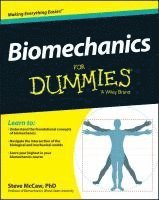
Biomechanics For Dummies
Häftad, Engelska, 2014
175 kr
Beställningsvara. Skickas inom 5-8 vardagar. Fri frakt över 249 kr.
Beskrivning
A thorough explanation of the tenets of biomechanics At once a basic and applied science, biomechanics focuses on the mechanical cause-effect relationships that determine the motions of living organisms. Biomechanics for Dummies examines the relationship between biological and mechanical worlds. It clarifies a vital topic for students of biomechanics who work in a variety of fields, including biological sciences, exercise and sports science, health sciences, ergonomics and human factors, and engineering and applied science. Following the path of a traditional introductory course, Biomechanics for Dummies covers the terminology and fundamentals of biomechanics, bone, joint, and muscle composition and function, motion analysis and control, kinematics and kinetics, fluid mechanics, stress and strain, applications of biomechanics, and black and white medical illustrations. Offers insights and expertise in biomechanics to provide an easy-to-follow, jargon-free guide to the subjectProvides students who major in kinesiology, neuroscience, biomedical engineering, mechanical engineering, occupational therapy, physical therapy, physical education, nutritional science, and many other subjects with a basic knowledge of biomechanicsStudents and self-motivated learners interested in biological, applied, exercise, sports, and health sciences should not be without this accessible guide to the fundamentals.
Produktinformation
- Utgivningsdatum:2014-05-30
- Mått:185 x 231 x 31 mm
- Vikt:567 g
- Format:Häftad
- Språk:Engelska
- Antal sidor:416
- Förlag:John Wiley & Sons Inc
- ISBN:9781118674697
Utforska kategorier
Mer om författaren
Steve McCaw, PhD, is a professor at Illinois State University. Dr. McCaw has taught Biomechanics of Human Movement, Occupational Biomechanics, and Quantitative Biomechanics and has vast experience presenting biomechanics concepts in easy-to-understand formats for use in criminal and civil cases.
Innehållsförteckning
- Introduction 1About This Book 1Foolish Assumptions 2Icons Used in This Book 3Beyond the Book 3Where to Go from Here 4Part I: Getting Started with Biomechanics 5Chapter 1: Jumping Into Biomechanics 7Analyzing Movement with Biomechanics 7Mechanics 8Bio 9Expanding on Mechanics 10Describing motion with kinematics 11Causing motion with kinetics 13Putting Biomechanics to Work 14Chapter 2: Reviewing the Math You Need for Biomechanics 15Getting Orientated 16Brushing Up on Algebra 17Following the order of operations 17Defining some math operations 19Isolating a variable 20Interpreting proportionality 22Looking for the Hypotenuse 23Using the Pythagorean theorem 24De-tricking trigonometric functions: SOH CAH TOA 26Unvexing Vector Quantities 31Resolving a vector into components 33Composing a vector from components 35Chapter 3: Speaking the Language of Biomechanics 37Measuring Scalars and Vectors 38Standardizing a Reference Frame 39Directing your attention to locations of the body 40Referencing planes and axes 40Describing Movement: Kinematics 42Typecasting motion: Linear, angular, and general 42Describing how far: Distance and displacement 43Describing how fast: Speed and velocity 44Changing velocity: Acceleration 45Pushing and Pulling into Kinetics 45Forcing yourself to understand Newton’s laws of motion 47Using the impulse–momentum relationship 49Working with Energy and Power 49Mechanical work 49Mechanical energy 50Mechanical power 51Turning Force into Torque 51Dealing with Measurement Units 51Using the Neuromusculoskeletal System to Move 52The skeletal system 53The muscular system 53The nervous system 55Part II: Looking At Linear Mechanics 57Chapter 4: Making Motion Change: Force 59Pushing and Pulling: What Is Force? 59Working with Force Vectors 65Using the force components to find the resultant 66Resolving a force into components 68Classifying Forces 69Contact and noncontact forces 69Internal and external forces 70Feeling the Pull of Gravity 74Slipping, Sliding, and Staying Put: Friction Is FμN 76Materials do matter: The coefficient of friction ( μ ) 80Squeezing to stick: Normal reaction force (N) 81Chapter 5: Describing Linear Motion: Linear Kinematics 83Identifying Position 84Describing How Far a Body Travels 85Distance.85Displacement 86Describing How Fast a Body Travels 88Speed 89Velocity 90Momentum 92Speeding Up or Slowing Down: Acceleration 92Constant acceleration 95Projectile motion 95Chapter 6: Causing Linear Motion: Linear Kinetics 103Clarifying Net Force and Unbalanced Force 103Newton’s First Law: The Law of Inertia 106Newton’s Third Law: The Law of Equal and Opposite Action–Reaction 107Newton’s Second Law: The Law of Acceleration 109Deriving the impulse–momentum relationship from the law of acceleration 112Applying the impulse–momentum relationship for movement analysis 114Chapter 7: Looking At Force and Motion Another Way: Work, Energy, and Power 119Working with Force 120Energizing Movement 122Kinetic energy 123Potential energy 124Conserving Mechanical Energy 128Powering Better Performance 130The Work–Energy Relationship 131Part III: Investigating Angular Mechanics 137Chapter 8: Twisting and Turning: Torques and Moments of Force 139Defining Torque 140Lining up for rotation: The moment arm of a force 141Calculating the turning effect of a force 142Measuring Torque 144Muscling into torque: How muscles serve as torque generators 145Resisting torque: External torques on the body 148Expanding on Equilibrium: Balanced Forces and Torques 149Locating the Center of Gravity of a Body 152Chapter 9: Angling into Rotation: Angular Kinematics 157Measuring Angular Position 157Describing How Far a Body Rotates 160Angular distance 161Angular displacement 162Describing How Fast a Body Rotates 163Angular speed.163Angular velocity 164Speeding Up or Slowing Down: Angular Acceleration 165Relating Angular Motion to Linear Motion 167Angular displacement and linear displacement 168Angular velocity and linear velocity 169Angular acceleration and linear acceleration 171Chapter 10: Causing Angular Motion: Angular Kinetics 173Resisting Angular Motion: The Moment of Inertia 174The moment of inertia of a segment174The moment of inertia of the whole body 178Considering Angular Momentum 180Angular momentum of a rigid body 180Angular momentum of the human body when individual segments rotate 181A New Angle on Newton: Angular Versions of Newton’s Laws 181Maintaining angular momentum: Newton’s first law.182Changing angular momentum: Newton’s second law 186Equal but opposite: Newton’s third law189Changing Angular Momentum with Angular Impulse 191Chapter 11: Fluid Mechanics 193Buoyancy: Floating Along 193Considering Force Due to Motion in Fluid 197Causing drag in a fluid 198Causing lift in a fluid 201Part IV: Analyzing the “Bio” of Biomechanics 205Chapter 12: Stressing and Straining: The Mechanics of Materials 207Visualizing Internal Loading of a Body 208Applying Internal Force: Stress 210Normal stress 212Shear stress 217Responding to Internal Force: Strain 219Determining tensile strain 221Determining compressive strain 221Determining shear strain 222Straining from Stress: The Stress–Strain Relationship 223Give and go: Behaving elastically 224Give and stay: Behaving plastically 224Chapter 13: Boning Up on Skeletal Biomechanics 227What the Skeletal System Does 228How Bones Are Classified 228The Materials and Structure of Bones 230Materials: What bones are made of 231Structure: How bones are organized 232Connecting Bones: Joints 234Immovable joints 234Slightly movable joints 234Freely movable joints 235Growing and Changing Bone 237Changing bone dimensions 238Stressing bone: The effects of physical activity and inactivity 239Chapter 14: Touching a Nerve: Neural Considerations in Biomechanics 247Monitoring and Controlling the Body: The Roles of the Nervous System 248Outlining the Nervous System 248The central nervous system 250The peripheral nervous system 250Zeroing In on Neurons 251Parts of neurons 251Types of neurons 251Controlling Motor Units 259Motor unit recruitment 261Rate coding 261Chapter 15: Muscling Segments Around: Muscle Biomechanics 263Characterizing Muscle 263Seeing How Skeletal Muscles Are Structured 265The macrostructure of muscles 266The microstructure of muscle fibers.268Comparing Types of Muscle Activity 270Isometric activity 271Concentric activity 272Eccentric activity 272Producing Muscle Force 274Relating muscle length and tension 274Relating muscle velocity and tension277Stretching before Shortening: The Key to Optimal Muscle Force 279Part V: Applying Biomechanics 283Chapter 16: Eyeballing Performance: Qualitative Analysis 285Serving as a Movement Analyst 286Evaluating the Performance 287Identifying the goal of the movement 287Specifying the mechanical objective 289Determining whether the goal has been reached 290Troubleshooting the Performance 293Constraints on performance 293Technique errors 294Pitching by the phases 298Intervening to Improve the Performance 302Adapting the constraints on throwing performance 302Refining technique 303Chapter 17: Putting a Number on Performance: Quantitative Analysis 305Converting Continuous Data to Numbers 305Measuring Kinematics: Motion-Capture Systems 306Collecting kinematic data 307Processing kinematic data 308Measuring Kinetics: Force Platform Systems 310Collecting kinetic data 310Processing kinetic data 312Recording Muscle Activity: Electromyography 313Collecting the electromyogram 314Processing the electromyogram 315Chapter 18: Furthering Biomechanics: Research Applications 319Exercising in Space 319Repairing the Anterior Cruciate Ligament 320Running Like Our Ancestors 322Protecting Our Beans: Helmet Design 324Balancing on Two Legs: Harder Than You Think 326Chapter 19: Investigating Forensic Biomechanics: How Did It Happen? 329Collecting Information for a Forensic Biomechanics Analysis 330Witness accounts 330Police incident investigation reports 331Medical records 331Determining the Mechanism of Injury 332Evaluating Different Scenarios 335Ending up on the far side of the road 335Landing in water with a broken jaw 336Part VI: The Parts of Tens 339Chapter 20: Ten Online Resources for Biomechanics 341The Exploratorium 341The Physics Classroom 341Coaches Info 342Textbook-Related Websites 343Topend Sports 343Dr. Mike Marshall’s Pitching Coach Services 343Waterloo’s Dr. Spine, Stuart McGill 344Skeletal Bio Lab 345Biomch-L 345American Society of Biomechanics 346Chapter 21: Ten Things You May Not Know about Biomechanics 347Looking at How Biomechanics Got Its Start 347Adding Realism to Entertainment 348Developing Safer Motor Vehicles 348Improving the On-Shelf Quality of Fruits and Vegetables 349Fitting Footwear to the Activity 350Banning Biomechanically Improved Sport Techniques 351Re-Creating Dinosaurs 352Designing Universally and Ergonomically 352Giving a Hand to Prosthetics Design 353Losing Weight to Help Your Joints 354Chapter 22: Ten Ways to Succeed in Your Biomechanics Course 355Go to Class and Ask Questions 355Read the Textbook 356Do the Problems and Review Questions at the End of the Chapter 357Create Flashcards 357Go to Office Hours 358Form a Study Group with Classmates 358Accept and Apply Newton as the Foundation of Movement Analysis 359Talk Fluent Biomechanics with Your Classmates 359Volunteer for Research Projects 360Attend a Biomechanics Conference 361Index 363
Hoppa över listan


Du kanske också är intresserad av
Delavier's Stretching Anatomy
Frederic Delavier, Jean-Pierre Clemenceau, Michael Gundill
Häftad, 2011
4,5 utav 5 stjärnor. Totalt antal röster:(2)
313 kr
- -22%
Del 3
- 4 för 3
En flicka som kallas Alice
Kristin Hannah
Pocket, 2025
4,5 utav 5 stjärnor. Totalt antal röster:(38)
99 kr
- 4 för 3
Del 1
- 4 för 3
Del 1
- -30%
- Nyhet
Del 2
- -30%