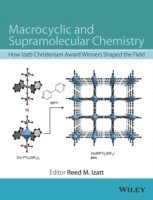
Macrocyclic and Supramolecular Chemistry
How Izatt-Christensen Award Winners Shaped the Field
1 944 kr
Skickas . Fri frakt över 249 kr.
Beskrivning
Produktinformation
- Utgivningsdatum:2016-07-29
- Mått:196 x 254 x 28 mm
- Vikt:1 243 g
- Format:Inbunden
- Språk:Engelska
- Antal sidor:504
- Förlag:John Wiley & Sons Inc
- ISBN:9781119053842
- Utmärkelser:Joint winner of Nobel Prize in Chemistry 2016 (UK)
Utforska kategorier
Mer om författaren
Dr. Reed M. Izatt, Charles E. Maw Professor of Chemistry (Emeritus), Brigham Young University, U.S.A.Reed M. Izatt received a BS degree in Chemistry from Utah State University (1951) and a PhD degree in Chemistry from Pennsylvania State University (1954). After post-doctoral work at Mellon Institute of Industrial Research, he embarked on an academic career at Brigham Young University retiring as Charles E. Maw Professor of Chemistry (1993). He is the author or co-author of over 550 publications.Reed has edited several books, contributed numerous chapters in books, written many journal and review articles and presented plenary, invited, and regular lectures at universities worldwide; regional, national, and international chemistry conferences; and government laboratories.Reed has been involved in research in macrocyclic chemistry since the late 1960s. Together with James Christensen, he organized the first Symposium on Macrocyclic Chemistry in Provo, Utah in 1977. This Symposium has thrived and was one of the major precursors of the present ISMSC.
Innehållsförteckning
- List of Contributors xvPreface xviiiAcknowledgements xx1 The Izatt–Christensen Award in Macrocyclic and Supramolecular Chemistry: A 25-Year History (1991–2016) 1Reed M. Izatt, Jerald S. Bradshaw, Steven R. Izatt, and Roger G. Harrison1.1 Introduction 11.2 International Izatt–Christensen Award in Macrocyclic and Supramolecular Chemistry 21.3 International Symposium on Macrocyclic and Supramolecular Chemistry 41.4 Izatt–Christensen award sponsor: IBC Advanced Technologies, Inc. 61.5 Summary 7References 82 Supramolecular Chemistry with DNA 10Pongphak Chidchob and Hanadi Sleiman2.1 Introduction 102.2 Motifs in structural DNA nanotechnology 102.3 Dynamic assembly and molecular recognition with DNA 132.4 Supramolecular assembly with hybrid DNA materials: increasing the letters of the alphabet 142.5 Conclusion 33References 343 Anion, Cation and Ion-Pair Recognition by Macrocyclic and Interlocked Host Systems 38Paul D. Beer and Matthew J. Langton3.1 Introduction 383.2 Electrochemical molecular recognition 383.3 Anion recognition and sensing by macrocyclic and interlocked hosts 443.4 Halogen-bonding anion recognition 553.5 Ion-pair recognition 593.6 Metal-directed self-assembly 623.7 Conclusions 673.8 Acknowledgements 67References 674 Perspectives in Molecular Tectonics 73Mir Wais Hosseini4.1 Preamble: dreams and pathway 734.2 Introduction 754.3 From tectons to networks 754.4 Summary and outlook 874.5 Acknowledgements 88References 885 Three Tales of Supramolecular Analytical Chemistry 92Margaret K. Meadows and Eric V. Anslyn5.1 Introduction 925.2 Citrate sensing 935.3 Rapid analysis of enantiomeric excess 1015.4 Differential sensing 1095.5 Conclusion 123References 1236 Robust Host–Guest Chemistry of Cucurbit[n-uril: Fundamentals and Applications of the Synthetic Receptor Family 127Kimoon Kim, Dinesh Shetty, and Kyeng Min Park6.1 Personal pathway to the discovery of cucurbit[n-uril and early day developments 1276.2 Structures and physical properties of CB[n- 1296.3 General host–guest chemistry of CB[n- 1296.4 High-affinity host–guest pairs 1306.5 Functionalized CBs 1336.6 Applications of high-affinity CB[6- complexes 1346.7 Applications of high-affinity CB[7- complexes 1376.8 Conclusions 1406.9 Acknowledgements 141References 1417 Molecular Recognition in Biomimetic Receptors 146Peter C. Knipe, Sam Thompson, and Andrew D. Hamilton7.1 Molecular recognition in biological systems 1467.2 Model systems to investigate fundamental forces 1467.3 Recognition of more complex systems – into the realm of peptides 1497.4 A general approach to peptide mimicry – targeting secondary structure 1527.5 Super-secondary structures and beyond 1567.6 Outlook 159References 1608 A Lifetime Walk in the Realm of Cyclam 165Luigi Fabbrizzi8.1 Synthesis and development of cyclam and related macrocycles 1658.2 Macrocyclic effects and the importance of being 14-membered 1708.3 Cyclam promotes the redox activity of the encircled metal ion 1768.4 Scorpionands: cyclam derivatives with an aggressive tail, biting a chelated metal from the top 1808.5 Azacyclams: cyclam-like macrocycles with built-in functionalization 1878.6 Conclusion 1938.7 Acknowledgements 195References 1969 Porosity in Metal–Organic Compounds 200Alexander Schoedel and Omar M. Yaghi9.1 Introduction 2009.2 Werner complexes 2019.3 Hofmann clathrates 2019.4 Coordination polymers 2049.5 Porosity in metal–organic frameworks 2099.6 The discovery of MOF-5: the golden age of metal–organic frameworks 2119.7 The Cambridge Structural Database – an essential tool for MOF chemists 2149.8 Concluding remarks 2159.9 Acknowledgement 215References 21510 Cyclodextrin-based Supramolecular Systems 220Akira Harada10.1 Introduction 22010.2 Cyclodextrin-containing polymers 22010.3 CD-organometallic complexes 22210.4 Complex formation of cyclodextrin with polymers 22310.5 Polymerization by CDs 22510.6 Supramolecular polymers 22810.7 Side-chain recognition by CDs 23010.8 CD-based molecular machines 23010.9 Macroscopic self-assembly through molecular recognition 23310.10 Self-healing by molecular recognition 23510.11 Stimuli-responsive polymers 23610.12 Conclusion 238References 23811 Making the Tiniest Machines 241David A. Leigh11.1 Introduction 24111.2 Property effects using molecular shuttles 24511.3 Molecular motors and ratchet mechanisms 24811.4 Small molecules that can “walk” along molecular tracks 25411.5 Making molecules that make molecules 25711.6 Outlook 25711.7 Acknowledgements 259References 25912 Clipping an Angel’s Wings 261Roeland J.M. Nolte, Alan E. Rowan, and Johannes A.A.W. Elemans12.1 Introduction 26112.2 Molecular clips 26312.3 Molecular capsules 27812.4 Outlook 28212.5 Acknowledgements 282References 28313 From Lanthanide Shift Reagents to Molecular Knots: The Importance of Molecular and Mental Flexibility 288Jeremy K.M. Sanders13.1 Introduction: 1969–76 28813.2 Metalloporphyrins 28913.3 Macrocycles based on cholic acid 29613.4 Designed donor–acceptor catenanes 29713.5 Dynamic combinatorial chemistry 29813.6 Conclusions 304References 30514 Texaphyrins: Life, Death, and Attempts at Resurrection 309Jonathan L. Sessler14.1 Introduction 30914.2 Early days 30914.3 Starting Pharmacyclics, Inc. 31114.4 Early biological studies of texaphyrins 31414.5 Clinical studies of texaphyrins at Pharmacyclics, Inc. 31614.6 Changes in direction at Pharmacyclics, Inc. 31614.7 Current research efforts involving texaphyrin 31714.8 Texaphyrin-platinum conjugates 31814.9 Acknowledgements 321References 32115 Macrocyclic Coordination Chemistry of Resorcin[4-arenes and Pyrogallol[4-arenes 325Harshita Kumari, Carol A. Deakyne, and Jerry L. Atwood15.1 Introduction 32515.2 History of hydrogen-bonded pyrogallol[4-arene- and resorcin[4-arene-based nanocapsules 32615.3 Metal-seamed pyrogallol[4-arene- and resorcin[4-arene-based complexes 32715.4 Concluding remarks 342References 34216 Dynamic Control of Recognition Processes in Host–Guest Systems and Polymer–Polymer Interactions 346Seiji Shinkai16.1 Introduction 34616.2 Dynamic control of crown ether functions by chemical and physical signals 34716.3 Stereochemical studies of calix[n-arene derivatives 35116.4 Ion and molecule recognition by functionalized calix[n-arenes and their application to super Na+-sensors and novel [60-fullerene isolation methods 35116.5 Molecular design of novel sugar-sensing systems using boronic acid–diol macrocyclization 35216.6 From molecular machines to allosteric effects 35316.7 From allosteric effects to aggregation-induced emission (AIE) 35416.8 Extension of cooperative actions to polymeric and biological systems 35616.9 Summary 35716.10 Acknowledgements 357References 35717 Cation Binders, Amphiphiles, and Membrane Active Transporters 360George W. Gokel, Saeedeh Negin, Joseph W. Meisel, Mohit B. Patel, Michael R. Gokel, and Ryan Cantwell17.1 Introduction 36017.2 Conceptual development of lariat ethers for transport 36117.3 Recognition of the ability of lariat ethers to form membranes 36317.4 Use of lariat ethers to demonstrate cation–π interactions 36517.5 Development of synthetic cation channels based on crown ethers 36717.6 Development of synthetic anion channels based on amphiphilic peptides 37017.7 Membrane active amphiphiles as biologically active and applicable compounds 37117.8 Conclusion 373References 37318 Supramolecular Technology 377David N. Reinhoudt18.1 Introduction 37718.2 Chemical sensing 37818.3 Membrane transport 37918.4 Nonlinear optical materials 38018.5 Supramolecular technology for nanofabrication 380References 38219 Synthesis of Macrocyclic Complexes Using Metal Ion Templates 383Daryle H. Busch19.1 Introduction 38319.2 Macrocycle synthesis 384References 38620 Serendipity 388Paul R. McGonigal and J. Fraser Stoddart20.1 Serendipity in scientific discovery 38820.2 Donor–acceptor charge transfer interactions 39020.3 Cyclodextrins (CDs) 40020.4 Conclusions and outlook 410References 41121 Evolution of ZnII–Macrocyclic Polyamines to Biological Probes and Supramolecular Assembly 415Eiichi Kimura, Tohru Koike, and Shin Aoki21.1 Introduction 41521.2 Zinc enzyme models from ZnII macrocyclic polyamine complexes 41521.3 ZnII–cyclens for selective recognition of nucleobases (thymine and uracil) and manipulation of genes 42721.4 New supramolecular assemblies with ZnII–cyclen 43421.5 Acknowledgements 438References 43822 Contractile and Extensile Molecular Systems: Towards Molecular Muscles 444Jean-Pierre Sauvage, Vincent Duplan, and Frédéric Niess22.1 Preamble: the Izatt–Christensen award and Jean-Pierre Sauvage 44422.2 Introduction 44622.3 Interlocking ring compounds 44722.4 Non-interlocking compounds 45622.5 Conclusion 45822.6 Acknowledgements 461References 461Index 465
Du kanske också är intresserad av
- Signerad!
- -30%
- -30%
- Nyhet
Hjärnans akilleshälar : hur din hjärna lurar dig, och vad du kan göra åt det
Anders Hansen
289 kr
- -22%
- Signerad!
- -30%