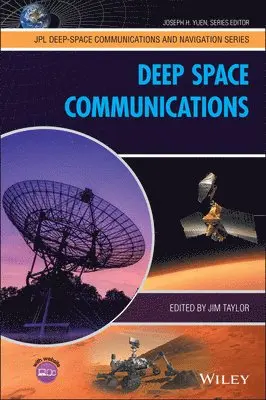
Del i serien JPL Deep-Space Communications and Navigation Series
1 764 kr
Beställningsvara. Skickas inom 5-8 vardagar. Fri frakt över 249 kr.
Beskrivning
Produktinformation
- Utgivningsdatum:2016-11-18
- Mått:185 x 262 x 38 mm
- Vikt:1 170 g
- Format:Inbunden
- Språk:Engelska
- Serie:JPL Deep-Space Communications and Navigation Series
- Antal sidor:592
- Förlag:John Wiley & Sons Inc
- ISBN:9781119169024
Utforska kategorier
Mer om författaren
JIM TAYLOR is a principal engineer at JPL, working on telecommunications analysis, ground-system implementation, and flight operations for deep-space and Earth-orbiting projects. He was the founding telecommunications member of JPL’s Spaceflight Significant Events Group, now called Lessons Learned. He received the NASA Exceptional Achievement Medal in 2000 for innovative use of the DS1 communications systems and the NASA Exceptional Service Medal in 2006 for operational development and support on Deep impact.
Innehållsförteckning
- Foreword xvPreface xviiAcknowledgments xixContributors xxiiiChapter 1 Deep Space Communications: An Introduction 1by Joseph H. Yuen1.1 Introduction and Overview 11.2 Telecommunications Link Analysis 41.2.1 Received Power 41.2.2 Noise Spectral Density 51.2.3 Carrier Performance Margin 61.2.4 Telemetry and Command Performance Margins 61.2.5 Ranging Performance Margin 71.3 Communications Design Control 81.3.1 Design Control Tables 81.3.2 Design Procedure and Performance Criterion Selection 9References 12Chapter 2 The Deep Space Network: A Functional Description 15by Jim Taylor2.1 Uplink and Downlink Carrier Operation 172.1.1 The 34-m BWG Stations 172.1.2 The 70-m (DSS-14 and DSS-43) Stations 192.2 Radiometric Data (Doppler and Ranging) 212.3 Delta Differential One-Way Ranging 242.4 Command Processing and Radiation 252.5 Telemetry Demodulation and Decoding 282.6 DSN Performance 312.6.1 Antenna Gain 322.6.2 Transmitter Power 332.6.3 System Noise Temperature 332.6.4 Thresholds and Limits 33References 35Chapter 3 Voyager Telecommunications 37by Roger Ludwig and Jim Taylor3.1 Voyager Interstellar Mission Description 373.2 Overview of Telecom Functional Capabilities 443.2.1 Uplink 463.2.2 Downlink 473.3 Spacecraft Telecom System Design 483.3.1 Spacecraft Telecom System Overview 483.3.2 Modulation Demodulation Subsystem 513.3.3 Radio Frequency Subsystem 523.3.4 S/X-Band Antenna Subsystem 543.3.5 Telecom System Input Power and Mass 553.4 Telecom Ground System Description 563.4.1 Uplink and Downlink Carrier Operation 573.4.2 Command Processing 593.4.3 Telemetry Processing 593.5 Sample Telecom System Performance 603.5.1 Design Control Tables 613.5.2 Long-Term Planning Predicts 613.6 New Spacecraft and Ground Telecom Technology 643.6.1 Spacecraft and Telecom Link Design Compared with Previous Missions 643.6.2 Spacecraft Improvements for Uranus and Neptune Encounters 643.6.3 Ground System Performance Improvements 653.6.4 Ground Display and Operability Improvements 683.7 Operational Scenarios of the Voyager Interstellar Mission 693.7.1 Tracking Coverage 693.7.2 RFS Strategies 703.7.3 Spacecraft Fault Protection 72References 74Additional Resources 76Chapter 4 Galileo Telecommunications 79by Jim Taylor, Kar-Ming Cheung, and Dongae Seo4.1 Mission and Spacecraft Description 794.1.1 The Mission 794.1.2 The Spacecraft 824.2 Galileo Spacecraft Telecommunications System 864.2.1 Galileo Telecommunications Functions and Modes 874.2.2 Radio Frequency Subsystem 894.2.3 Modulation Demodulation Subsystem 904.2.4 S-/X-Band Antenna Subsystem 924.2.5 X- to S-Band Downconverter 934.2.6 Telecom Hardware Performance during Flight 934.2.7 Orbiter Input Power and Mass Summary 964.3 Galileo S-Band Mission 984.3.1 Overview 984.3.2 Ground System Improvements for Galileo S-Band Mission 1014.3.3 Data Compression 1034.3.4 Galileo Encoding and Feedback Concatenated Decoding 1064.4 Telecom Link Performance 1104.4.1 Design Control Tables 1114.4.2 Long-Term Planning Predicts 1124.5 Telecom Operational Scenarios 1154.5.1 Planned and Actual DSN Coverage 1154.5.2 Launch Phase 1154.5.3 Cruise Phase 1164.5.4 HGA Deployment Attempts 1184.5.5 Probe Separation, Jupiter Cruise, and Jupiter Orbit Insertion 1204.5.6 Orbital Operational Phase 1214.5.7 Solar Conjunction 1234.5.8 Galileo Europa Mission and Galileo Millennium Mission 1254.6 Probe-to-Orbiter Relay-Link Design 1254.6.1 Overview 1254.6.2 Link Requirements and Design 1264.6.3 Summary of Achieved Relay-Link Performance 1284.7 Lessons Learned 129References 131Chapter 5 Deep Space 1 135by Jim Taylor, Michela Muñoz Fernández, Ana I. Bolea-Alamañac, and Kar-Ming Cheung5.1 Mission and Spacecraft Description 1365.1.1 Technology Validation 1365.1.2 Mission Overview 1375.1.3 Telecom Subsystem Overview 1385.2 Telecom Subsystem Requirements 1395.3 Telecom System Description 1405.4 DS1 Telecom Technology 1445.4.1 Small Deep Space Transponder (SDST) 1445.4.2 Ka-Band Solid-State Power Amplifier (KaPA) 1475.4.3 Beacon Monitor Operations Experiment (BMOX) 1495.4.4 Telecom System Mass and Input Power 1535.5 Telecom Ground System Description 1535.5.1 Uplink and Downlink Carrier Operation 1545.5.2 Radiometric Data (Doppler and Ranging) 1545.5.3 Command Processing and Radiation 1575.5.4 Telemetry Demodulation, Decoding, Synchronization, and Display 1585.6 Telecom Link Performance 1615.7 Operational Scenarios 1735.7.1 Launch 1735.7.2 Safing 1745.7.3 Anchor Pass (at HGA Earth Point, High Rate) 1745.7.4 Midweek Pass (at Thrust Attitude for IPS Operation) 1755.7.5 High-Gain-Antenna Activity (January–June 2000, March 2001) 1765.7.6 Solar Conjunction 1815.7.7 Ka-Band Downlink 1835.8 Lessons Learned 1835.8.1 Telecom-Related Lessons Learned 1835.8.2 Project-Level Lessons Learned 188References 190Additional Resources 192Chapter 6 Mars Reconnaissance Orbiter 193by Jim Taylor, Dennis K. Lee, and Shervin Shambayati6.1 Mission Overview 1936.2 Mission Phases and Orbit Summary 1946.2.1 Mission Objectives 1946.2.2 The MRO Spacecraft 1956.2.3 Mission Phases 1966.2.4 The MRO Orbit and Its Relay Coverage for Surface Vehicles 2046.2.5 MRO Orbit Phasing to Support Landing Vehicle EDL 2066.3 Telecommunications Subsystem Overview 2076.3.1 X-Band: Cruise and Orbital Operations 2076.3.2 UHF: Proximity Relay Communications 2196.3.3 Ka-Band: Operational Demonstration 2276.4 Ground Data System 2276.4.1 Deep Space Network 2276.4.2 Ka-Band Demonstration Requirements 2286.4.3 Ground Data Network Flow for Relay Data through Electra 2296.5 X-Band Telecom Operations 2316.5.1 Cruise Calibrations 2316.5.2 MOI Telecom Configurations 2316.5.3 Aerobraking Telecom Configurations 2326.5.4 Downlink Telemetry Modulation and Coding 2336.5.5 Coordinating MRO and MER X-Band Operations 2366.6 Ka-Band Cruise Verification 2406.6.1 Ka-Band Operations Overview 2406.6.2 Ka-Band Link Prediction and Performance during Cruise 2406.6.3 Ka-Band Communications Demonstration Plans 2426.6.4 Spacecraft X-Band and Ka-Band Constraints and Operational Factors 2436.6.5 Delta-DOR X-Band and Ka-Band Operations and Performance 2446.6.6 Planned Solar Conjunction Experiments 2456.7 Lessons Learned 2466.7.1 X-Band 2466.7.2 Ka-Band 2476.7.3 UHF 248References 248Chapter 7 Mars Exploration Rover Telecommunications 251by Jim Taylor, Andre Makovsky, Andrea Barbieri, Ramona Tung, Polly Estabrook, and A. Gail Thomas7.1 Mission and Spacecraft Summary 2527.1.1 Mission Objectives 2527.1.2 Mission Description 2537.1.3 The Spacecraft 2557.2 Telecommunications Subsystem Overview 2617.2.1 X-Band: Cruise, EDL, Surface 2617.2.2 UHF: EDL, Surface 2627.2.3 Direct-to-Earth Downlink Capability 2637.2.4 UHF Relay Capability 2637.3 Telecom Subsystem Hardware and Software 2677.3.1 X-Band Flight Subsystem Description 2677.3.2 UHF 2807.3.3 MER Telecom Hardware Mass and Power Summary 2857.4 Ground Systems 2857.4.1 Deep Space Network 2857.4.2 Entry, Descent, and Landing Communications 2917.4.3 Relay Data Flow 2967.5 Telecom Subsystem and Link Performance 2997.5.1 X-Band: Cruise, EDL, and Surface 2997.5.2 UHF: EDL and Primary Mission Surface Operations 3227.6 Lessons Learned 3367.6.1 What Could Serve as a Model for the Future 3377.6.2 What Could Be Improved 3447.7 Beyond the Extended Mission 3557.7.1 Spirit 3557.7.2 Opportunity 356References 356Chapter 8 Mars Science Laboratory 359by Andre Makovsky, Peter Ilott, and Jim Taylor8.1 Mars Science Laboratory Mission and SpacecraftSummary 3598.1.1 Mission Description 3628.1.2 Launch/Arrival Period Selection 3648.1.3 Launch Phase and Initial Acquisition 3708.1.4 Cruise Phase 3818.1.5 Approach Phase 3848.1.6 EDL Phase 3858.1.7 Flight System Description 4008.2 Telecom Subsystem Overview 4078.2.1 Telecom for Launch, Cruise, and into EDL 4128.2.2 Surface Operations 4138.2.3 X-Band Flight Subsystem Description 4158.2.4 UHF Flight Subsystem Description 4418.2.5 Terminal Descent Sensor (Landing Radar) Description 4548.2.6 MSL Telecom Hardware Mass and Power Summary 4578.3 Ground Systems EDL Operations: EDL Data Analysis (EDA) 4598.4 Telecom Subsystem Link Performance 4608.4.1 X-Band 4608.4.2 UHF 4748.5 Surface Operations (Plans) 4818.5.1 Mission Operations System Approach 4818.5.2 Initial Surface Ground Operations 4828.5.3 Tactical Operations after First 90 Sols 4848.5.4 UHF Telecom Constraints 4848.6 Surface Operations (Characterized in Flight) 4888.6.1 Mitigating the Effects of Electromagnetic Interference 4898.6.2 Data Volume Achieved with MRO and Odyssey Links 4898.6.3 Relay Link Models 491References 494Acronyms and Abbreviations 499About the Companion Website 523Index 525
Mer från samma författare
Visionary's Handbook: Nine Paradoxes That Will Shape the Future of Your Business
Watts Wacker, Jim Taylor
233 kr
Mer från samma serie
Autonomous Software-Defined Radio Receivers for Deep Space Applications
Jon Hamkins, Jon Hamkins, Marvin K. Simon
2 571 kr
Formulation for Observed and Computed Values of Deep Space Network Data Types for Navigation
Theodore D. Moyer
3 165 kr
Bandwidth-Efficient Digital Modulation with Application to Deep Space Communications
Marvin K. Simon, Joseph H. Yuen, Joseph H Yuen
2 531 kr
Large Antennas of the Deep Space Network
William A. Imbriale, Joseph H. Yuen, Joseph H Yuen
2 809 kr
Antenna Arraying Techniques in the Deep Space Network
David H. Rogstad, Alexander Mileant, Timothy T. Pham
2 068 kr
Coupled-Oscillator Based Active-Array Antennas
Ronald J. Pogorzelski, Apostolos Georgiadis
1 764 kr
Du kanske också är intresserad av
Low-Energy Lunar Trajectory Design
Jeffrey S. Parker, Rodney L. Anderson, Joseph H Yeun
1 685 kr
Formulation for Observed and Computed Values of Deep Space Network Data Types for Navigation
Theodore D. Moyer
3 165 kr
Bandwidth-Efficient Digital Modulation with Application to Deep Space Communications
Marvin K. Simon, Joseph H. Yuen, Joseph H Yuen
2 531 kr
Coupled-Oscillator Based Active-Array Antennas
Ronald J. Pogorzelski, Apostolos Georgiadis
1 764 kr
Large Antennas of the Deep Space Network
William A. Imbriale, Joseph H. Yuen, Joseph H Yuen
2 809 kr