JPL Deep-Space Communications and Navigation Series - Böcker
Visar alla böcker i serien JPL Deep-Space Communications and Navigation Series. Handla med fri frakt och snabb leverans.
14 produkter
14 produkter
Del 11 - JPL Deep-Space Communications and Navigation Series
Deep Space Optical Communications
Inbunden, Engelska, 2006
2 623 kr
Skickas inom 7-10 vardagar
A quarter century of research into deep space and near Earth optical communications This book captures a quarter century of research and development in deep space optical communications from the Jet Propulsion Laboratory (JPL). Additionally, it presents findings from other optical communications research groups from around the world for a full perspective. Readers are brought up to date with the latest developments in optical communications technology, as well as the state of the art in component and subsystem technologies, fundamental limitations, and approaches to develop and fully exploit new technologies. The book explores the unique requirements and technologies for deep space optical communications, including:* Technology overview; link and system design drivers* Atmospheric transmission, propagation, and reception issues* Flight and ground terminal architecture and subsystems* Future prospects and applications, including navigational tracking and light science This is the first book to specifically address deep space optical communications. With an increasing demand for data from planetary spacecraft and other sources, it is essential reading for all optical communications, telecommunications, and system engineers, as well as technical managers in the aerospace industry. It is also recommended for graduate students interested in deep space communications.
Del 12 - JPL Deep-Space Communications and Navigation Series
Spaceborne Antennas for Planetary Exploration
Inbunden, Engelska, 2006
2 720 kr
Skickas inom 7-10 vardagar
JPL spacecraft antennas-from the first Explorer satellite in 1958 to current R & D Spaceborne Antennas for Planetary Exploration covers the development of Jet Propulsion Laboratory (JPL) spacecraft antennas, beginning with the first Explorer satellite in 1958 through current research and development activities aimed at future missions. Readers follow the evolution of all the new designs and technological innovations that were developed to meet the growing demands of deep space exploration. The book focuses on the radio frequency design and performance of antennas, but covers environmental and mechanical considerations as well. There is additionally a thorough treatment of all the analytical and measurement techniques used in design and performance assessment. Each chapter is written by one or more leading experts in the field of antenna technology. The presentation of the history and technology of spaceborne antennas is aided by several features:* Photographs and drawings of JPL spacecraft* Illustrations to help readers visualize concepts and designs* Tables highlighting and comparing the performance of the antennas* Bibliographies at the end of each chapter leading to a variety of primary and secondary source material This book complements Large Antennas of the Deep Space Network (Wiley 2002), which surveys the ground antennas covered in support of spacecraft. Together, these two books completely cover all JPL antenna technology, in keeping with the JPL Deep Space Communications and Navigation Series mission to capture and present the many innovations in deep space telecommunications over the past decades. This book is a fascinating and informative read for all individuals working in or interested in deep space telecommunications.
Del 13 - JPL Deep-Space Communications and Navigation Series
Autonomous Software-Defined Radio Receivers for Deep Space Applications
Inbunden, Engelska, 2006
2 477 kr
Skickas inom 7-10 vardagar
This book introduces the reader to the concept of an autonomous software-defined radio (SDR) receiver. Each distinct aspect of the design of the receiver is treated in a separate chapter written by one or more leading innovators in the field. Chapters begin with a problem statement and then offer a full mathematical derivation of an appropriate solution, a decision metric or loop-structure as appropriate, and performance results.
Del 15 - JPL Deep-Space Communications and Navigation Series
Low-Noise Systems in the Deep Space Network
Inbunden, Engelska, 2008
2 649 kr
Skickas inom 11-20 vardagar
DETAILED COVERAGE OF LOW-NOISE SYSTEMS IN THE DEEP SPACE NETWORK This book explores the low-noise microwave systems that form the front end of all DSN ground receiving stations. It explains why the front end of each antenna is key to establishing the sensitivity, polarization, frequency diversity, and capabilities of the receiving chain and, therefore, the entire ground station. The book uses precise definitions, measurements, and calibrations of system noise temperature for the calculations based on IEEE standards—an approach that is not generally used in industry and research—which facilitates clarity, understanding, and cross-referencing throughout the book.With the guidance of this book, readers will gain unprecedented insight into all of the major topics needed to understand how to improve a ground station's receiving capability. Low-Noise Systems in the Deep Space Network provides: A description of all internal and external noise elements A complete analysis of ruby maser microwave preamplifiers and closed-cycle refrigerators A comprehensive discussion of high electron mobility transistors (HEMT), including theory, operation, calibration, noise modeling, and characterization A look at external noise and changing atmospheric conditions An overview of antenna gain All noise contributions in the front end are detailed in their measurement and calibration, with an emphasis on achieving maximum accuracy and precision. Each step is analyzed with mathematical rigor, so that the logic trail can be followed throughout. Conversely, the author also provides the overall summary of measurements, error analyses, and statistical results. The book is complemented with copious photographs, diagrams, graphs, and tables; an extensive list of acronyms and abbreviations; cross-references; and an extended list of equations brought together compactly for easy reference. It is an invaluable resource for designers and operators of communications systems, radio- and radar-astronomy stations, space-research facilities, and interferometry observatories. It is also suitable for a range of scientists, engineers, and management personnel, and advanced undergraduate and graduate students in engineering and mathematics.
Del 3 - JPL Deep-Space Communications and Navigation Series
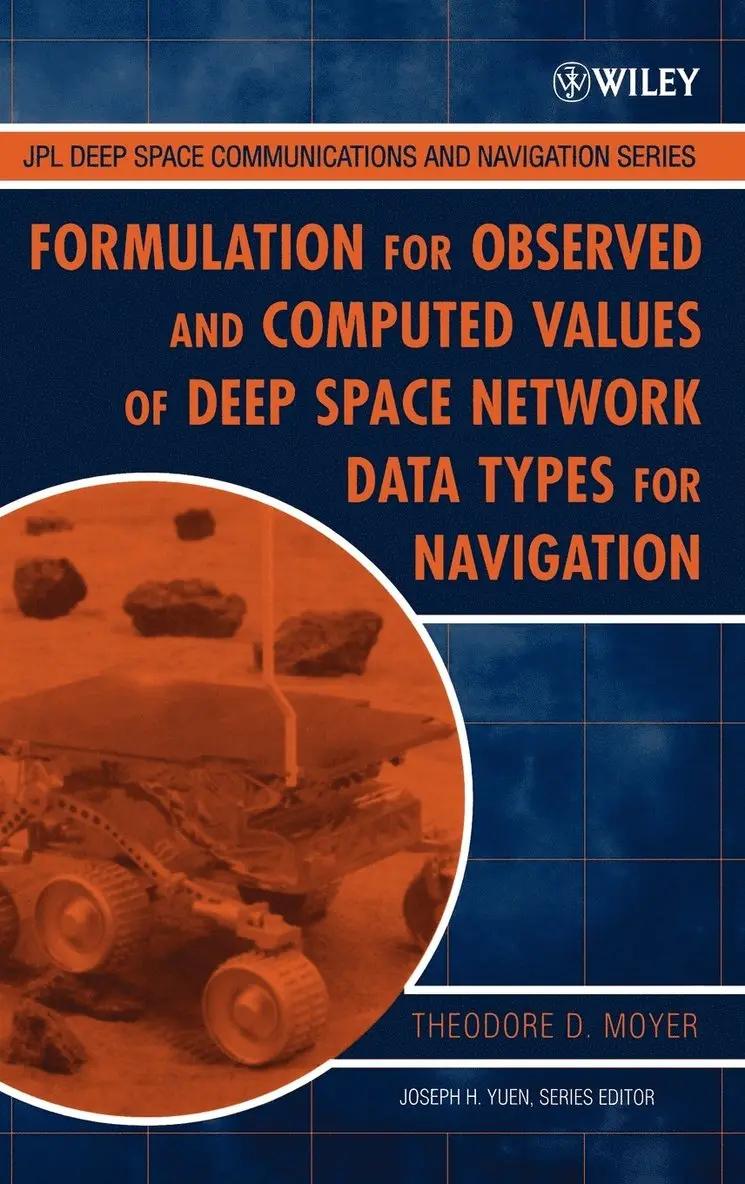
Formulation for Observed and Computed Values of Deep Space Network Data Types for Navigation
Inbunden, Engelska, 2003
3 051 kr
Skickas inom 7-10 vardagar
A valuable reference for students and professionals in the field of deep space navigation Drawing on fundamental principles and practices developed during decades of deep space exploration at the California Institute of Technology's Jet Propulsion Laboratory (JPL), this book documents the formation of program Regres of JPL's Orbit Determination Program (ODP). Program Regres calculates the computed values of observed quantities (e.g., Doppler and range observables) obtained at the tracking stations of the Deep Space Network, and also calculates media corrections for the computed values of the observable and partial derivatives of the computed values of the observables with respect to the solve-for-parameter vector-q. The ODP or any other program which uses its formulation can be used to navigate a spacecraft anywhere in the solar system. A publication of the JPL Deep Space Communications and Navigation System Center of Excellence (DESCANSO), Formulation for Observed and Computed Values of Deep Space Network Data Types for Navigation is an invaluable resource for graduate students of celestial mechanics or astrodynamics because it:* features the expertise of today's top scientists* places the entire program Regres formulation in an easy-to-access resource* describes technology which will be used in the next generation of navigation software currently under development The Deep Space Communications and Navigation Series is authored by scientists and engineers with extensive experience in astronautics, communications, and related fields. It lays the foundation for innovation in the areas of deep space navigation and communications by conveying state-of-the-art knowledge in key technologies.
Del 2 - JPL Deep-Space Communications and Navigation Series
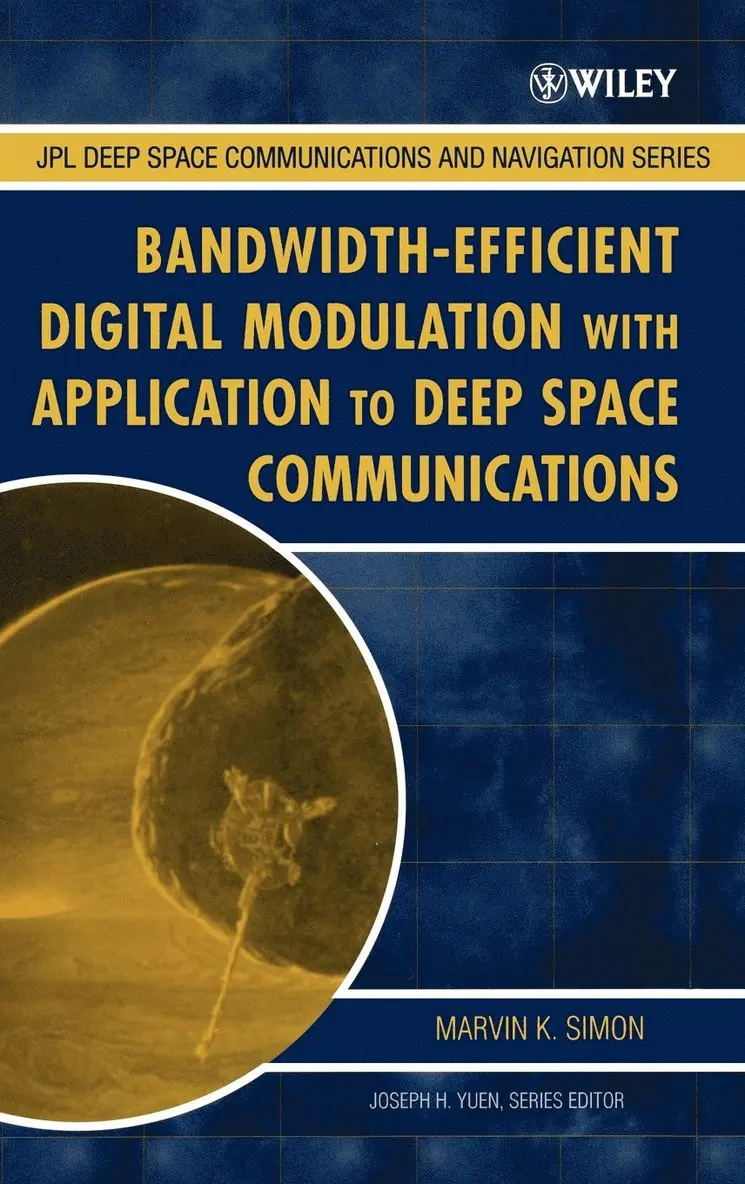
Bandwidth-Efficient Digital Modulation with Application to Deep Space Communications
Inbunden, Engelska, 2003
2 448 kr
Skickas inom 7-10 vardagar
An important look at bandwidth-efficient modulations with applications to today's Space program Based on research and results obtained at the California Institute of Technology's Jet Propulsion Laboratory, this timely book defines, describes, and then delineates the performance (power and bandwidth) of digital communication systems that incorporate a wide variety of bandwidth-efficient modulations appropriate for the design and implementation of space communications systems. The author compares the performance of these systems in the presence of a number of practical (non-ideal) transmitter and receiver characteristics such as modulator and phase imbalance, imperfect carrier synchronization, and transmitter nonlinearity. Although the material focuses on the deep space applications developed at the Jet Propulsion Laboratory, the presentation is sufficiently broad as to be applicable to a host of other applications dealing with RF communications. An important contribution to the scientific literature, Bandwidth-Efficient Digital Modulation with Application to Deep Space Communications* was commissioned by the JPL Deep Space Communications and Navigation System Center of Excellence* highlights many NASA-funded technical contributions pertaining to deep space communications systems* is a part of the prestigious Deep Space Communications and Navigation Series The Deep Space Communications and Navigation Series is authored by scientists and engineers with extensive experience in astronautics, communications, and related fields. It lays the foundation for innovation in the areas of deep space navigation and communications by disseminating state-of-the-art knowledge in key technologies.
Del 1 - JPL Deep-Space Communications and Navigation Series
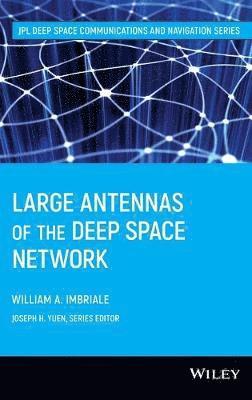
Large Antennas of the Deep Space Network
Inbunden, Engelska, 2003
2 711 kr
Skickas inom 7-10 vardagar
An important historical look at the space program's evolving telecommunications systems Large Antennas of the Deep Space Network traces the development of the antennas of NASA's Deep Space Network (DSN) from the network's inception in 1958 to the present. It details the evolution of the large parabolic dish antennas, from the initial 26-m operation at L-band (960 MHz) through the current Ka-band (32 GHz) systems. Primarily used for telecommunications, these antennas also support radar and radio astronomy observations in the exploration of the solar system and the universe. In addition, the author also offers thorough treatment of the analytical and measurement techniques used in design and performance assessment. Large Antennas of the Deep Space Network represents a vital addition to the literature in that it includes NASA-funded research that significantly impacts on deep space telecommunications. Part of the prestigious JPL Deep Space Communications and Navigation Series, it captures fundamental principles and practices developed during decades of deep space exploration, providing information that will enable antenna professionals to replicate radio frequencies and optics designs. Designed as an introduction for students in the field as well as a reference for advanced practitioners, the text assumes a basic familiarity with engineering and mathematical concepts and technical terms. The Deep Space Communications and Navigation Series is authored by scientists and engineers with extensive experience in astronautics, communications, and related fields. It lays the foundation for innovation in the areas of deep space navigation and communications by disseminating state-of-the-art knowledge in key technologies.
Del 4 - JPL Deep-Space Communications and Navigation Series
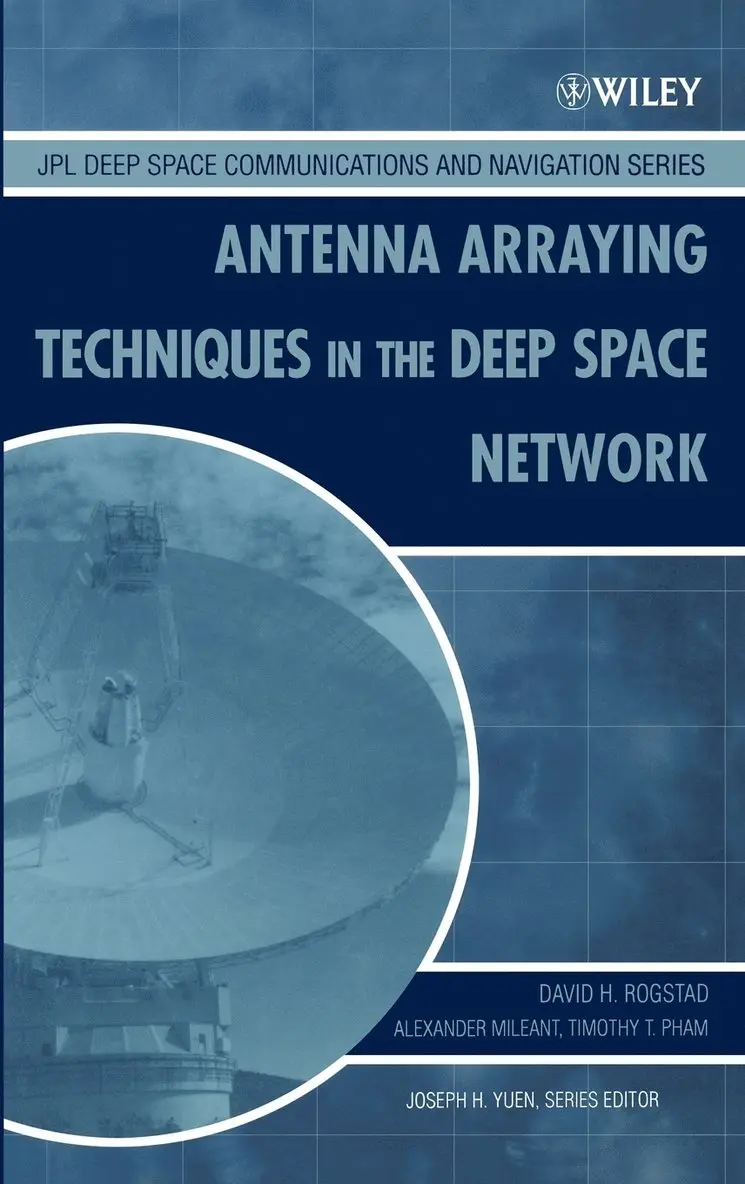
Antenna Arraying Techniques in the Deep Space Network
Inbunden, Engelska, 2003
1 991 kr
Skickas inom 7-10 vardagar
An introduction to antenna Arraying in the Deep Space network Antenna arraying is the combining of the output from several antennas in order to improve the signal-to-noise ratio (SNR) of the received signal. Now implemented at the Goldstone Complex and other Deep Space Network (DSN) overseas facilities, antenna arraying provides flexible use of multiple antennas to increase data rates and has enabled NASA's DSN to extend the missions of some spacecraft beyond their planned lifetimes. Antenna Arraying Techniques in the Deep Space Network introduces the development and use of antenna arraying as it is implemented in the DSN. Drawing on the work of scientists at JPL, this timely volume summarizes the development of antenna arraying and its historical background; describes key concepts and techniques; analyzes and compares several methods of arraying; discusses several correlation techniques used for obtaining the combined weights; presents the results of several arraying experiments; and suggests directions for future work. An important contribution to the scientific literature, Antenna Arraying Techniques in the Deep Space Network* Was commissioned by the JPL Deep Space Communications and Navigation Systems (DESCANSO) Center of Excellence* Highlights many NASA-funded technical contributions pertaining to deep space communications systems* Is a part of the prestigious JPL Deep Space Communications and Navigation Series The Deep Space Communications and Navigation Series is authored by scientists and engineers with extensive experience in astronautics, communications, and related fields. It lays the foundation for innovation in the areas of deep space navigation and communications by disseminating state-of-the-art knowledge in key technologies.
Del 5 - JPL Deep-Space Communications and Navigation Series
Radio Occultations Using Earth Satellites
A Wave Theory Treatment
Inbunden, Engelska, 2004
2 769 kr
Skickas inom 7-10 vardagar
the wave theory foundations of today's radio occultation techniques Forty years ago, the premier radio occultation problem was how to profile the atmosphere and radius of Mars using signals sent by the Mariner 4 spacecraft. Researchers then could rely on ray theory-based techniques for accurate analysis of the thin, uniform Martian atmosphere. Today's radio occultation challenges mostly involve communications platforms-and related data, instrument systems, and applications-in the Earth's own atmosphere. To deal with the density and complexity of this multilayered medium, an analytical framework that goes beyond ray theory is needed. Setting the cutting edge for the field, Radio Occultations Using Earth Satellites: A Wave Theory Treatment develops a purely wave-theoretic approach to occultation analysis. This approach yields more nuanced results than either ray or hybrid (ray/wave) methodologies offer, and proves suitable for the many variables at work in today's problems. This groundbreaking text provides:* An introduction to the general theory of radio occultations* Development of ray theory and scalar diffraction treatments of radio propagation processes* Development of a wave theoretic treatment of the above wave propagation processes* The correspondence between wave and ray theories* A discussion of how to use a wave-theoretic approach to infer the refractive properties of the propagation medium from a time series set of observations of the propagated wave's phase and amplitude A comprehensive resource that clearly defines the latest topics and methodologies, Radio Occultations Using Earth Satellites is a must-have text for engineers, scientists, students, and managers in satellites communications, navigation, deep space and planetary exploration, aerospace, atmospheric science, physics, and engineering. The Deep Space Communications and Navigation Series is authored by scientists and engineers with extensive experience in astronautics, communications, and related fields. It lays the foundation for innovation in the areas of deep space navigation and communications by disseminating state-of-the-art knowledge in key technologies.
Del 11 - JPL Deep-Space Communications and Navigation Series
Coupled-Oscillator Based Active-Array Antennas
Inbunden, Engelska, 2012
1 699 kr
Skickas inom 7-10 vardagar
Describing an innovative approach to phased-array control in antenna designThis book explores in detail phased-array antennas that use coupled-oscillator arrays, an arrangement featuring a remarkably simple beam steering control system and a major reduction in complexity compared with traditional methods of phased-array control. It brings together in one convenient, self-contained volume the many salient research results obtained over the past ten to fifteen years in laboratories around the world, including the California Institute of Technology's Jet Propulsion Laboratory.The authors examine the underlying theoretical framework of coupled-oscillator systems, clearly explaining the linear and nonlinear formalisms used in the development of coupled-oscillator arrays, while introducing a variety of state-of-the-art methodologies, design solutions, and tools for applying this control scheme. Readers will find: Numerous implementation examples of coupled-oscillator array prototypesA continuum model that permits application of diffusion theory to the analysis of phase dynamicsA demonstration of the array behavior through experimental results that validate the linearized theoryExamples of how incorporating coupling delay restores causality, including the latest published resultsGuidance on how to accurately analyze and optimize coupled-oscillator arrays using modern simulation toolsA review of current developments, including the design of compact couple-oscillator array antennasComplete with 150 diagrams and photographs, Coupled-Oscillator Based Active-Array Antennas is a highly useful tutorial for antenna designers and a valuable reference for researchers and engineers wishing to learn about this cutting-edge technology.
Del 12 - JPL Deep-Space Communications and Navigation Series
Low-Energy Lunar Trajectory Design
Inbunden, Engelska, 2014
1 621 kr
Skickas inom 7-10 vardagar
Based on years of research conducted at the NASA Jet Propulsion Laboratory, Low-Energy Lunar Trajectory Design provides high-level information to mission managers and detailed information to mission designers about low-energy transfers between Earth and the moon. The book answers high-level questions about the availability and performance of such transfers in any given month and year. Low-energy lunar transfers are compared with various other types of transfers, and placed within the context of historical missions.Using this book, designers may reconstruct any transfer described therein, as well as design similar transfers with particular design parameters.An Appendix, “Locating the Lagrange Points,” and a useful list of terms and constants completes this technical reference. Surveys thousands of possible trajectories that may be used to transfer spacecraft between Earth and the moon, including transfers to lunar libration orbits, low lunar orbits, and the lunar surfaceProvides information about the methods, models, and tools used to design low-energy lunar transfersIncludes discussion about the variations of these transfers from one month to the next, and the important operational aspects of implementing a low-energy lunar transferAdditional discussions address navigation, station-keeping, and spacecraft systems issues
1 699 kr
Skickas inom 7-10 vardagar
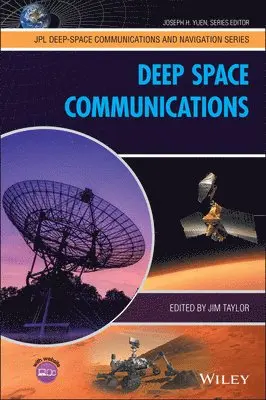
DEEP SPACE COMMUNICATIONS A COLLECTION OF SOME OF THE JET PROPULSION LABORATORY’S SPACE MISSIONS SELECTED TO REPRESENT THE PLANETARY COMMUNICATIONS DESIGNS FOR A PROGRESSION OF VARIOUS TYPES OF MISSIONS The text uses a case study approach to show the communications link performance resulting from the planetary communications design developed by the Jet Propulsion Laboratory (JPL). This is accomplished through the description of the design and performance of six representative planetary missions. These six cases illustrate progression through time of the communications system’s capabilities and performance from 1970s technology to the most recent missions. The six missions discussed in this book span the Voyager for fly-bys in the 1970s, Galileo for orbiters in the 1980s, Deep Space 1 for the 1990s, Mars Reconnaissance Orbiter (MRO) for planetary orbiters, Mars Exploration Rover (MER) for planetary rovers in the 2000s, and the MSL rover in the 2010s. Deep Space Communications: Provides an overview of the Deep Space Network and its capabilitiesExamines case studies to illustrate the progression of system design and performance from mission to mission and provides a broad overview of the mission systems describedDiscusses actual flight mission telecommunications performance of each systemDeep Space Communications serves as a reference for scientists and engineers interested in communications systems for deep-space telecommunications link analysis and design control.
1 475 kr
Skickas inom 7-10 vardagar
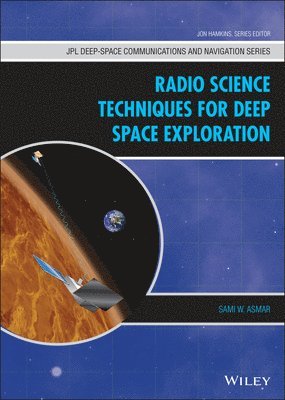
Explore the development and state-of-the-art in deep space exploration using radio science techniquesIn Radio Science Techniques for Deep Space Exploration, accomplished NASA/JPL researcher and manager Sami Asmar delivers a multi-disciplinary exploration of the science, technology, engineering, mission operations, and signal processing relevant to deep space radio science. The book discusses basic principles before moving on to more advanced topics that include a wide variety of graphical illustrations and useful references to publications by experts in their respective fields.Complete explanations of changes in the characteristics of electromagnetic waves and the instrumentation and technology used in scientific experiments are examined.Radio Science Techniques for Deep Space Exploration offers answers to the question of how to explore the solar system with radio links and better understand the interior structures, atmospheres, rings, and surfaces of other planets. The author also includes: Thorough introductions to radio science techniques and systems needed to investigate planetary atmospheres, rings, and surfacesComprehensive explorations of planetary gravity and interior structures, as well as relativistic and solar studiesPractical discussions of instrumentation, technologies, and future directions in radio science techniquesPerfect for students and professors of physics, astronomy, planetary science, aerospace engineering, and communications engineering, Radio Science Techniques for Deep Space Exploration will also earn a place in the libraries of engineers and scientists in the aerospace industry.
1 223 kr
Skickas inom 7-10 vardagar
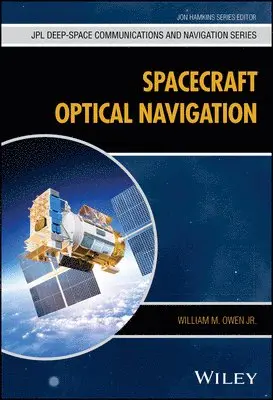
UNIQUE RESOURCE EXPLORING HOW SPACECRAFT IMAGERY PROVIDES PROFESSIONALS WITH ACCURATE ESTIMATES OF SPACECRAFT TRAJECTORY, WITH REAL-WORLD EXAMPLES AND DETAILED ILLUSTRATIONS Spacecraft Optical Navigation provides detailed information on the planning and analysis of spacecraft imagery to help determine the trajectory of a spacecraft. The author, an experienced engineer within the field, addresses the entirety of celestial targets and explains how a spacecraft captures their imagery. Aimed at professionals within spacecraft navigation, this book provides an extensive introduction and explains the history of optical navigation, reviewing a range of optical methods and presents real world examples throughout. With the use of mathematics, this book discusses everything from the orbits, sizes, and shapes of the bodies being imaged, to the location and properties of salient features on their surfaces. Specific sample topics covered in Spacecraft Optical Navigation include: History of various past spacecraft, including Mariner and Viking, Voyager, Galileo, NEAR Shoemaker, and Cassini, and flight hardware, star catalogs, and stereophotoclinometryCameras, covering the gnomonic projection (and deviations from it), creation of a digital picture, picture flattening, and readout smearsModeling optical navigation observables, covering apparent directions to an object, star, and limbs or terminators, and orientation of camerasObtaining optical navigation observables, covering centerfinding for stars and resolved and unresolved bodies, and using opnav data in orbit determinationSpacecraft Optical Navigation is an ideal resource for engineers working in spacecraft navigation and optical navigation, to update their knowledge of the technology and use it in their day-to-day. The text will also benefit researchers working with spacecraft, particularly in navigation, and professors and lecturers teaching graduate aerospace courses.