• Fri frakt över 249 kr
  • •
  • Snabba leveranser
  • •
  • Billiga böcker
Kundservice

Du är på sajten för privatpersoner.

Företag, bibliotek eller offentlig verksamhet?

Du handlar på classic.bokus.com, där alla dina funktioner finns intakta.
Till classic.bokus.com
Bokus logotyp. Gå till startsidan.
  • Erbjudanden
  • Student
  • Topplistor
  • Barn & ungdom
  • Bokus Play
  • E-böcker
  • Ljudböcker
  • Pocketböcker
  • Spel & pussel

Upp till 25% på utvalda nyheter →

Sidfot

Mina sidor

    Hjälp

    • Kundservice
    • Vanliga frågor och svar
    • Frakt och leverans
    • Retur vid ångerrätt
    • Reklamera vara
    • Betalning
    • Köpvillkor
    • Allmänna villkor
    • Information om webbplatsens tillgänglighet

    Om Bokus

    • Om oss
    • Pressrum
    • För studenter
    • För företag
    • För bibliotek och offentlig verksamhet
    • För leverantörer
    • Hållbarhet

    Populärt

    • Aktuella erbjudanden
    • Presentkort
    • Studentlitteratur
    • Nya böcker
    • Topplistor
    • Signerade böcker
    • Engelska böcker

    Inspiration

    • Boktips
    • BookTok
    • Populära bokserier
    • Barnbokskaraktärer
    • Populära författare
    Logotyp för Bokus
    Följ oss på Facebook (extern länk)Följ oss på Instagram (extern länk)Följ oss på YouTube (extern länk)Följ oss på TikTok (extern länk)
    bokus @ CookiesAnpassa cookiesIntegritetspolicyKöpvillkor
    Till Citymail hemsida (extern länk)Till Budbee hemsida (extern länk)Till Postnord hemsida (extern länk)Till Schenker hemsida (extern länk)Till Early Bird hemsida (extern länk)Till Walleys hemsida (extern länk)
    1. Naturvetenskap och teknik
    2. Teknik och industri
    3. Elektronik och kommunikationer

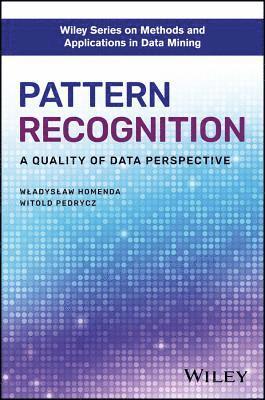
    Pattern Recognition

    A Quality of Data Perspective

    AvWladyslaw Homenda,Witold Pedrycz

    Inbunden, Engelska, 2018

    Del i serien Wiley Series on Methods and Applications in Data Mining

    1 458 kr

    Beställningsvara. Skickas inom 5-8 vardagar. Fri frakt över 249 kr.

    Beskrivning

    A new approach to the issue of data quality in pattern recognitionDetailing foundational concepts before introducing more complex methodologies and algorithms, this book is a self-contained manual for advanced data analysis and data mining. Top-down organization presents detailed applications only after methodological issues have been mastered, and step-by-step instructions help ensure successful implementation of new processes. By positioning data quality as a factor to be dealt with rather than overcome, the framework provided serves as a valuable, versatile tool in the analysis arsenal.For decades, practical need has inspired intense theoretical and applied research into pattern recognition for numerous and diverse applications. Throughout, the limiting factor and perpetual problem has been data—its sheer diversity, abundance, and variable quality presents the central challenge to pattern recognition innovation. Pattern Recognition: A Quality of Data Perspective repositions that challenge from a hurdle to a given, and presents a new framework for comprehensive data analysis that is designed specifically to accommodate problem data.Designed as both a practical manual and a discussion about the most useful elements of pattern recognition innovation, this book: Details fundamental pattern recognition concepts, including feature space construction, classifiers, rejection, and evaluationProvides a systematic examination of the concepts, design methodology, and algorithms involved in pattern recognitionIncludes numerous experiments, detailed schemes, and more advanced problems that reinforce complex conceptsActs as a self-contained primer toward advanced solutions, with detailed background and step-by-step processesIntroduces the concept of granules and provides a framework for granular computingPattern recognition plays a pivotal role in data analysis and data mining, fields which are themselves being applied in an expanding sphere of utility. By facing the data quality issue head-on, this book provides students, practitioners, and researchers with a clear way forward amidst the ever-expanding data supply.

    Produktinformation

    • Utgivningsdatum:2018-04-24
    • Mått:155 x 226 x 8 mm
    • Vikt:581 g
    • Format:Inbunden
    • Språk:Engelska
    • Serie:Wiley Series on Methods and Applications in Data Mining
    • Antal sidor:320
    • Förlag:John Wiley & Sons Inc
    • ISBN:9781119302827

    Utforska kategorier

    • Elektronik och kommunikationer inom Naturvetenskap och teknik
    • Systemvetenskap och AI inom Data och IT
    • Databaser inom Data och IT

    Mer om författaren

    WŁADYSŁAW HOMENDA, MSc., PhD, DSc., is an Associate Professor with the Faculty of Mathematics and Information Science at the Warsaw University of Technology, Poland, and an Associate Professor with the Faculty of Economics and Informatics in Vilnius at the University of Białystok, Lithuania. WITOLD PEDRYCZ is a Professor with the Systems Research Institute, Polish Academy of Sciences Warsaw, Poland and Department of Electrical & Computer Engineering, University of Alberta, Edmonton, AB, Canada.

    Innehållsförteckning

    • Preface ix Part I Fundamentals 1 Chapter 1 Pattern Recognition: Feature Space Construction 3 1.1 Concepts 3 1.2 From Patterns to Features 8 1.3 Features Scaling 17 1.4 Evaluation and Selection of Features 23 1.5 Conclusions 47 Appendix 1.A 48 Appendix 1.B 50 References 50 Chapter 2 Pattern Recognition: Classifiers 53 2.1 Concepts 53 2.2 Nearest Neighbors Classification Method 55 2.3 Support Vector Machines Classification Algorithm 57 2.4 Decision Trees in Classification Problems 65 2.5 Ensemble Classifiers 78 2.6 Bayes Classifiers 82 2.7 Conclusions 97 References 97 Chapter 3 Classification with Rejection Problem Formulation And An Overview 101 3.1 Concepts 102 3.2 The Concept of Rejecting Architectures 107 3.3 Native Patterns-Based Rejection 112 3.4 Rejection Option in the Dataset of Native Patterns: A Case Study 118 3.5 Conclusions 129 References 130 Chapter 4 Evaluating Pattern Recognition Problem 133 4.1 Evaluating Recognition with Rejection: Basic Concepts 133 4.2 Classification with Rejection with No Foreign Patterns 145 4.3 Classification with Rejection: Local Characterization 149 4.4 Conclusions 156 References 156 Chapter 5 Recognition with Rejection: Empirical Analysis 159 5.1 Experimental Results 160 5.2 Geometrical Approach 175 5.3 Conclusions 191 References 192 Part II Advanced Topics: a Framework of Granular Computing 195 Chapter 6 Concepts and Notions of Information Granules 197 6.1 Information Granularity and Granular Computing 197 6.2 Formal Platforms of Information Granularity 201 6.3 Intervals and Calculus of Intervals 205 6.4 Calculus of Fuzzy Sets 208 6.5 Characterization of Information Granules: Coverage and Specificity 216 6.6 Matching Information Granules 219 6.7 Conclusions 220 References 221 Chapter 7 Information Granules: Fundamental Constructs 223 7.1 The Principle of Justifiable Granularity 223 7.2 Information Granularity as a Design Asset 230 7.3 Single-Step and Multistep Prediction of Temporal Data in Time Series Models 235 7.4 Development of Granular Models of Higher Type 236 7.5 Classification with Granular Patterns 241 7.6 Conclusions 245 References 246 Chapter 8 Clustering 247 8.1 Fuzzy C-Means Clustering Method 247 8.2 k-Means Clustering Algorithm 252 8.3 Augmented Fuzzy Clustering with Clusters and Variables Weighting 253 8.4 Knowledge-Based Clustering 254 8.5 Quality of Clustering Results 254 8.6 Information Granules and Interpretation of Clustering Results 256 8.7 Hierarchical Clustering 258 8.8 Information Granules in Privacy Problem: A Concept of Microaggregation 261 8.9 Development of Information Granules of Higher Type 262 8.10 Experimental Studies 264 8.11 Conclusions 272 References 273 Chapter 9 Quality of Data: Imputation and Data Balancing 275 9.1 Data Imputation: Underlying Concepts and Key Problems 275 9.2 Selected Categories of Imputation Methods 276 9.3 Imputation with the Use of Information Granules 278 9.4 Granular Imputation with the Principle of Justifiable Granularity 279 9.5 Granular Imputation with Fuzzy Clustering 283 9.6 Data Imputation in System Modeling 285 9.7 Imbalanced Data and their Granular Characterization 286 9.8 Conclusions 291 References 291 Index 293