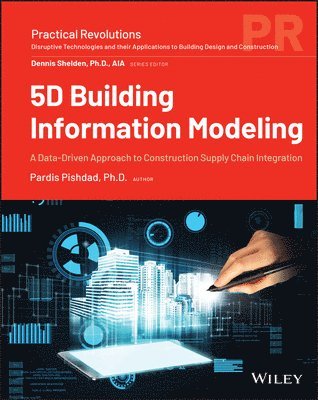
5D Building Information Modeling
A Data-Driven Approach to Construction Supply Chain Integration
Del i serien Practical Revolutions
573 kr
Kommande
Beskrivning
Produktinformation
- Utgivningsdatum:2026-09-10
- Vikt:666 g
- Format:Häftad
- Språk:Engelska
- Serie:Practical Revolutions
- Antal sidor:208
- Förlag:John Wiley & Sons Inc
- ISBN:9781119705758
Utforska kategorier
Mer om författaren
Pardis Pishdad, PhD, is a Professor at Georgia Tech, in the College of Design, School of Building Construction, and a globally recognized scholar in Integrated Project Delivery (IPD), collaboration and trust-building, Building Information Modeling (BIM), and technological integration. Dr. Pishdad is the founder and director of the Smart Built-Environment Ecosystem (Smart BEES) Lab, which conducts research at the intersection of cyber, physical, and behavioral systems. Her work focuses on integrating data, processes, and stakeholders across the project life cycle to improve efficiency and enable the sustainable design, construction, and operation of smart built environments. Her scholarly publications examine ways to enhance productivity through integration, digitalization, industrialization, and automation. Dr. Pishdad holds a PhD in Environmental Design and Planning from Virginia Tech and master’s degrees in civil engineering (Virginia Tech), design studies with a focus on project management (Harvard University), and architecture (University of Tehran). Series Editor Dennis Shelden, PhD, is an expert in the application of digital technology to building design, construction, and operations. He is a Director of CASE and an Associate Professor in the School of Architecture at Rensselaer.
Innehållsförteckning
- CHAPTER 1: INTRODUCTION 91.1 Overview, Purpose, and Structure of the Book 9Guiding Questions 101.2 Construction Industry and Its Current State of Inefficiency 101.3 Productivity Booster and Opportunities for Improvement 111.4 Significant Role of Construction Supply Chain Integration in Construction Productivity 121.5 Role of BIM in Enhancing Supply Chain Integration and Boosting Productivity 131.6 Construction Supply Chain Integration (CSCI) 141.7 Main Research Areas of Construction Supply Chain Integration 161.7.1 Adoption of Manufacturing Theories 161.7.2 Benefits of Construction Supply Chain Integration 161.7.3 Successful implementation 161.7.4 Digitization and utilization of Information and Communications Technology 161.7.5 Contract and relationship governance 171.7.6 Sustainability 171.8 Discussion and Conclusion 17CHAPTER 2: BACKGROUND OF CONSTRUCTION SUPPLY CHAIN MANAGEMENT, PROBLEMS, AND FRAMEWORK OF POTENTIAL SOLUTIONS 19Guiding Questions 192.1 Construction Supply Chain Management: Definition and Significance 192.1.1 Definition of Construction Supply Chain Management 192.1.2 Significance 192.2 Construction Supply Chain Issues: Broken Supply Chain of Data, Products, and Money 202.2.1 Lack of Accessibility to Data 202.2.2 Lack of Traceability of Products in the Supply Chain 202.2.3 Dis-connectivity of Payment Application & the Single Source of Truth 202.3 Solution for Seamless Flow of Data, Products, and Money 212.3.1 Flows in the Construction Supply Chain 212.3.2 Achieving Seamless Data Flow 222.3.3 Achieving Seamless Product Flow 482.3.4 Achieving Seamless Money Flow 502.3.5. Achieving Construction Supply Chain Integration 512.4 BIM Addressing Supply Chain Challenges 522.4.1 Definition of BIM 522.4.2 State of BIM Adoption 532.5 Future Vision: A Framework for Integrated Supply Chain Empowered by Emerging Technologies, like Blockchain, IoT, GIS 542.5.1 Learning from Other Industries: Models for Integration 542.5.2 Why BIM Matters in the Supply Chain 552.5.3 The Evolving Role of the CM/GC: From Coordinator to Data Merchant 552.5.4 BIM Implementation Maturity: From Chaos to Civilization 552.5.5 Asset Tracking, Naming Conventions, and Systematic Templates 552.5.6 A Cultural Shift Driven by Value 552.5.7 What Gets Measured Gets Managed: Feedback and Continuous Improvement 552.5.8 What Gets Measured Gets Managed: Performance Feedback and Learning 562.5.9 Program Validation and Budget-Driven Design: A Lifecycle Approach 562.6 Discussion and Conclusion 57CHAPTER 3: 5D BIM CURRENT STATE OF ART AND PRACTICE 59Guiding Questions 593.1 Applicable Industry Standards for 5D BIM 593.1.1. Industry Foundation Classes (IFC) 613.1.2. Level of Development (LOD) 623.1.3. The buildingSMART Data Dictionary (bsDD) 623.1.4. Information Delivery Manual (IDM) 623.1.5. Model View Definitions (MVD) 633.1.6. Rules of Measurement 633.1.7. Classification Systems 643.2 Key Resources and Collaborative Implementation 663.2.1. BIM Costing Library 663.2.2. BIM Object Library 663.2.3. 5D BIM Collaborative Implementation 663.3 Integrated Benefits of 5D BIM 673.4 5D BIM State of the Practice: Study of Three 5D BIM Tools 683.4.1. RIB iTWO/ MTWO 683.4.2. Destini Profiler 703.4.3. Vico Office 713.4.4. Synthesis of Common Practices vs. Case Studies 733.5 Pathways to Full Automation in 5D BIM 743.6 Discussion and Conclusion 75CHAPTER 4: LIFE CYCLE IMPLEMENTATION OF 5D BUILDING INFORMATION MODELING 76Guiding Questions 764.1 Introduction 764.2 5D BIM cost estimation during preconstruction 764.2.1 Detailed cost estimation and bill of quantities 774.2.2 5D BIM cost control during construction and manufacturing 774.2.3 5D BIM as-built cost data recording postconstruction 774.3 Implementation guidelines for 5D BIM 784.3.1 5D BIM implementation in the United States 784.3.2 5D BIM implementation in the United Kingdom (UK) 794.4 Data collection methodology 804.5 Case Studies 814.6 Case Study 1 824.6.1 Cost Estimating 824.6.2 Cost data 834.6.3 Mechanisms for quality Control 844.6.4 Multidisciplinary model 844.6.5 Cloud-based software/ Collaboration with Stakeholders 844.6.6 Guidelines for implementation of 5D BIM 844.6.7 Cost control during design and construction 854.6.8 Interoperability of Pay applications 854.6.9 Challenges Encountered in 5D practice 864.7 Case Study 2 874.7.1 Cost estimation 884.7.2 Cost data 884.7.3 Mechanisms for quality Control 884.7.4 Multidisciplinary model 884.7.5 Cloud-based software/ Collaboration with stakeholders 894.7.6 Guidelines for implementation of 5D BIM 894.7.7 Cost control during design and construction 894.7.8 Interoperability of pay applications 904.7.9 Challenges Encountered in 5D practice 904.8 Case Study 3 914.8.1 Cost estimation during conceptual design 924.8.2 Cost data 924.8.3 Mechanisms for quality Control 934.8.4 Multidisciplinary model 934.8.5 Cloud-based software 934.8.6 Cost control during design and construction 934.8.7 Interoperability with pay applications 944.8.8 Challenges Encountered in 5D practice 944.9 Case Study 4 954.9.1 Cost estimation during conceptual design 954.9.2 Cost data 964.9.3 Mechanisms for quality Control 964.9.4 Multidisciplinary model 964.9.5 Cloud-based software 964.9.6 Cost control during design and construction 964.9.7 Interoperability with pay applications 974.9.8 Challenges Encountered in 5D practice 974.10 Case Study 5 974.10.1 Cost estimation during conceptual design 974.10.2 Cost data 984.10.3 Mechanisms for quality Control 984.10.4 Multidisciplinary model 984.10.5 Cloud-based software 984.10.6 Cost control during design and construction 984.10.7 Interoperability with pay applications 994.10.8 Challenges Encountered in 5D practice 994.11 Case Study 6 994.11.1 Cost estimation during conceptual design 994.11.2 Cost data 994.11.3 Mechanisms for quality Control 1004.11.4 Multidisciplinary model 1004.11.5 Cloud-based software 1004.11.6 Cost control during design and construction 1004.11.7 Interoperability with pay applications 1004.11.8 Challenges Encountered in 5D practice 1004.12 Synthesis of Case Studies 1014.13 Findings and Discussions 1014.13.1 Results 1024.13.2 Future studies and recommendations 104CHAPTER 5: CASE STUDIES FOR IMPLEMENTING 5D BIM 106Georgia Tech Campus Center Case Study 106Guiding Questions: 1065.1 Project overview 1065.1.1 Contractual provisions to facilitate implementation of 5D BIM 1065.2 Overview of adopted BIM software 1075.2.1 BIM applications during the design phase 1075.2.2 BIM applications during the pre-construction and construction phase 1075.2.3 BIM tools used for close-out and BIM handover to facilities management team. 1075.3 BIM model development 1075.3.1 Workflows 1075.3.2 Standards & guidelines followed 1105.3.3 Integration of Supply chain data 1115.4 Quantities extraction 1115.4.1 Model creation and import 1115.4.2 Rules of measurement 1115.4.3Cost database 1115.4.4Mapping of objects to cost 1115.4.5 Classification systems 1115.4.6 Non-modeling cost items 1125.4.7 Costing 1125.4.8 Collaboration 1125.5 Cost Adjustments and quality control 1125.5.1 Cost adjustments due to changes 1125.5.2 Cost monitoring during construction 1125.5.3 Mechanisms for quality control 1125.6 Pay applications 1125.6.1 Pay applications and accounting systems used 1135.6.2 Interoperability of pay application software with 5D BIM software 1135.6.3 Comparison of actual cost to initial cost estimated 1135.7 Evaluation of software 1135.7.1 Cost estimation during conceptual design 1135.7.2 Detailed Cost Estimating and Bill of Quantities 1135.7.3 Cost control during design and construction 1135.7.4 As-built cost data recording post installation 1145.7.5 Operation and maintenance cost data 1145.8 Challenges and benefits 1145.8.1 Challenges 1145.8.2 Value Proposition 1145.8.3 Cost involved 1155.8.4 Benefits 1155.9 Findings and lessons learned 116New Slussen Project Case Study 1175.10 Project overview 1175.11 Project location 1185.12 BIM design for project (Amin, 2020) 1205.13 Overview of adopted BIM software 1215.13.1 BIM applications during the design phase 1215.13.2 BIM applications during the pre-construction and construction phase 1215.13.3 BIM tools used for close-out and BIM handover to facilities management team. 1215.14 BIM model development 1225.14.1 Workflows 1225.14.2 Standards & guidelines followed 1265.15 Quantities extraction 1265.15.1 Model creation and import 1265.15.2 Expertise Required for 5D BIM 1265.15.3 Rules of measurement 1275.15.4 Cost database 1275.15.5 Mapping of objects to cost 1275.15.6 Classification systems 1275.15.7 Non-modeling cost items 1275.15.8 Costing 1275.15.9 Collaboration 1285.16 Adjustments and quality control 1285.16.1 Cost adjustments due to changes preconstruction 1285.16.2 Cost monitoring during construction 1285.16.3 Mechanisms for quality control 1295.17 Pay applications 1295.17.1 Pay applications and accounting systems used 1295.17.2 Interoperability of pay application software with 5D BIM software 1295.17.3 Comparison of actual cost to initial cost estimated 1305.18 Evaluation of software 1305.18.1 Cost estimation during conceptual design 1305.18.2 Detailed Cost estimating and bill of Quantities 1305.18.3 Cost control during design and construction 1305.18.4 As-built cost data recording post construction 1305.18.5 Operation and maintenance cost data 1305.19 Challenges and benefits 1305.19.1 Challenges 1315.19.2 Benefits 131CHAPTER 6: VALUE PROPOSITION OF 5D BIM 132Guiding Questions 1326.1 Summary 1326.2 Introduction 1326.3 Value proposition of 5D BIM to project stakeholders 1326.3.1 Owners 1326.3.2 Architects and Engineers 1336.3.3 Estimators 1336.3.4 Suppliers 1336.3.5 Contractors 1346.3.6 Manufacturers 1346.4 Value proposition of 5D BIM in Supply Chain Integration 1346.4.1 Information flow 1346.4.2 Materials procurement and product flow 1356.4.3 Cash flow and Payments 1366.5 Case studies Highlighting Value Proposition of 5D BIM 1366.5.1 Case Study I: The New Slussen Project 1366.5.2 Texas Health Mansfield Hospital Case Study 1386.5.3 Georgia Tech Campus Center Case Study 1396.6 Conclusion 140CHAPTER 7: BLOCKCHAIN-ENABLED 5D BIM FOR CASH FLOW AND DATA SHARING 142Guiding Questions 1427.1 Leveraging Blockchain and Smart Contracts to Solve Payment Delays 1427.1.1 Blockchain Smart Contracts for Expediting Construction Payments 1427.1.2 Inefficiencies in Traditional Construction Payment Workflows 1437.1.3 Integrated 5D BIM + Smart Contract Architecture 1447.2 Blockchain-Enabled Smart Contracts Integrated with 5D BIM 1467.2.1 Integrated 5D BIM + Smart Contract Architecture 1467.2.2 Payment Trigger Mechanisms from BIM Models 1477.2.3 Industry Prototypes and Frameworks 1487.3 Blockchain for Secure BIM Data Sharing 1497.3.1 Challenges in Data Sharing Across Construction Supply Chains 1497.3.2 Blockchain Characteristics that Enable Trusted Exchange 1507.3.3 Frameworks for Secure Data Sharing 1517.4 Applications and Real-World Implementations 1547.4.1 Use Cases Across the AEC Industry 1547.4.2 Current Trends, Standards, and Research Prototypes 1557.5 Discussion and Conclusion 1577.5.1 Integrating Trust with Process Efficiency 1577.5.2 Challenges and Limitations 1577.5.3 Emerging Research Directions 1587.5.4 Future Practical Implementations 158CHAPTER 8: CONCLUSION ON INTEGRATED COST MANAGEMENT WITH 5D BIM 159Guiding Questions 1598.1 Integration and Automation of Cost Management in 5D BIM: Practices, Technologies, and Future Directions 1598.2 Discussion and Conclusion 1628.2.1 Integration of 5D BIM in Cost Management Throughout the Project Lifecycle 1628.2.2 Automation and Interoperability: Current State and Future Prospects 1628.2.3 Case Study Insights: Lessons Learned from 5D BIM Implementation 1638.2.4 Value Proposition of 5D BIM for Stakeholders 1638.2.5 Overcoming Barriers and Recommendations for Practice 1648.2.6 Future Directions: Toward Fully Integrated and Automated 5D BIM 164REFERENCES 165
Mer från samma serie
Parametric Analysis, Generative Design and Machine Learning in Architectural Practice
Victor Okhoya, Marcelo Bernal
519 kr
Du kanske också är intresserad av
Parametric Analysis, Generative Design and Machine Learning in Architectural Practice
Victor Okhoya, Marcelo Bernal
519 kr
- Nyhet
Tsaren i egen hög person : hur Vladimir Putin lurade oss alla
Roman Badanin, Michail Rubin
349 kr
- Signerad!
- 4 för 3
- -30%
- 4 för 3
- Nyhet
- -30%
- -30%