• Fri frakt över 249 kr
  • •
  • Snabba leveranser
  • •
  • Billiga böcker
Kundservice

Du är på sajten för privatpersoner.

Företag, bibliotek eller offentlig verksamhet?

Du handlar på classic.bokus.com, där alla dina funktioner finns intakta.
Till classic.bokus.com
Bokus logotyp. Gå till startsidan.
  • Erbjudanden
  • Student
  • Topplistor
  • Barn & ungdom
  • Bokus Play
  • E-böcker
  • Ljudböcker
  • Pocketböcker
  • Spel & pussel

Upp till 25% på utvalda nyheter →

Sidfot

Mina sidor

    Hjälp

    • Kundservice
    • Vanliga frågor och svar
    • Frakt och leverans
    • Retur vid ångerrätt
    • Reklamera vara
    • Betalning
    • Köpvillkor
    • Allmänna villkor
    • Information om webbplatsens tillgänglighet

    Om Bokus

    • Om oss
    • Pressrum
    • För studenter
    • För företag
    • För bibliotek och offentlig verksamhet
    • För leverantörer
    • Hållbarhet

    Populärt

    • Aktuella erbjudanden
    • Presentkort
    • Studentlitteratur
    • Nya böcker
    • Topplistor
    • Signerade böcker
    • Engelska böcker

    Inspiration

    • Boktips
    • BookTok
    • Populära bokserier
    • Barnbokskaraktärer
    • Populära författare
    Logotyp för Bokus
    Följ oss på Facebook (extern länk)Följ oss på Instagram (extern länk)Följ oss på YouTube (extern länk)Följ oss på TikTok (extern länk)
    bokus @ CookiesAnpassa cookiesIntegritetspolicyKöpvillkor
    Till Citymail hemsida (extern länk)Till Budbee hemsida (extern länk)Till Postnord hemsida (extern länk)Till Schenker hemsida (extern länk)Till Early Bird hemsida (extern länk)Till Walleys hemsida (extern länk)
    1. Samhälle och politik
    2. Sociologi och antropologi
    3. Sociologi

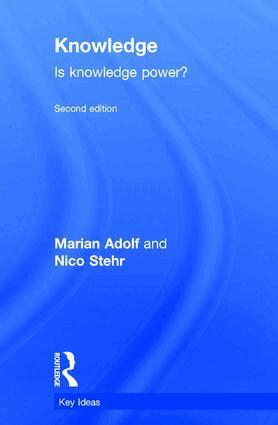
    Knowledge

    Is Knowledge Power?

    AvMarian Adolf,Nico Stehr

    Inbunden, Engelska, 2016

    Del i serien Key Ideas

    2 415 kr

    Beställningsvara. Skickas inom 10-15 vardagar. Fri frakt över 249 kr.

    Fler format och utgåvor

    Häftad

    707 kr

    Beskrivning

    As we move through our modern world, the phenomenon we call knowledge is always involved. Whether we talk of know-how, technology, innovation, politics or education, it is the concept of knowledge that ties them all together. But despite its ubiquity as a modern trope we seldom encounter knowledge in itself. How is it produced, where does it reside, and who owns it? Is knowledge always beneficial, will we know all there is to know at some point in the future, and does knowledge really equal power? This book pursues an original approach to this concept that seems to define so many aspects of modern societies. It explores the topic from a distinctly sociological perspective, and traces the many ways that knowledge is woven into the very fabric of modern society.

    Produktinformation

    • Utgivningsdatum:2016-09-26
    • Mått:129 x 198 x undefined mm
    • Vikt:760 g
    • Format:Inbunden
    • Språk:Engelska
    • Serie:Key Ideas
    • Antal sidor:312
    • Upplaga:2
    • Förlag:Taylor & Francis Ltd
    • ISBN:9781138685673

    Utforska kategorier

    • Sociologi inom Samhälle och politik

    Mer om författaren

    Marian Adolf is Professor of Media Culture at Zeppelin University. His research interest revolves around the interface of media and social change, communication and cultural theory. He has held appointments as Visiting Professor at Quest University and Alpen-Adria-University Klagenfurt, and currently serves as chair of the German Communication Association’s section for Media Sociology.Nico Stehr is Karl Mannheim Professor of Cultural Studies at Zeppelin University in Friedrichshafen Germany. He formerly held professorships at the University of Alberta, Edmonton, The University of British Columbia, Ludwig Maximilians University in Munich and was Paul F. Lazarsfeld Guest Professor at the University of Vienna. He has published widely on the topic of Knowledge and is one of the proponents of Knowledge Society, a term that has acquired widespread currency not only in academia.

    Innehållsförteckning

    • PrefaceIntroduction1. Classical Conceptions of Knowledge2. Knowledge about Knowledge2.1. Attributes of Knowledge2.2. Knowledge as a Capacity to Act2.3. Knowledge and Information2.4. Practical Knowledge2.5. Additional Knowledge2.6. The Uneven Development of Knowledge2.7. The Limits of the Growth of Knowledge2.8. A Sociological Concept of Knowledge and its Context3. The Knowledge of the Powerful3.1. Knowledge is Power and Power is Knowledge3.2. The Iron Law of Oligarchy3.3. Knowledge/Power3.4. The Global Class4. Non-knowledge4.1. Sigmund Freud and Friedrich August von Hayek4.2. Observations about Non-Knowledge4.3. Non-knowledge as a Myth?4.4. Non-knowledge4.5. Ignorance4.6. Knowledge Gaps4.7. Non-knowledge about Non-knowledge5. Policing Knowledge5.1. The Self-realization of Knowledge5.2. The Self-protection of Knowledge5.3. Knowledge becomes Superfluous6. Forms of Knowledge6.1. Everyday Knowledge6.2. The Power of Everyday Knowledge6.3. Indigenous or Traditional Knowledge6.4. Tacit Knowledge7. Global Knowledge7.1. Basic Reflections on Global Knowledge7.2. Global Knowledge Worlds7.3. Structures of Global Knowledge Spaces7.4. Forms of Global Knowledge Worlds7.5. Attributes of Knowledge that Promote Globalization7.6. Limits to the Globalization of Knowledge7.7. The Project of Worldwide Worlds of Knowledge, and the Doubts about its Likelihood8. Digital Worlds and Knowledge/Information8.1. Information, Communication and Technology8.2. Societal Communication and Shared Knowledge 8.3. Analyzing the Ubiquity of the Media: Mediatization8.4. New Media, Old Media and the Hybrid Media System 8.5. ITC’s, Surveillance and Knowledge8.6. Communication, Media and Knowledge9. Functions of Knowledge9.1. Knowledge as Power and Authority9.2. The Power of Ideas9.3. Knowledge and the Economy9.4. Knowledge as Property and Public Good10. The Price of Knowledge10.1. Human Capital10.2. Symbolic Capital10.3. Patents10.4. Taxation11. The Benefits of Knowledge11.1. The Distribution of Knowledge11.2 Knowledge, Power and Participation11.3. The knowledge societyBibliographyIndex