• Fri frakt över 249 kr
  • •
  • Snabba leveranser
  • •
  • Billiga böcker
Kundservice

Du är på sajten för privatpersoner.

Företag, bibliotek eller offentlig verksamhet?

Du handlar på classic.bokus.com, där alla dina funktioner finns intakta.
Till classic.bokus.com
Bokus logotyp. Gå till startsidan.
  • Erbjudanden
  • Student
  • Topplistor
  • Barn & ungdom
  • Bokus Play
  • E-böcker
  • Ljudböcker
  • Pocketböcker
  • Spel och pussel

Pocketfynda! Hundratals böcker för 49 kr/st →

Sidfot

Mina sidor

    Hjälp

    • Kundservice
    • Vanliga frågor och svar
    • Frakt och leverans
    • Retur vid ångerrätt
    • Reklamera vara
    • Betalning
    • Köpvillkor
    • Allmänna villkor
    • Information om webbplatsens tillgänglighet

    Om Bokus

    • Om oss
    • Pressrum
    • För studenter
    • För företag
    • För bibliotek och offentlig verksamhet
    • För leverantörer
    • Hållbarhet

    Populärt

    • Aktuella erbjudanden
    • Presentkort
    • Studentlitteratur
    • Nya böcker
    • Topplistor
    • Signerade böcker
    • Engelska böcker

    Inspiration

    • Boktips
    • BookTok
    • Barnbokskaraktärer
    • Populära författare
    Logotyp för Bokus
    Följ oss på Facebook (extern länk)Följ oss på Instagram (extern länk)Följ oss på YouTube (extern länk)Följ oss på TikTok (extern länk)
    bokus @ CookiesAnpassa cookiesIntegritetspolicyKöpvillkor
    Till Citymail hemsida (extern länk)Till Budbee hemsida (extern länk)Till Postnord hemsida (extern länk)Till Schenker hemsida (extern länk)Till Early Bird hemsida (extern länk)Till Walleys hemsida (extern länk)
    1. Naturvetenskap och teknik
    2. Teknik och industri
    3. Elektronik och kommunikationer

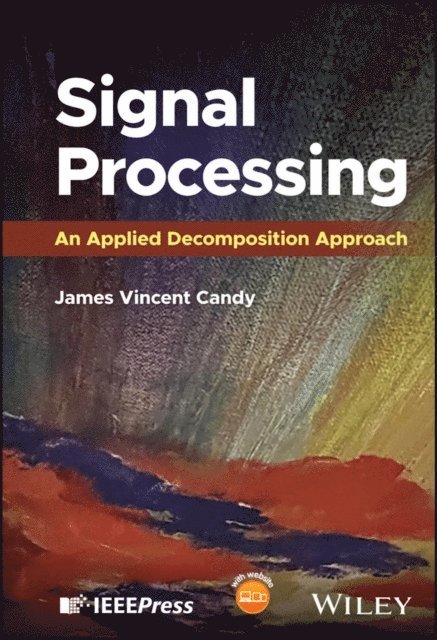
    Signal Processing

    An Applied Decomposition Approach

    AvJames V. Candy

    Inbunden, Engelska, 2024

    1 457 kr

    Beställningsvara. Skickas inom 5-8 vardagar. Fri frakt över 249 kr.

    Fler format och utgåvor

    E-bok

    1 751 kr

    E-bok

    1 751 kr

    Beskrivning

    Separate signals from noise with this valuable introduction to signal processing by applied decomposition The decomposition of complex signals into the sub-signals, or individual components, is a crucial tool in signal processing. It allows each component of a signal to be analyzed individually, enables the signal to be isolated from noise, and processed in full. Decomposition processes have not always been widely adopted due to the difficult underlying mathematics and complex applications. This text simplifies these obstacles. Signal Processing: An Applied Decomposition Approach demystifies these tools from a model-based perspective. This offers a mathematically informed, “step-by-step” analysis of the process by breaking down a composite signal/system into its constituent parts, while introducing both fundamental concepts and advanced applications. This comprehensive approach addresses each of the major decomposition techniques, making it an indispensable addition to any library specializing in signal processing. Signal Processing readers will find: Signal decomposition techniques developed from the data-based, spectral-based and model-based perspectives incorporate: statistical approaches (PCA, ICA, Singular Spectrum); spectral approaches (MTM, PHD, MUSIC); and model-based approaches (EXP, LATTICE, SSP)In depth discussion of topics includes signal/system estimation and decomposition, time domain and frequency domain techniques, systems theory, modal decompositions, applications and many more Numerous figures, examples, and tables illustrating key concepts and algorithms are developed throughout the text Includes problem sets, case studies, real-world applications as well as MATLAB notes highlighting applicable commandsSignal Processing is ideal for engineering and scientific professionals, as well as graduate students seeking a focused text on signal/system decomposition with performance metrics and real-world applications.


    Produktinformation

    • Utgivningsdatum:2024-10-02
    • Mått:237 x 158 x 35 mm
    • Vikt:875 g
    • Format:Inbunden
    • Språk:Engelska
    • Antal sidor:480
    • Förlag:John Wiley & Sons Inc
    • ISBN:9781394207442

    Utforska kategorier

    • Elektronik och kommunikationer inom Naturvetenskap och teknik

    Mer om författaren

    James Vincent Candy, PhD, is the Chief Scientist for Engineering, a Distinguished Member of the Technical Staff, founder and former Director of the Center for Advanced Signal & Image Sciences (CASIS) at the Lawrence Livermore National Laboratory and an Adjunct Full-Professor at the University of California, Santa Barbara. He received his his BSEE from the University of Cincinnati along with his MSE and PhD in Electrical Engineering from the University of Florida. Dr. Candy is a Life-Fellow of the IEEE and a 25-Year-Fellow of the Acoustical Society of America (ASA). He was elected as a Life Member at the University of Cambridge (Clare Hall College). Dr. Candy has been awarded the Interdisciplinary Helmholtz-Rayleigh Silver Medal in Signal Processing/Underwater Acoustics by the Acoustical Society of America, the IEEE Distinguished Technical Achievement Award for the development of model-based signal processing as well as an elected IEEE Distinguished Lecturer in Oceanic Signal Processing. He also received the R&D100 award for his innovative invention in radiation threat detection. He has published over 250 journal articles, book chapters, and technical reports as well as written six texts in signal processing: Signal Processing: the Model-Based Approach, (McGraw-Hill, 1986), Signal Processing: the Modern Approach,(McGraw-Hill, 1988), Model-Based Signal Processing, (Wiley/IEEE Press, 2006), Bayesian Signal Processing: Classical, Modern and Particle Filtering (Wiley/IEEE Press, 2009), Bayesian Signal Processing: Classical, Modern and Particle Filtering, 2nd Ed. (Wiley/IEEE Press, 2016), and Model-Based Processing: An Applied Subspace Identification Approach (Wiley, 2019).

    Innehållsförteckning

    • About the Author xiiiPreface xvAcknowledgments xxvGlossary xxviAbout the Companion Website xxx1 Introduction 11.1 Background 11.2 Spectral Decomposition 41.3 Data Decomposition 61.4 Model-based Decomposition 131.5 Notation and Terminology 241.6 Summary 25MATLAB® Notes 26References 26Problems 272 Random Signals and Systems 312.1 Introduction 312.2 Discrete Random Signals 342.3 Spectral Representation of Random Signals 382.4 Discrete Systems with Random Inputs 412.5 Classical Spectral Estimation 442.6 Case Study: Sinusoids in Noise 522.7 Summary 54MATLAB® Notes 55References 55Problems 563 Signal Models 613.1 Data-Based Models 613.2 Parametric-Based Models 653.3 State-space Models 853.4 Summary 103MATLAB® Notes 103References 104Problems 1054 Signal Estimation 1114.1 Classical Estimation 1114.2 Minimum Variance (MV) Estimation 1164.3 Maximum A-Posteriori (MAP) Estimation 1194.4 Maximum Likelihood (ML) Estimation 1214.5 Least-squares (LS) Estimation 1244.6 Optimal Signal Estimation 1334.7 Projection Theory 1374.8 Summary 142MATLAB® Notes 142References 143Problems 1445 Signal Decomposition 1495.1 Introduction 1495.2 Data-Based Decompositions 1495.3 Spectral-Based Decompositions 1685.4 Model-Based Decomposition 1795.5 Case Study: Harmonics in Noise 1985.6 Summary 201MATLAB® Notes 201References 202Problems 2066 Model-based Decomposition: Time Domain 2116.1 Background: State-space Systems 2116.2 Realization Problem 2206.3 Realization Decomposition 2286.4 Subspace Decomposition: Orthogonal Projections 2336.5 Subspace Decomposition: Oblique Projections 2446.6 System Order Estimation and Validation 2536.7 Case Study: Multichannel Mechanical Systems 2596.8 Summary 267MATLAB® Notes 268References 268Problems 2707 Model-Based Decomposition: Frequency Domain 2797.1 Introduction 2797.2 Frequency Response Functions (FRF) 2827.3 Least-squares Complex Frequency (LSCF) Method 2957.4 PolyReference Least-Squares Complex Frequency (pLSCF) Method 3017.5 Maximum Likelihood PolyReference Frequency Domain Estimation (ML-pLSCF) 3077.6 Case Study: 15-DOF Structure 3127.7 Summary 320MATLAB® Notes 322References 322Problems 3248 Performance Analysis 3298.1 Statistical Performance Methods 3298.2 Physical Performance Metrics 3448.3 Case Study: Resonant Modal MCK System 3528.4 Summary 355MATLAB® Notes 355References 3559 Applications 3599.1 Modal Decomposition: Sounding Rocket Flight 3599.2 Vibrational Response of a Cylindrical Structure: Identification and Modal Tracking 3709.3 Resonant Ultrasound Spectroscopy 3779.4 Model-Based Subsystem Decomposition of an 8-Story (8-Mass) Structure 3909.5 Data-Based Decomposition: Time-Reversal Processing 403References 413A Probability and Statistics Overview 417A.1 Probability Theory 417A.2 Gaussian Random Vectors 422A.3 Uncorrelated Transformation: Gaussian Random Vectors 423A.4 Toeplitz Correlation Matrices 424A.5 Important Processes 424References 426B Projection Theory 427B.1 Projections: Deterministic Spaces 427B.2 Projections: Random Spaces 428B.3 Projection: Operators 429B.3.1 Orthogonal (Perpendicular) Projections 429B.3.2 Oblique (Parallel) Projections 430References 432C Matrix Decompositions 433C.1 Singular Value Decomposition 433C.2 QR Decomposition 435C.3 LQ Decomposition 435References 436Index 437