James V. Candy – författare
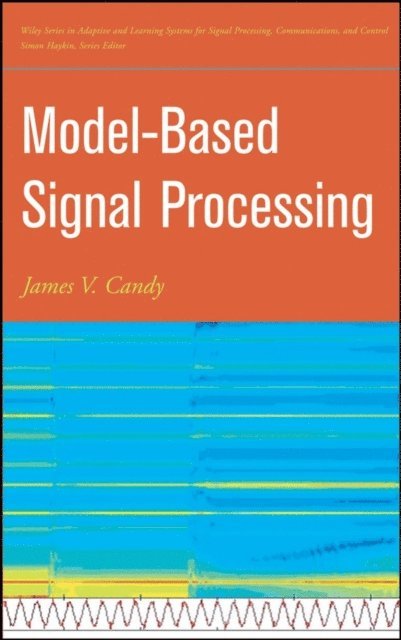
Model-Based Signal Processing
2 308 kr
Skickas inom 5-8 vardagar
2 580 kr
Läs direkt efter köp
An Instructor''s Manual presenting detailed solutions to all the problems in the book is available from the Wiley editorial department
Bayesian Signal Processing
Classical, Modern, and Particle Filtering Methods
1 634 kr
Skickas inom 5-8 vardagar
1 801 kr
Läs direkt efter köp
Presents the Bayesian approach to statistical signal processing for a variety of useful model sets
This book aims to give readers a unified Bayesian treatment starting from the basics (Baye’s rule) to the more advanced (Monte Carlo sampling), evolving to the next-generation model-based techniques (sequential Monte Carlo sampling). This next edition incorporates a new chapter on “Sequential Bayesian Detection,” a new section on “Ensemble Kalman Filters” as well as an expansion of Case Studies that detail Bayesian solutions for a variety of applications. These studies illustrate Bayesian approaches to real-world problems incorporating detailed particle filter designs, adaptive particle filters and sequential Bayesian detectors. In addition to these major developments a variety of sections are expanded to “fill-in-the gaps” of the first edition. Here metrics for particle filter (PF) designs with emphasis on classical “sanity testing” lead to ensemble techniques as a basic requirement for performance analysis. The expansion of information theory metrics and their application to PF designs is fully developed and applied. These expansions of the book have been updated to provide a more cohesive discussion of Bayesian processing with examples and applications enabling the comprehension of alternative approaches to solving estimation/detection problems.
The second edition of Bayesian Signal Processing features:
“Classical” Kalman filtering for linear, linearized, and nonlinear systems; “modern” unscented and ensemble Kalman filters: and the “next-generation” Bayesian particle filters Sequential Bayesian detection techniques incorporating model-based schemes for a variety of real-world problems Practical Bayesian processor designs including comprehensive methods of performance analysis ranging from simple sanity testing and ensemble techniques to sophisticated information metrics New case studies on adaptive particle filtering and sequential Bayesian detection are covered detailing more Bayesian approaches to applied problem solving MATLAB® notes at the end of each chapter help readers solve complex problems using readily available software commands and point out other software packages available Problem sets included to test readers’ knowledge and help them put their new skills into practice Bayesian Signal Processing, Second Edition is written for all students, scientists, and engineers who investigate and apply signal processing to their everyday problems.1 867 kr
Läs direkt efter köp
Presents the Bayesian approach to statistical signal processing for a variety of useful model sets
This book aims to give readers a unified Bayesian treatment starting from the basics (Baye’s rule) to the more advanced (Monte Carlo sampling), evolving to the next-generation model-based techniques (sequential Monte Carlo sampling). This next edition incorporates a new chapter on “Sequential Bayesian Detection,” a new section on “Ensemble Kalman Filters” as well as an expansion of Case Studies that detail Bayesian solutions for a variety of applications. These studies illustrate Bayesian approaches to real-world problems incorporating detailed particle filter designs, adaptive particle filters and sequential Bayesian detectors. In addition to these major developments a variety of sections are expanded to “fill-in-the gaps” of the first edition. Here metrics for particle filter (PF) designs with emphasis on classical “sanity testing” lead to ensemble techniques as a basic requirement for performance analysis. The expansion of information theory metrics and their application to PF designs is fully developed and applied. These expansions of the book have been updated to provide a more cohesive discussion of Bayesian processing with examples and applications enabling the comprehension of alternative approaches to solving estimation/detection problems.
The second edition of Bayesian Signal Processing features:
“Classical” Kalman filtering for linear, linearized, and nonlinear systems; “modern” unscented and ensemble Kalman filters: and the “next-generation” Bayesian particle filters Sequential Bayesian detection techniques incorporating model-based schemes for a variety of real-world problems Practical Bayesian processor designs including comprehensive methods of performance analysis ranging from simple sanity testing and ensemble techniques to sophisticated information metrics New case studies on adaptive particle filtering and sequential Bayesian detection are covered detailing more Bayesian approaches to applied problem solving MATLAB® notes at the end of each chapter help readers solve complex problems using readily available software commands and point out other software packages available Problem sets included to test readers’ knowledge and help them put their new skills into practice Bayesian Signal Processing, Second Edition is written for all students, scientists, and engineers who investigate and apply signal processing to their everyday problems.1 690 kr
Skickas inom 5-8 vardagar
1 898 kr
Läs direkt efter köp
A bridge between the application of subspace-based methods for parameter estimation in signal processing and subspace-based system identification in control systems
Model-Based Processing: An Applied Subspace Identification Approach provides expert insight on developing models for designing model-based signal processors (MBSP) employing subspace identification techniques to achieve model-based identification (MBID) and enables readers to evaluate overall performance using validation and statistical analysis methods. Focusing on subspace approaches to system identification problems, this book teaches readers to identify models quickly and incorporate them into various processing problems including state estimation, tracking, detection, classification, controls, communications, and other applications that require reliable models that can be adapted to dynamic environments.
The extraction of a model from data is vital to numerous applications, from the detection of submarines to determining the epicenter of an earthquake to controlling an autonomous vehicles—all requiring a fundamental understanding of their underlying processes and measurement instrumentation. Emphasizing real-world solutions to a variety of model development problems, this text demonstrates how model-based subspace identification system identification enables the extraction of a model from measured data sequences from simple time series polynomials to complex constructs of parametrically adaptive, nonlinear distributed systems. In addition, this resource features:
Kalman filtering for linear, linearized, and nonlinear systems; modern unscented Kalman filters; as well as Bayesian particle filters Practical processor designs including comprehensive methods of performance analysis Provides a link between model development and practical applications in model-based signal processing Offers in-depth examination of the subspace approach that applies subspace algorithms to synthesized examples and actual applications Enables readers to bridge the gap from statistical signal processing to subspace identification Includes appendices, problem sets, case studies, examples, and notes for MATLABModel-Based Processing: An Applied Subspace Identification Approach is essential reading for advanced undergraduate and graduate students of engineering and science as well as engineers working in industry and academia.
1 898 kr
Läs direkt efter köp
A bridge between the application of subspace-based methods for parameter estimation in signal processing and subspace-based system identification in control systems
Model-Based Processing: An Applied Subspace Identification Approach provides expert insight on developing models for designing model-based signal processors (MBSP) employing subspace identification techniques to achieve model-based identification (MBID) and enables readers to evaluate overall performance using validation and statistical analysis methods. Focusing on subspace approaches to system identification problems, this book teaches readers to identify models quickly and incorporate them into various processing problems including state estimation, tracking, detection, classification, controls, communications, and other applications that require reliable models that can be adapted to dynamic environments.
The extraction of a model from data is vital to numerous applications, from the detection of submarines to determining the epicenter of an earthquake to controlling an autonomous vehicles—all requiring a fundamental understanding of their underlying processes and measurement instrumentation. Emphasizing real-world solutions to a variety of model development problems, this text demonstrates how model-based subspace identification system identification enables the extraction of a model from measured data sequences from simple time series polynomials to complex constructs of parametrically adaptive, nonlinear distributed systems. In addition, this resource features:
Kalman filtering for linear, linearized, and nonlinear systems; modern unscented Kalman filters; as well as Bayesian particle filters Practical processor designs including comprehensive methods of performance analysis Provides a link between model development and practical applications in model-based signal processing Offers in-depth examination of the subspace approach that applies subspace algorithms to synthesized examples and actual applications Enables readers to bridge the gap from statistical signal processing to subspace identification Includes appendices, problem sets, case studies, examples, and notes for MATLABModel-Based Processing: An Applied Subspace Identification Approach is essential reading for advanced undergraduate and graduate students of engineering and science as well as engineers working in industry and academia.
1 480 kr
Skickas inom 5-8 vardagar
1 756 kr
Läs direkt efter köp
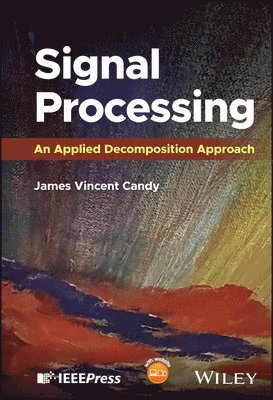
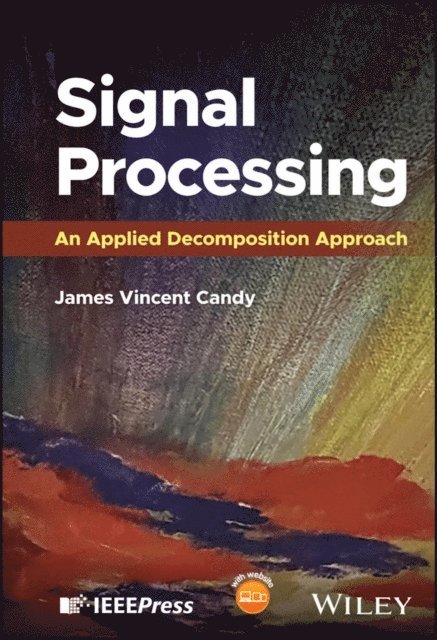
Separate signals from noise with this valuable introduction to signal processing by applied decomposition
The decomposition of complex signals into the sub-signals, or individual components, is a crucial tool in signal processing. It allows each component of a signal to be analyzed individually, enables the signal to be isolated from noise, and processed in full. Decomposition processes have not always been widely adopted due to the difficult underlying mathematics and complex applications. This text simplifies these obstacles.
Signal Processing: An Applied Decomposition Approach demystifies these tools from a model-based perspective. This offers a mathematically informed, “step-by-step” analysis of the process by breaking down a composite signal/system into its constituent parts, while introducing both fundamental concepts and advanced applications. This comprehensive approach addresses each of the major decomposition techniques, making it an indispensable addition to any library specializing in signal processing.
Signal Processing readers will find:
Signal decomposition techniques developed from the data-based, spectral-based and model-based perspectives incorporate: statistical approaches (PCA, ICA, Singular Spectrum); spectral approaches (MTM, PHD, MUSIC); and model-based approaches (EXP, LATTICE, SSP)In depth discussion of topics includes signal/system estimation and decomposition, time domain and frequency domain techniques, systems theory, modal decompositions, applications and many more Numerous figures, examples, and tables illustrating key concepts and algorithms are developed throughout the text Includes problem sets, case studies, real-world applications as well as MATLAB notes highlighting applicable commandsSignal Processing is ideal for engineering and scientific professionals, as well as graduate students seeking a focused text on signal/system decomposition with performance metrics and real-world applications.
1 694 kr
Läs direkt efter köp
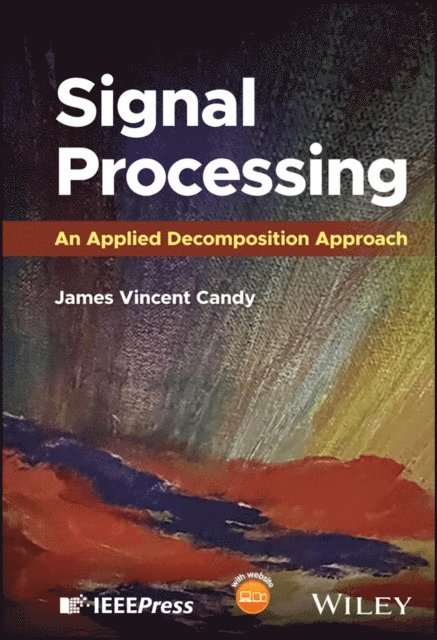
Separate signals from noise with this valuable introduction to signal processing by applied decomposition
The decomposition of complex signals into the sub-signals, or individual components, is a crucial tool in signal processing. It allows each component of a signal to be analyzed individually, enables the signal to be isolated from noise, and processed in full. Decomposition processes have not always been widely adopted due to the difficult underlying mathematics and complex applications. This text simplifies these obstacles.
Signal Processing: An Applied Decomposition Approach demystifies these tools from a model-based perspective. This offers a mathematically informed, “step-by-step” analysis of the process by breaking down a composite signal/system into its constituent parts, while introducing both fundamental concepts and advanced applications. This comprehensive approach addresses each of the major decomposition techniques, making it an indispensable addition to any library specializing in signal processing.
Signal Processing readers will find:
Signal decomposition techniques developed from the data-based, spectral-based and model-based perspectives incorporate: statistical approaches (PCA, ICA, Singular Spectrum); spectral approaches (MTM, PHD, MUSIC); and model-based approaches (EXP, LATTICE, SSP)In depth discussion of topics includes signal/system estimation and decomposition, time domain and frequency domain techniques, systems theory, modal decompositions, applications and many more Numerous figures, examples, and tables illustrating key concepts and algorithms are developed throughout the text Includes problem sets, case studies, real-world applications as well as MATLAB notes highlighting applicable commandsSignal Processing is ideal for engineering and scientific professionals, as well as graduate students seeking a focused text on signal/system decomposition with performance metrics and real-world applications.