• Fri frakt över 249 kr
  • •
  • Snabba leveranser
  • •
  • Billiga böcker
Kundservice

Du är på sajten för privatpersoner.

Företag, bibliotek eller offentlig verksamhet?

Du handlar på classic.bokus.com, där alla dina funktioner finns intakta.
Till classic.bokus.com
Bokus logotyp. Gå till startsidan.
  • Erbjudanden
  • Student
  • Topplistor
  • Barn & ungdom
  • Bokus Play
  • E-böcker
  • Ljudböcker
  • Pocketböcker
  • Spel och pussel

Pocketfynda! Hundratals böcker för 49 kr/st →

Sidfot

Mina sidor

    Hjälp

    • Kundservice
    • Vanliga frågor och svar
    • Frakt och leverans
    • Retur vid ångerrätt
    • Reklamera vara
    • Betalning
    • Köpvillkor
    • Allmänna villkor
    • Information om webbplatsens tillgänglighet

    Om Bokus

    • Om oss
    • Pressrum
    • För studenter
    • För företag
    • För bibliotek och offentlig verksamhet
    • För leverantörer
    • Hållbarhet

    Populärt

    • Aktuella erbjudanden
    • Presentkort
    • Studentlitteratur
    • Nya böcker
    • Topplistor
    • Signerade böcker
    • Engelska böcker

    Inspiration

    • Boktips
    • BookTok
    • Barnbokskaraktärer
    • Populära författare
    Logotyp för Bokus
    Följ oss på Facebook (extern länk)Följ oss på Instagram (extern länk)Följ oss på YouTube (extern länk)Följ oss på TikTok (extern länk)
    bokus @ CookiesAnpassa cookiesIntegritetspolicyKöpvillkor
    Till Citymail hemsida (extern länk)Till Budbee hemsida (extern länk)Till Postnord hemsida (extern länk)Till Schenker hemsida (extern länk)Till Early Bird hemsida (extern länk)Till Walleys hemsida (extern länk)
    1. Data och IT
    2. Systemvetenskap och AI

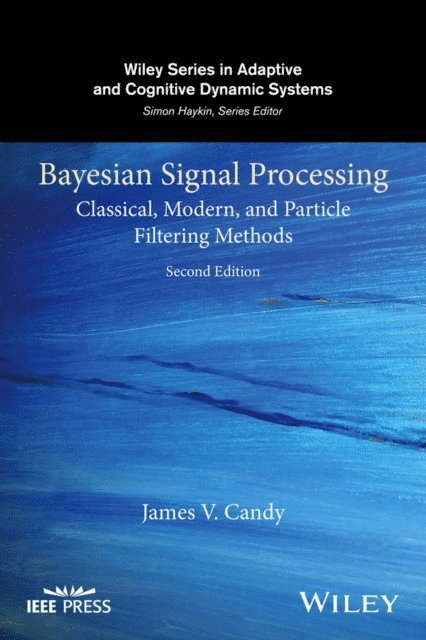
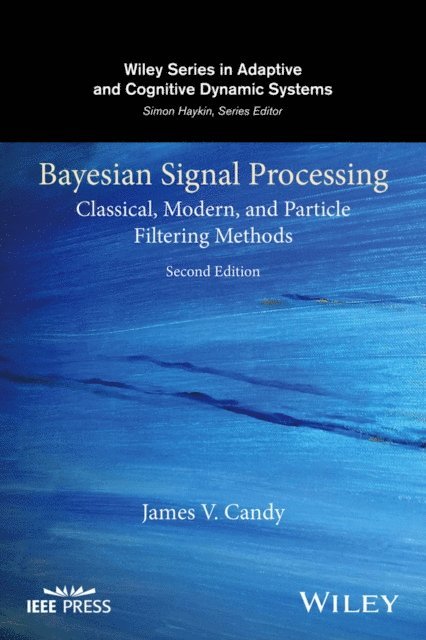
    Bayesian Signal Processing

    Classical, Modern, and Particle Filtering Methods

    AvJames V. Candy

    Inbunden, Engelska, 2016

    Del 54 i serien Adaptive and Cognitive Dynamic Systems: Signal Processing, Learning, Communications and Control

    1 633 kr

    Beställningsvara. Skickas inom 5-8 vardagar. Fri frakt över 249 kr.

    Fler format och utgåvor

    E-bok

    1 861 kr

    E-bok

    1 830 kr

    Beskrivning

    Presents the Bayesian approach to statistical signal processing for a variety of useful model sets This book aims to give readers a unified Bayesian treatment starting from the basics (Baye’s rule) to the more advanced (Monte Carlo sampling), evolving to the next-generation model-based techniques (sequential Monte Carlo sampling). This next edition incorporates a new chapter on “Sequential Bayesian Detection,” a new section on “Ensemble Kalman Filters” as well as an expansion of Case Studies that detail Bayesian solutions for a variety of applications. These studies illustrate Bayesian approaches to real-world problems incorporating detailed particle filter designs, adaptive particle filters and sequential Bayesian detectors. In addition to these major developments a variety of sections are expanded to “fill-in-the gaps” of the first edition. Here metrics for particle filter (PF) designs with emphasis on classical “sanity testing” lead to ensemble techniques as a basic requirement for performance analysis. The expansion of information theory metrics and their application to PF designs is fully developed and applied. These expansions of the book have been updated to provide a more cohesive discussion of Bayesian processing with examples and applications enabling the comprehension of alternative approaches to solving estimation/detection problems.The second edition of Bayesian Signal Processing features:  “Classical” Kalman filtering for linear, linearized, and nonlinear systems; “modern” unscented and ensemble Kalman filters: and the “next-generation” Bayesian particle filtersSequential Bayesian detection techniques incorporating model-based schemes for a variety of real-world problemsPractical Bayesian processor designs including comprehensive methods of performance analysis ranging from simple sanity testing and ensemble techniques to sophisticated information metricsNew case studies on adaptive particle filtering and sequential Bayesian detection are covered detailing more Bayesian approaches to applied problem solvingMATLAB® notes at the end of each chapter help readers solve complex problems using readily available software commands and point out other software packages availableProblem sets included to test readers’ knowledge and help them put their new skills into practice Bayesian Signal Processing, Second Edition is written for all students, scientists, and engineers who investigate and apply signal processing to their everyday problems.

    Produktinformation

    • Utgivningsdatum:2016-08-26
    • Mått:142 x 234 x 38 mm
    • Vikt:1 021 g
    • Format:Inbunden
    • Språk:Engelska
    • Serie:Adaptive and Cognitive Dynamic Systems: Signal Processing, Learning, Communications and Control
    • Antal sidor:640
    • Upplaga:2
    • Förlag:John Wiley & Sons Inc
    • ISBN:9781119125457

    Utforska kategorier

    • Systemvetenskap och AI inom Data och IT

    Mer om författaren

    JAMES V. CANDY, PhD, is Chief Scientist for Engineering, a Distinguished Member of the Technical Staff, founder, and former director of the Center for Advanced Signal & Image Sciences at the Lawrence Livermore National Laboratory. He is also an Adjunct Full Professor at the University of California, Santa Barbara, a Fellow of the IEEE, and a Fellow of the Acoustical Society of America. Dr. Candy has published more than 225 journal articles, book chapters, and technical reports. He is also the author of Signal Processing: Model-Based Approach, Signal Processing: A Modern Approach, and Model-Based Signal Processing (Wiley 2006). Dr. Candy was awarded the IEEE Distinguished Technical Achievement Award for his development of model-based signal processing and the Acoustical Society of America Helmholtz-Rayleigh Interdisciplinary Silver Medal for his contributions to acoustical signal processing and underwater acoustics.

    Innehållsförteckning

    • Preface to Second Edition xiiiReferences xvPreface to First Edition xviiReferences xxiiiAcknowledgments xxviiList of Abbreviations xxix1 Introduction 11.1 Introduction 11.2 Bayesian Signal Processing 11.3 Simulation-Based Approach to Bayesian Processing 41.3.1 Bayesian Particle Filter 81.4 Bayesian Model-Based Signal Processing 91.5 Notation and Terminology 13References 15Problems 162 Bayesian Estimation 202.1 Introduction 202.2 Batch Bayesian Estimation 202.3 Batch Maximum Likelihood Estimation 232.3.1 Expectation–Maximization Approach to Maximum Likelihood 272.3.2 EM for Exponential Family of Distributions 302.4 Batch Minimum Variance Estimation 342.5 Sequential Bayesian Estimation 372.5.1 Joint Posterior Estimation 412.5.2 Filtering Posterior Estimation 422.5.3 Likelihood Estimation 452.6 Summary 45References 46Problems 473 Simulation-Based Bayesian Methods 523.1 Introduction 523.2 Probability Density Function Estimation 543.3 Sampling Theory 583.3.1 Uniform Sampling Method 603.3.2 Rejection Sampling Method 643.4 Monte Carlo Approach 663.4.1 Markov Chains 713.4.2 Metropolis–Hastings Sampling 743.4.3 Random Walk Metropolis–Hastings Sampling 753.4.4 Gibbs Sampling 793.4.5 Slice Sampling 813.5 Importance Sampling 833.6 Sequential Importance Sampling 873.7 Summary 90References 91Problems 944 State–Space Models for Bayesian Processing 984.1 Introduction 984.2 Continuous-Time State–Space Models 994.3 Sampled-Data State–Space Models 1034.4 Discrete-Time State–Space Models 1074.4.1 Discrete Systems Theory 1094.5 Gauss–Markov State–Space Models 1154.5.1 Continuous-Time/Sampled-Data Gauss–Markov Models 1154.5.2 Discrete-Time Gauss–Markov Models 1174.6 Innovations Model 1234.7 State–Space Model Structures 1244.7.1 Time Series Models 1244.7.2 State–Space and Time Series Equivalence Models 1314.8 Nonlinear (Approximate) Gauss–Markov State–Space Models 1374.9 Summary 142References 142Problems 1435 Classical Bayesian State–Space Processors 1505.1 Introduction 1505.2 Bayesian Approach to the State–Space 1515.3 Linear Bayesian Processor (Linear Kalman Filter) 1535.4 Linearized Bayesian Processor (Linearized Kalman Filter) 1625.5 Extended Bayesian Processor (Extended Kalman Filter) 1705.6 Iterated-Extended Bayesian Processor (Iterated-Extended Kalman Filter) 1795.7 Practical Aspects of Classical Bayesian Processors 1855.8 Case Study: RLC Circuit Problem 1905.9 Summary 194References 195Problems 1966 Modern Bayesian State–Space Processors 2016.1 Introduction 2016.2 Sigma-Point (Unscented) Transformations 2026.2.1 Statistical Linearization 2026.2.2 Sigma-Point Approach 2056.2.3 SPT for Gaussian Prior Distributions 2106.3 Sigma-Point Bayesian Processor (Unscented Kalman Filter) 2136.3.1 Extensions of the Sigma-Point Processor 2226.4 Quadrature Bayesian Processors 2236.5 Gaussian Sum (Mixture) Bayesian Processors 2246.6 Case Study: 2D-Tracking Problem 2286.7 Ensemble Bayesian Processors (Ensemble Kalman Filter) 2346.8 Summary 245References 247Problems 2497 Particle-Based Bayesian State–Space Processors 2537.1 Introduction 2537.2 Bayesian State–Space Particle Filters 2537.3 Importance Proposal Distributions 2587.3.1 Minimum Variance Importance Distribution 2587.3.2 Transition Prior Importance Distribution 2617.4 Resampling 2627.4.1 Multinomial Resampling 2677.4.2 Systematic Resampling 2687.4.3 Residual Resampling 2697.5 State–Space Particle Filtering Techniques 2707.5.1 Bootstrap Particle Filter 2707.5.2 Auxiliary Particle Filter 2747.5.3 Regularized Particle Filter 2817.5.4 MCMC Particle Filter 2837.5.5 Linearized Particle Filter 2867.6 Practical Aspects of Particle Filter Design 2907.6.1 Sanity Testing 2907.6.2 Ensemble Estimation 2917.6.3 Posterior Probability Validation 2937.6.4 Model Validation Testing 3047.7 Case Study: Population Growth Problem 3117.8 Summary 317References 318Problems 3218 Joint Bayesian State/Parametric Processors 3278.1 Introduction 3278.2 Bayesian Approach to Joint State/Parameter Estimation 3288.3 Classical/Modern Joint Bayesian State/Parametric Processors 3308.3.1 Classical Joint Bayesian Processor 3318.3.2 Modern Joint Bayesian Processor 3388.4 Particle-Based Joint Bayesian State/Parametric Processors 3418.4.1 Parametric Models 3428.4.2 Joint Bayesian State/Parameter Estimation 3448.5 Case Study: Random Target Tracking Using a Synthetic Aperture Towed Array 3498.6 Summary 359References 360Problems 3629 Discrete Hidden Markov Model Bayesian Processors 3679.1 Introduction 3679.2 Hidden Markov Models 3679.2.1 Discrete-Time Markov Chains 3689.2.2 Hidden Markov Chains 3699.3 Properties of the Hidden Markov Model 3729.4 HMM Observation Probability: Evaluation Problem 3739.5 State Estimation in HMM: The Viterbi Technique 3769.5.1 Individual Hidden State Estimation 3779.5.2 Entire Hidden State Sequence Estimation 3809.6 Parameter Estimation in HMM: The EM/Baum–Welch Technique 3849.6.1 Parameter Estimation with State Sequence Known 3859.6.2 Parameter Estimation with State Sequence Unknown 3879.7 Case Study: Time-Reversal Decoding 3909.8 Summary 395References 396Problems 39810 Sequential Bayesian Detection 40110.1 Introduction 40110.2 Binary Detection Problem 40210.2.1 Classical Detection 40310.2.2 Bayesian Detection 40710.2.3 Composite Binary Detection 40810.3 Decision Criteria 41110.3.1 Probability-of-Error Criterion 41110.3.2 Bayes Risk Criterion 41210.3.3 Neyman–Pearson Criterion 41410.3.4 Multiple (Batch) Measurements 41610.3.5 Multichannel Measurements 41810.3.6 Multiple Hypotheses 42010.4 Performance Metrics 42310.4.1 Receiver Operating Characteristic (ROC) Curves 42410.5 Sequential Detection 44010.5.1 Sequential Decision Theory 44210.6 Model-Based Sequential Detection 44710.6.1 Linear Gaussian Model-Based Processor 44710.6.2 Nonlinear Gaussian Model-Based Processor 45110.6.3 Non-Gaussian Model-Based Processor 45410.7 Model-Based Change (Anomaly) Detection 45910.7.1 Model-Based Detection 46010.7.2 Optimal Innovations Detection 46110.7.3 Practical Model-Based Change Detection 46310.8 Case Study: Reentry Vehicle Change Detection 46810.8.1 Simulation Results 47110.9 Summary 472References 475Problems 47711 Bayesian Processors for Physics-Based Applications 48411.1 Optimal Position Estimation for the Automatic Alignment 48411.1.1 Background 48511.1.2 Stochastic Modeling of Position Measurements 48711.1.3 Bayesian Position Estimation and Detection 48911.1.4 Application: Beam Line Data 49011.1.5 Results: Beam Line (KDP Deviation) Data 49211.1.6 Results: Anomaly Detection 49411.2 Sequential Detection of Broadband Ocean Acoustic Sources 49711.2.1 Background 49811.2.2 Broadband State–Space Ocean Acoustic Propagators 50011.2.3 Discrete Normal-Mode State–Space Representation 50411.2.4 Broadband Bayesian Processor 50411.2.5 Broadband Particle Filters 50511.2.6 Broadband Bootstrap Particle Filter 50711.2.7 Bayesian Performance Metrics 50911.2.8 Sequential Detection 50911.2.9 Broadband BSP Design 51211.2.10 Summary 52011.3 Bayesian Processing for Biothreats 52011.3.1 Background 52111.3.2 Parameter Estimation 52411.3.3 Bayesian Processor Design 52511.3.4 Results 52611.4 Bayesian Processing for the Detection of Radioactive Sources 52811.4.1 Physics-Based Processing Model 52811.4.2 Radionuclide Detection 53111.4.3 Implementation 53511.4.4 Detection 53911.4.5 Data 54011.4.6 Radionuclide Detection 54011.4.7 Summary 54111.5 Sequential Threat Detection: An X-ray Physics-Based Approach 54111.5.1 Physics-Based Models 54311.5.2 X-ray State–Space Simulation 54711.5.3 Sequential Threat Detection 54911.5.4 Summary 55411.6 Adaptive Processing for Shallow Ocean Applications 55411.6.1 State–Space Propagator 55511.6.2 Processors 56211.6.3 Model-Based Ocean Acoustic Processing 56511.6.4 Summary 572References 572Appendix: Probability and Statistics Overview 576A.1 Probability Theory 576A.2 Gaussian Random Vectors 582A.3 Uncorrelated Transformation: Gaussian Random Vectors 583References 584Index 585